



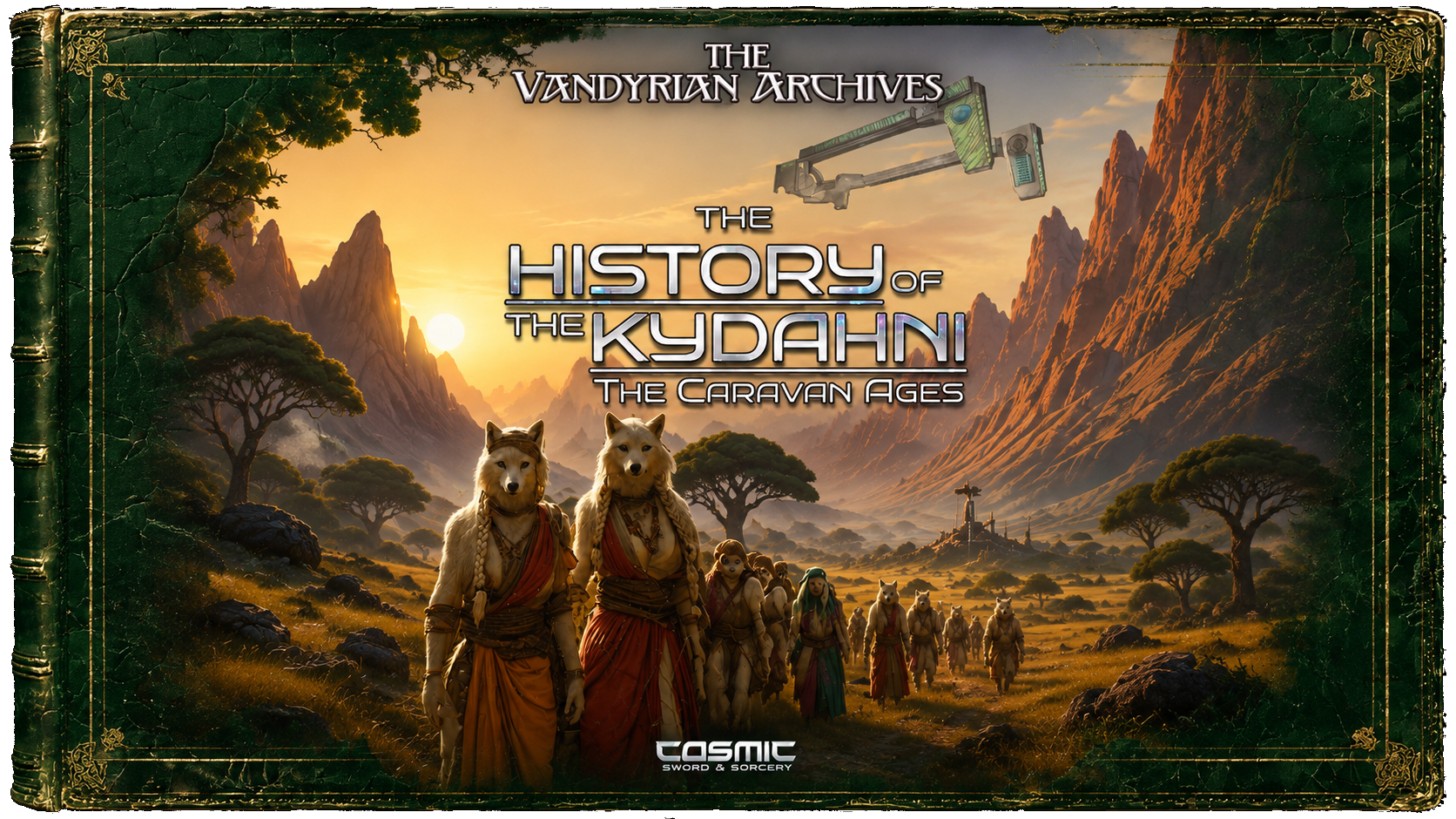
The Early Broker Clans
Neighboring powers generally understood civilization through possession: a people possessed territory, a capital, borders, monuments, roads, fortifications, and institutions rooted within a recognizable geographic domain. The early Kydahni increasingly developed the opposite proposition. Civilization could reside in systems rather than soil. Infrastructure could move. Authority could travel. Records could survive the destruction of the building that once contained them. Markets could be reconstructed around relationships rather than locations. Communities separated by foreign borders could remain components of the same larger social organism. Their lack of a recognized homeland therefore represented a profound vulnerability, but it also forced the development of forms of organization that settled powers had little reason to cultivate.
Over time, this existence produced a distinctive worldview. The Kydahni learned to view stability as temporary, security as conditional, and survival as an active process rather than a permanent state. Yet the Caravan Ages were not merely an extended history of survival. They were an age of institutional invention. The White Wolves learned how to maintain advanced civilization without controlling the political geography through which that civilization moved, and in doing so developed systems capable of functioning across borders precisely because they did not require borders of their own. These lessons would remain embedded within Kydahni civilization long after the caravans themselves vanished from history. The flotillas, broker houses, distributed archives, commercial networks, and portable authorities of later centuries would expand these principles enormously, but their foundation had already been established among the first caravan polities: a civilization could lose its ground without losing itself.
As caravan culture matured, certain families and commercial lineages accumulated disproportionate influence within the migratory networks. These groups gradually evolved into the first recognizable broker clans, organizations whose authority derived not from territorial ownership but from their ability to manage relationships, contracts, resources, and information across vast distances. The broker clans occupied a unique position within the political landscape of the age. They rarely possessed military strength sufficient to challenge established powers directly, yet they became increasingly indispensable to the operation of those same powers. Merchant houses relied upon them to move goods through unstable regions. Governments utilized their networks to acquire resources beyond official borders. Noble dynasties employed them as intermediaries in negotiations they preferred not to conduct openly.
This role granted the clans considerable influence, though influence of a highly unusual kind. Unlike conventional aristocracies, their power existed primarily within systems rather than territories. They controlled routes rather than worlds, obligations rather than populations, and relationships rather than borders. Their strength derived from utility. The older civilizations often viewed these developments with unease. Contemporary records reveal a persistent pattern of mistrust directed toward the broker clans. They were frequently described as opportunistic, manipulative, or dangerously adaptable. Yet these same records reveal an equally persistent dependence upon their services. The contradiction would become a defining feature of Kydahni history. They were rarely loved, often distrusted, and almost always needed.
The organizational methods pioneered during this period would later form the foundations of Kydahni governance itself. Many institutions commonly associated with the later empire—including procurement systems, logistical authorities, contract networks, information exchanges, and commercial intelligence operations—can trace their origins directly to the structures developed by the broker clans during the caravan era.