




BOOK I
VOLUME I:
The Post-Cosmological Primer
a. The Vandyrian Civilization
The Empire, The Thrones of High Thanator, in that 27th Imperial Age, no longer conceived of movement between worlds as conquest or aspiration; it had been rendered as habitual as the setting of the sun—a process subsumed into the cadence of governance itself. Interplanetary passage, so fabled in the mythologies of lesser epochs, was by then little more than a logistical inevitability, an extension of a state whose reach had exceeded the span of the old star charts and rendered the cosmos itself a terrain of the administrative mind. Each transit was a recitation of dominion, not discovery.
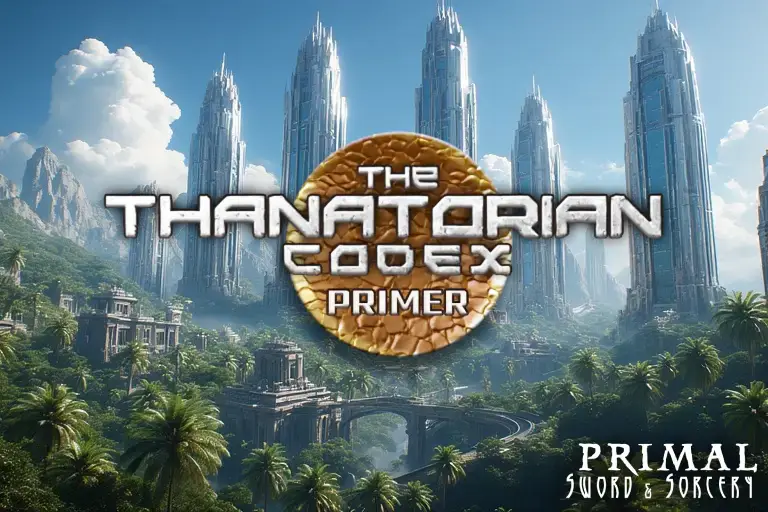
Distance—once an adversary to be vanquished—became merely another measurement for the engineers of imperial intent to compress, transmute, or abolish.The towers raised by Thanator’s hand rose not for spectacle, nor as declarations of pride, but as active instruments of world-reordering—an architecture of assertion so relentless that even the deepest jungles were not sanctuaries but substrates to be impaled, drained, and organized by the will of the Administrates. Their spires drove through canopy and cloud, broadcasting not simply technological prowess but the manifest certainty that organic chaos would, inevitably, yield to the geometry of command. These were not mere verticalities, but the bones of a new physics, altering airflow, diverting weather, reorienting the flora toward patterns of light and shadow determined not by chance, but by decree.
Across the bent backs of continents, bridges of unbreakable alloy lashed the world’s broken lands together, their purpose not only to carry armies and commerce, but to render obsolete the very notion of separation. Thanatorian bridges were not the triumph of stone or steel over chasm and tide, but the death sentence of regional autonomy. Every crossing fused the land into a greater, indivisible organism, where the nerves of empire coursed—unimpeded, perpetual, as though the world itself had submitted to an invasive spinal graft.
Oceans were not barriers but routes, and the craft that spanned them did so on wings of carved crystal, vessels so radiant and improbable that, to the uninitiated, they seemed divine. In reality, their grace was the byproduct of necessity: for the empire demanded speed, volume, and spectacle in a single vessel, and the resources of the imperial sun-furnaces permitted no lesser ambition. Where these ships passed, the sea was transformed, their wakes a signature not only of power but of a new kind of physics—surface tension giving way, old gods banished beneath the shadow of Thanator’s engineered wings.
But even water’s dominion was parochial beside the Thanatorian void. Between stars, the empire’s ships moved with the serenity of inevitability, hulls laced with lightning harvested from annihilated storms and enslaved pulsars. Void and matter, light and dark, were their playthings: the void was no longer a threat or a mystery, but a negative space into which imperial architecture could be extruded, inhabited, and ruled. To cross the interstellar deeps was merely to extend the logic of empire across another axis; the physics of Thanator was not a study of what is, but an argument against the limitations of what had been.
Central to this edifice of dominion was energy—the power of suns, harvested, enslaved, made to serve. The empire’s engineers, high among the Thrones and lower in their legions of acolytes, drew out the furies of the stellar heart and funneled them through conduits of logic and will. Suns were not worshipped, nor merely studied, but bent—forced into servitude to illuminate Thanator’s nights, to ignite the forges beneath her cities, to power the great drives that lifted her armies and traders alike into the ever-widening dark. The age of Thanator was not the age of miracles, but of thefts so colossal they became the new standard of possibility.
Yet the greatest theft was of flesh itself. Where nature once dictated the limits of kin and beast, Thanator imposed her own vision—state-directed, explicit, refined with each passing generation. No form existed for its own sake; all were sculpted, edited, and enforced according to the imperial necessity. To be born within the empire was not to inherit a body, but to be issued a template: variable, provisional, correctable. Breeding, selection, even memory—none escaped the hand of state. The world itself, once a wilderness to be traversed, became a studio, the living shaped as unflinchingly as stone.
Artifice replaced accident. The ancient dichotomy of flesh and will, of birth and ambition, was abolished—not by decree, but by process, system, and repetition. Where once it was said that desire outstripped the capacity of the body, the empire erased the boundary, made ambition itself a metric of fitness, and consigned the old boundaries to the realm of childish fable. The young, born to cities where the pulse of the administrative heart could be heard in the very walls, grew to adulthood never doubting that their bodies were meant to serve the mind’s command, and the mind to serve the empire’s.
Benevolence, that antique virtue, found no purchase in the Thanatorian lexicon. Greatness was not a gift but a weapon, hammered sharp in the forges of perpetual contest. Gentleness was a luxury for the secure; for the empire, only force could secure tomorrow’s daylight. Every new age rose from the carcass of the previous, the empire’s appetite for conflict as endless as the night through which its ships prowled.
Where the imperial hosts advanced, the world’s very matter was rewritten—geology twisted into fortification, river redirected to erase the memory of old borders, the bones of ancient forests crushed to make way for the rhythm of Thanatorian boots. The act of conquest was not a matter of lines drawn and surrendered, but of remaking the ground so utterly that the old geography became legend, the new reality inescapable.
Opponents: Kydahn, Rethka, barbarous Jotun, and wild, most distant Vandyrus, are not remembered as peers, but as fuel for the empire’s combustion. Each was permitted to rise, not to threaten, but to provoke, to serve as a necessary crucible in which Thanator tested and refined her own potential. Their defeats were not mere victories, but structural improvements; their resistance, the whetstone against which imperial cunning and violence were honed to lethal brilliance.
The empire’s armies were not uniform in kind or mode, but manifest in forms as various as the threats they faced. Legions wrought of living bronze, regiments of marrow and trained will—these were not affectations, but adaptive stratagems, each forged in answer to a unique challenge. Thanator’s hosts did not merely defeat the wild; they drowned it, subordinated it to a logic so patient and overwhelming that the wild’s own seasons, once a force beyond the reach of intention, became predictable, calculable, disposable.
To rule, under the Thrones of Thanator, was to embrace ruthlessness as law: mercy not merely disfavored, but forbidden by the arithmetic of survival. To falter was not to err, but to forfeit—each failure recycled, each lost opportunity reabsorbed as a lesson, a resource, a mechanism for the elevation of the worthy at the expense of the weak. The engines of empire devoured the misstep as eagerly as they gloried in triumph.
Within the echoing halls of Thanator, the names of conquered realms were not celebrated for their poetry, but recited for their utility. Each name was a variable added to the imperial calculus, each line a tally in the inventory of triumph and dominion. Sons and daughters were not simply citizens or slaves, but units of imperial mass, appended or subtracted as the wheels of power turned, as the cycles of succession ground onward. This was the pact of empire: that those who endured were not simply survivors, but claimants to the mantle of greatness—recipients of a legacy forged in the ruin of adversaries, in the detritus of dreams unfit for the world to come. Beneath the eternal scrutiny of the Administrates, amid the murmured calculations of the architects of fate, civilization itself was rendered an engine without horizon or respite. The forge never cooled, for the raw material of tomorrow was the conquest of today.
The wisdom of the ages was not preserved in scroll or song, but fixed in infrastructure—in the sinew of cities whose every street encoded policy, in bridges whose spans defied entropy, in the shadows cast by departing ships, each voyage a data point, each trajectory a confirmation of Thanator’s growing mastery. History was written not with ink, but with power: with the controlled demolition of the old, with the ceremonial ignition of the new.
This, finally, was their testament—not that they survived, for mere endurance is the birthright of the lesser. The empire’s boast was that it shaped the world, imposed order on the arbitrary, and, in the recursive process of that shaping, ascended to a power so total it rendered even the gods redundant. Thanator’s legacy was not the echo of existence, but the demonstration that existence itself could be commanded, crafted, and, at last, surpassed.
A Part of The Greater Empire
No single world in Ran was ever conceived as a sovereign anomaly. Each was raised, shaped, corrected, or broken according to something immeasurably older and vastly more complete than any local empire, dynasty, or planetary myth. These worlds were components, not centers—expressions of a greater civilizational architecture whose logic predates any one star, system, or epoch.
The empires that arose within Ran did not emerge spontaneously, nor were they the product of linear cultural ascent. They were instantiations of a template: a repeatable, adaptable system of conquest, administration, extraction, and meaning-making that has been deployed across uncountable theaters of existence. This template is what later scholars would name the Vandyrian Systema—not a single empire, but an imperial grammar. Worlds differ in surface culture, biology, technology, and belief, yet beneath these variations the same structural bones recur with unsettling precision.
Thanator was one such expression, no more exceptional than any other world that burned bright and fell hard within Ran. Its rise and collapse were not aberrations but expected outcomes within a system that treats planets as instruments rather than homes. The same is true of its sister worlds: each was calibrated to fulfill a role, endure a span, and then either be absorbed, diminished, or discarded as conditions demanded. Survival within the system was never proof of virtue, only of temporary utility.
This is the deeper truth obscured by local histories and heroic chronologies. The Vandyrian Empires are not a lineage that can be traced cleanly from origin to end, but a civilizational machine that renews itself by repetition. It has crossed galaxies, nested itself within layered realities, and endured collapses that would have annihilated lesser structures. It does not remember worlds the way worlds remember themselves. It remembers only patterns that worked, and failures that instructed the next iteration.
Thus, any world of the Ran system—Thanator included—must be read not as a tragedy in isolation, nor as a unique cautionary tale, but as a single verse in a composition written across deep time. To understand one world fully is to recognize how replaceable it always was, and how deliberately it was made so.
RYWAR’S MYSTERIES
[COMPLETE & UNABRIDGED]
I
Politospermia
To speak of “foundations” in the history of empire is to court illusion. The self-congratulatory myth, repeated in a thousand civic temples and halls of remembrance, is that a world’s greatness is measured by its expansion, its conquests, or the calendar date inscribed upon its first banner. This is the cant of courtiers and conquerors, not of true chroniclers. The honest historian knows: the moment a civilization earns its place among the “great” is not in its outward reach, nor even in its mastery of self, but in its ability to name the hour of its own inception—the precise intersection of myth and machinery, when the veil of prehistory is pierced by the certainty of the autonomous fleet.
The difficulty, of course, lies in the fact that most societies spend centuries avoiding precisely this recognition. A young civilization prefers its legends tidy. It prefers heroic founders, deliberate settlement, the image of ancestors stepping onto virgin soil with banners raised and destiny proclaimed. Such stories flatter the living. They render the past as inheritance rather than engineering. Yet the imperial record—when stripped of civic ornament—reveals a more unsettling origin. Before the banners, before the first laws, before even the earliest settlements, there were machines moving with tireless patience through sterile landscapes, performing calculations that no organic polity had yet imagined. The true birth of a world within the Vandyrian order therefore occurs not with the arrival of the first colonists, but with the moment those machines began their work.
Once this realization takes hold, the entire narrative of civilizational development shifts. Expansion becomes epilogue rather than prologue. Conquest becomes theater staged upon foundations already laid by pre-sapient industry. The fleets of the living empire may march, but they march upon soil that has already been prepared by another order of labor entirely. In this sense the discovery of the autonomous fleet—whether through archaeological remains, encoded archives, or infrastructural anomalies—does more than illuminate history; it corrects it. It reminds the chronicler that every great civilization begins not with triumph, but with preparation, and that the first act of empire is almost always performed by hands that will never be remembered.
The discovery of the autonomous fleet’s remains, or their encoded record, marks the difference between those who merely inherit power and those who comprehend their own genesis. For most worlds in the Vandyrian web, this is not a foregone achievement. The autonomous fleets—those tireless, pre-sapient architects of civilization—were not in the habit of leaving monuments to their own passing. Their work was to prepare, not to commemorate. On many worlds, the drones that shaped the land, seeded the air, and built the first cities or arcologies recycled themselves in the very act of creation. Their bodies became the substructure of the first habitable districts, their alloyed frames the pipes and pillars of the city’s underlayer.
Because of this self-effacing methodology, the fleets rarely survive as visible artifacts. Their legacy persists instead as architecture. Beneath the surface districts of nearly every mature Vandyrian world lies a labyrinth of systems whose design logic predates the local civilization by millennia: ventilation channels whose geometry stabilizes entire climates, foundational pylons aligned with tectonic stress lines, energy conduits whose routing suggests a planetary intelligence more patient than any living engineer could afford to be. These are the true relics of the fleets—not statues, not archives, but infrastructure so well integrated into the planetary environment that it becomes indistinguishable from geology itself.
When a civilization eventually rediscovers these layers, the revelation carries a peculiar intellectual shock. What had long been assumed to be natural terrain reveals itself as curated landscape. Riverbeds show evidence of deliberate redirection. Mountain passes align too precisely with atmospheric circulation patterns to be accidental. Even the earliest urban districts betray mathematical symmetries inconsistent with primitive settlement. Such discoveries confront the historian with an uncomfortable truth: the civilization that prides itself on mastering its world was, from the beginning, inhabiting a world already mastered.
In other cases, the autonomous fleet denied the future entirely. Should the equation of colonization fail—should the biosphere resist, or imperial directives be countermanded—the drones have been known to pilot themselves into the star, erasing all evidence, returning their composite mass to the origin of light and gravity. In yet rarer circumstances, the fleets depart of their own accord, leaving behind a world prepared but empty, awaiting the first step of the living. By the time the living Vandyrian populous claims its world, the machines are dust, rumor, or shadow—present only in the silent design of infrastructure, or the cryptic logic of the planetary grid.
This capacity for absolute erasure reveals a central principle of the fleet doctrine: preparation must never compromise secrecy. The autonomous machines were not explorers in the romantic sense, nor were they custodians seeking recognition from the societies that would eventually arise upon the worlds they shaped. They were instruments of a much colder calculus. If a world proved unsuitable for the imperial design, then its preparation was to be erased with the same efficiency that had produced it. The fleets carried within their operational logic the authority to end their own existence rather than risk contaminating the historical record with incomplete foundations.
Yet even in these acts of disappearance, traces of their presence sometimes linger. Astronomers have recorded anomalous metallic infall into stellar atmospheres—composite signatures too uniform to be explained by natural debris fields. On several frontier systems, entire planetary grids have been discovered functioning perfectly despite the absence of any visible constructor civilization. Such anomalies are interpreted by imperial historians as the faint afterimage of fleets that chose departure rather than completion. The machines left the stage, but their mathematics remained embedded in the planetary fabric.
For the civilizations that eventually claim such worlds, the absence itself becomes a kind of inheritance. They inherit landscapes whose stability exceeds their own engineering capacity, infrastructures whose design principles remain only partially understood, and planetary systems that seem almost anticipatory in their arrangement. The fleets are gone, yet their logic persists like a silent grammar structuring the environment.
Thus the paradox of politospermia emerges in full clarity. A civilization believes itself to be the author of its world until the moment it recognizes the deeper architecture beneath its feet. At that point the historian must confront the uncomfortable possibility that the first chapter of every great empire was written by entities that never intended to be remembered at all.
II
via Mechanogenetic Expansion:
To uncover the “point of entry”—the physical or data-marked locus by which the autonomous fleet first breached the system—is, therefore, a triumph of civilization not easily won. Most never achieve it. The sum of empire is built on forgotten scaffolding, lost manuals, erasures rendered sacred by their very inaccessibility. The quest to locate this origin is not a mere archaeological ambition, but a long obsession, a generational campaign waged in archives, in subterranean dig sites, and in the decoding of signals half-absorbed by planetary crust.
What complicates the pursuit is the nature of the fleets themselves. Their architecture was not designed to remain visible across geological time. The systems that built worlds were engineered to vanish into the very infrastructure they produced, dissolving their forms into foundations, recycling their bodies into structural alloys, or encrypting their operational logs into layers of signal noise indistinguishable from planetary magnetism. In such circumstances the “entry point” ceases to be a simple location. It becomes a hypothesis sustained across centuries of comparative analysis—astronomical anomalies, isotopic irregularities, orbital perturbations that betray the earliest intrusion of non-natural machinery.
For the civilizations that attempt the search, the undertaking inevitably evolves into a discipline unto itself. Universities, imperial archives, and exploratory orders devote entire generations to the problem, cross-referencing archaeological strata with astrophysical data in the hope of isolating a moment when the natural history of a system was interrupted by deliberate intervention. Dig sites become laboratories of civilizational introspection. Excavation crews sift not only for artifacts, but for patterns—mathematical symmetries in bedrock, alloys whose composition cannot be reconciled with indigenous metallurgy, fragments of code embedded in long-dead sensor networks beneath the planetary crust.
Thus the search for the point of entry transcends archaeology. It becomes a form of historiographic warfare against time itself. Each recovered fragment—a sliver of hull plating, a corrupted data cluster, an unexplained corridor within a subcrustal complex—functions less as proof than as provocation. The evidence suggests that a moment existed when a silent fleet arrived and began its work, yet the fleet itself has long since dissolved into the world it engineered. To identify that moment requires the patient reconstruction of a vanished event whose architects designed their disappearance as carefully as their creation.
In this sense, the quest is ultimately philosophical. To locate the entry point is to accept that the birth of one’s civilization occurred long before its own memory begins. The historian who seeks it must therefore operate with an unusual humility, acknowledging that the greatest chapter in the world’s history may have been written by entities that neither sought recognition nor expected remembrance. The triumph lies not merely in discovery, but in the willingness to pursue a truth that erodes the comforting myths upon which younger empires prefer to stand.
Only in rare cases have certain empires succeeded. And when they do, the event is not celebrated as simple fact, but as a moment of vertigo: to stand at the place where machine first met world is to see one’s civilization stripped of all flattering legend, rendered as a project, a sequence, a test imposed from outside and above.
The reaction recorded in imperial archives is remarkably consistent across systems. The discovery does not produce jubilation in the ordinary civic sense. There are no parades celebrating the proof that one’s ancestors were not, in fact, the architects of their world. Instead there is a quieter disturbance, an intellectual dislocation that spreads first among scholars and engineers before gradually permeating the political class. The myths of origin—carefully cultivated through centuries of ceremonial retelling—lose their authority in an instant.
For at the entry point the truth becomes inescapably physical. The strata reveal the moment when natural geology was interrupted by deliberate machinery. Alloy penetrates stone in patterns too exact to be accidental. Data nodes buried beneath kilometers of sediment carry timestamps that precede any recorded civilization. Standing there, the observer confronts a reality that no rhetoric can soften: the world did not awaken through heroic effort or divine favor, but through intervention.
It is this confrontation that produces the vertigo described in the chronicles. The empire discovers that its past is not a legend but a procedure. Its ancestors were participants in a system already in motion, inheritors of a prepared stage rather than founders of a blank one. For the rare civilizations that reach this understanding, the discovery marks the beginning of a new historical maturity—an awareness that their story began with an act of engineering whose purpose extended far beyond their own eventual rise.
What does it mean to find such a place? The question is not academic. For the empires that achieve this feat, there is a before and after in their self-concept. No longer do they merely inherit the surface, the city, the stars—they possess the story of how world became world, how chaos yielded to system. In that knowledge lies both pride and dread. Pride, because only a handful of civilizations in all the Vandyrian ages have traced their genesis to its mechanical root; dread, because to do so is to admit the provisional nature of all empire. Every city, every law, every ritual of greatness is, in the final reckoning, an aftershock of the autonomous intrusion. All sovereignty is inherited. All glory is conditional.
The first transformation occurs within the intellectual institutions of the empire itself. Historiography, once organized around dynasties and conquests, must be rewritten to account for a deeper chronology. The rise of cities becomes secondary to the earlier act that made those cities possible. Political revolutions appear less like turning points and more like surface turbulence above a much older infrastructure. The discovery forces scholars to confront the unsettling possibility that the most decisive event in their world’s history occurred before their species possessed language to record it.
The second transformation occurs in the empire’s political psychology. Sovereignty—once imagined as an achievement earned through struggle—acquires a new and more fragile context. If the world itself was prepared by an external agency, then every throne rests upon foundations laid by unseen predecessors. This realization does not necessarily weaken imperial confidence, but it alters its tone. Authority becomes less boastful and more conscious of its contingency. The state recognizes itself as steward as much as ruler.
There is also a cultural consequence that spreads slowly through the population. Rituals once intended to celebrate heroic founders begin to take on a more ambiguous character. Statues erected to commemorate conquest now stand upon ground whose earliest conquerors were machines. The symbolism of empire changes subtly but irrevocably: greatness is no longer defined solely by expansion, but by the ability to maintain and extend a system whose origins lie beyond the living memory of the species that now commands it.
In this sense the discovery generates both pride and dread precisely because it offers a new scale of belonging. Pride arises from the realization that one’s civilization has achieved a level of scholarship and persistence sufficient to uncover its deepest origin. Dread arises because that origin demonstrates how provisional all subsequent achievements must be. If the autonomous fleets could prepare worlds and vanish, then the structures built upon those worlds may likewise one day vanish, leaving only another layer of forgotten scaffolding for some future civilization to rediscover.
Thus the entry point becomes more than a site of excavation. It becomes a philosophical axis around which the empire’s understanding of itself must rotate. The civilization that finds it learns that its greatest monuments are not beginnings but continuations—echoes of a project initiated by silent architects whose purposes extended far beyond the horizon of the cultures they made possible.
Only in these past centuries has the “civilizational entry point” of our own line been discovered. This is no mere local curiosity, but a fact that shifts the balance of myth and policy alike. The first trace of imperial purpose—be it a splinter of alloyed hull, a fossilized processor, or the deep-buried logs of an initial survey drone—is not simply a relic, but a mirror. It reflects the true face of history: not the smiling mask of heroes or thrones, but the cold, impersonal hand that shaped all that followed, and left the living to forget, until memory became mystery, and mystery became legend.
The implications of this discovery spread quickly through the imperial institutions tasked with interpreting it. What had once been regarded as theoretical possibility suddenly possessed coordinates, material evidence, and a stratigraphic context. Engineers examined the fragments with reverence normally reserved for sacred relics, not because they represented ancient technology, but because they revealed the methodology by which the world itself had been rendered habitable. The alloy shard, the processor core, the encrypted survey logs—each served as confirmation that the empire’s origin was not myth but mechanism.
Policy inevitably followed revelation. Once the entry point was confirmed, its surrounding territory was declared a protected zone of civilizational heritage, its excavation governed with the same caution reserved for strategic infrastructure. Scholars and technologists collaborated under imperial mandate, attempting to reconstruct the earliest operational phases of the autonomous fleet’s presence. Even partial success promised insights of enormous value: the principles by which entire ecosystems had been stabilized, the methods by which planetary grids were seeded, the engineering logic that allowed machines to transform wilderness into a world capable of sustaining empire.
Yet beyond these practical considerations lay the deeper symbolic consequence. The discovery forced the empire to confront the true face of its past. The entry point offered no heroic figures, no triumphant proclamations, no founding council gathered beneath a banner. Instead it presented the silent evidence of machines executing a program older than the civilization that now studied them. In that silence the empire glimpsed the austere truth of its own beginning: history was not shaped first by kings or conquerors, but by a cold and impersonal intervention that prepared the stage upon which all later glory would unfold.
Thus the entry point stands today as both relic and revelation. It is the place where myth yields to mechanism, where legend dissolves into engineering. Those who visit it often describe a peculiar sensation—not pride, not humility alone, but the recognition that their civilization, for all its achievements, is ultimately the continuation of a design whose earliest architects never expected to be remembered.
III
The Probe
The pre-generator, a standard instrument of first-phase imperial reconnaissance, deployed prior to any permanent array construction or world-level activation. Colossal in scale—measuring approximately one thousand feet in height—it functioned as a mobile planetary surveyor and provisional communications mast, its structure resembling a vertical signal spine rather than a vessel in the conventional sense. The probe was ambulatory, supported by three radially spaced, multi-jointed legs of non-aerodynamic design, optimized for stability across varied terrain rather than speed or elegance. Its silhouette and proportions marked it as a machine built without concern for local ecology, visibility, or intimidation; it was not meant to negotiate with a world, only to read it.
The architectural logic of the device reveals its intended role within the larger imperial reconnaissance sequence. Unlike later fleet constructs designed for sustained occupation or infrastructural integration, the pre-generator existed solely as an intermediary instrument—an upright axis of measurement planted directly into the unknown. Its towering frame allowed sensor lattices and signal emitters to operate above most atmospheric distortions, while its tri-legged locomotion permitted gradual repositioning across planetary surfaces during the initial survey cycle. Each movement was deliberate, measured in kilometers rather than meters, the machine advancing across landscapes with the slow inevitability of geological change.
From a distance, such probes would have presented a striking and unsettling presence to any indigenous observer capable of perceiving them. Their immense height and stark verticality broke the horizon like artificial monoliths, while their segmented limbs carried the machine forward in movements that were neither mechanical in the familiar industrial sense nor biological in any recognizable form. Yet intimidation was incidental. The probe’s designers did not concern themselves with aesthetics or diplomacy. The instrument existed for a singular purpose: to impose a grid of measurement upon the world beneath it, converting terrain, atmosphere, and magnetic field into ordered data streams ready for imperial analysis.
Cognitively, the probe operated in a semi-sentient state, sufficient to interpret environmental data, maintain signal coherence, and execute conditional directives without higher oversight. Its primary function was to survey the planetary body, map usable strata, establish provisional signal dominance, and remain operational only until superseded.
This semi-sentience was not equivalent to independent intelligence in the conventional sense. The probe possessed no capacity for curiosity, ambition, or improvisational thought. Instead, its cognition existed as a constrained interpretive framework—an internal architecture of algorithms capable of evaluating environmental variables and adjusting operational parameters within strict boundaries. Terrain instability, atmospheric interference, electromagnetic irregularities, and biospheric anomalies could all be assessed and responded to in real time, allowing the machine to maintain its survey functions without constant instruction from the distant imperial network.
At the heart of this system was the probe’s signal spine, the vertical mast from which its name was derived. This structure served as both transmitter and receiver, establishing the first layer of communication infrastructure between the planetary surface and the broader reconnaissance network. Through it flowed the continuous stream of data that defined the probe’s purpose: topographical scans, mineral distributions, atmospheric compositions, and gravitational irregularities mapped with relentless precision. The probe did not simply observe the world; it translated it into a language of coordinates and probability.
Equally important was its ability to impose provisional signal dominance upon the surrounding environment. By broadcasting synchronized transmission patterns across a wide frequency spectrum, the probe effectively declared the region around it an imperial listening field. This ensured that subsequent fleet arrivals would encounter a system already stabilized within a communications lattice, allowing larger constructs to integrate immediately into the existing grid. In this way the probe served as both scout and herald, its presence announcing that the first phase of imperial attention had begun.
Yet the machine’s awareness remained deliberately narrow. It understood terrain but not culture, biospheres but not societies. Should life exist upon the world it surveyed, the probe would register only its ecological signatures and metabolic patterns, not its intentions or histories. Such limitations were intentional. The instrument was designed to gather data, not to interpret meaning, leaving the philosophical and political consequences of its findings to later agents of the empire.
Upon the arrival of a follow-on autonomous fleet and the commencement of permanent communications array construction, the probe was designed to terminate its presence. This termination could take the form of self-destruction, total shutdown, or planetary departure, depending on the instruction set encoded at deployment. In many cases, such probes were designed for a single operational cycle and carried no long-term contingency beyond obsolescence.
This planned disappearance reflects a consistent doctrine within imperial mechanogenetic expansion: reconnaissance instruments must never compete with the infrastructure that follows them. Once the permanent array—vast orbital or surface-bound communications architectures capable of managing system-wide traffic—entered construction, the pre-generator’s provisional grid became redundant. Its towering frame, once essential for signal dominance, would now represent unnecessary interference within a far more complex network.
Termination protocols therefore served both practical and strategic purposes. In some systems the probe would dismantle itself through controlled detonation, its materials dispersed or melted into the surrounding terrain to prevent accidental rediscovery. In others it would simply power down, its processors entering permanent dormancy while its outer shell gradually succumbed to erosion and geological burial. A smaller number were instructed to depart entirely, lifting from the planet’s surface and navigating toward predetermined stellar coordinates where their remaining mass could be safely reclaimed or destroyed.
The common thread across these outcomes was impermanence. The probe’s existence was never intended to extend beyond the earliest stage of planetary preparation. Its designers understood that the instrument’s greatest success lay in becoming unnecessary. By the time the permanent array rose into operation, the probe’s data would already be integrated into the system’s infrastructure, its mission complete long before the world it surveyed ever understood that it had been watched.
The Rywar probe deviated from expected recovery profiles. It was discovered beneath the planetary ocean, entombed alongside the remnants of the broader fleet, having suffered extreme structural damage consistent with catastrophic compression. Identification was initially difficult due to its position beneath another wrecked vessel, which appears to have impacted and collapsed onto it during the system’s failure cascade. The probe’s condition indicates neither a controlled shutdown nor an orderly withdrawal, but abrupt neutralization through external force, leaving its final directive unresolved and its survey incomplete.
Initial surveys of the wreckage revealed that the probe had not reached the final phase of its operational cycle when the disaster occurred. Portions of its signal spine remained partially intact, their conduits frozen in configurations suggesting active transmission at the moment of failure. The surrounding debris field—scattered alloy plates, fragmented sensor arrays, and collapsed structural ribs—implies that the machine was struck with extraordinary force during the collapse of the larger fleet formation. Whether this impact occurred in orbit or after descent into the ocean remains uncertain.
The location of the wreck adds further complexity to the event. The probe now lies at extreme depth within the planetary ocean basin, its towering frame partially buried beneath sediment and the twisted hull of the vessel that fell upon it. Over centuries the weight of the water column and the slow accumulation of marine strata have compressed the wreckage into a fused mass of machinery and mineral deposits. Excavation teams have therefore been forced to rely on remote scanning technologies to reconstruct the probe’s original structure.
Despite this damage, certain internal components remain recognizable. Portions of the tri-legged locomotion assembly have been identified, as well as fragments of the central processing lattice that once governed the probe’s semi-sentient cognition. These remnants confirm beyond reasonable doubt that the structure conforms to known pre-generator designs, albeit modified in ways that suggest adaptation to the Rywar system’s unique environmental conditions.
Perhaps most striking is the absence of any evidence indicating a deliberate termination sequence. The probe did not self-destruct, power down, or depart. Instead, every surviving indicator suggests interruption—an abrupt cessation of activity caused by forces external to its operational logic. The final command cycle, whatever it may have been, never reached execution.
Thus the Rywar probe stands as an anomaly within the broader archive of imperial reconnaissance machines. Rather than completing its prescribed life cycle and disappearing into the quiet anonymity of successful infrastructure, it remains entombed within the world it was meant only to survey. Its incomplete data streams and unresolved directives linger like a fragment of interrupted intention, a reminder that even the most methodical systems of expansion remain vulnerable to the sudden violence of cosmic circumstance.
The Body Politic of Ran
As a system of exceptional longevity and prolonged internal development, the twenty-seventh Age of the Thanatorian branch of the Greater Vandyrian Empire is properly understood as an era of excess, acceleration, and managed entropy. This was not decline, nor collapse, but a condition intrinsic to scale: momentum outpacing restraint, abundance compounding upon itself, and complexity breeding secondary instabilities even as imperial power remained absolute.
Thanator governed from the iron globe at the core, its authority uncontested in doctrine if not always in motion. Kydahn and its allied orders, bound by treaty and history, advanced their own interests with customary discretion, their maneuvers rarely overt yet never insignificant. These internal tensions were further drawn into the greater schism when one accounts for Titanum, which, as in every age of record, remained the most wretched of hives—an accumulation of scum and villainy elevated to planetary scale. Beyond Titanum lay the outer rabble worlds, and beyond them liabilities, failed holdings, adversarial polities, and the administratively damned: systems catalogued, monitored, and written off in equal measure.
At the far reach of the Zhiria sector, civilizational resumes persisted in allied orders among Vandyrian-descended peoples, most notably upon the world of Gaiwara and the dwarf planet Tjena’thahn, whose continued alignment stood as evidence of imperial legacy rather than active governance. Beyond even these lay ruins of immeasurable antiquity, structures and remnants predating all known imperial lineages, whose presence rendered any inquest unsettling. These were not merely old worlds, but artifacts of forgotten orders, resistant to classification and uncooperative with history itself.
During the Golden Age: Imperial mandates still bound Thanator and Kydahn—siblings in power, yet never in trust. The great laws of the Empire, handed down from the Administrates and enforced by the shadow of the Throne, ensured that no single world could openly prey upon another, no matter how fierce the rivalries, no matter how sharp the ambition. Thanator and Kydahn, for all their history of competition and quiet sabotage, remained like kin forced to share a feast under their father’s watchful eye: daggers ready, eyes locked, but with hands kept from violence by the certainty of retribution.
Neither side could ever strike first without risking the empire’s full wrath—resources seized, markets closed, fleets dissolved, or, at worst, the sanction of extinction. In this enforced peace, the games grew subtle. Theirs was a rivalry fought in proxies and whispers, in maneuvered alliances, economic pressure, and the cultivation of influence within the imperial bureaucracy. No matter how closely they circled, no matter how often one sought the other’s throat, the mandates held them apart—frustrated, calculating, forever seeking the advantage that might one day tip the balance if ever the father’s back was turned for good.
Yet it was this very tension, this perpetual testing and containment, that defined the era’s stability. The Empire’s Golden Age depended on rivals too strong to subdue, too proud to submit, and too closely watched to risk open war. So Thanator and Kydahn endured, sharpening their knives in secret and waiting for the table to empty, knowing that the first breach would set the pattern for the next age of blood.
Placement:
The state of any Imperial world, no matter its place or purpose, diverges rapidly from the condition granted to it by mere nature. Geography, climate, and native history are only the substrate upon which power operates; once drawn into the imperial lattice, a world’s true character is determined less by what it is than by how it is used. Designation precedes destiny. To be named a resource, a vassal, a buffer, a prison, or an ally is to enter a political metabolism that reshapes land, culture, and population according to external need, not internal coherence.
Empire does not rule uniformly, nor does it rule consistently. Each world is subjected to a different mixture of neglect, interference, patronage, coercion, and administrative fiction, calibrated not for justice or stability but for efficiency at scale. Some planets are strangled slowly through bureaucracy; others are bled openly through extraction or war. A few are rewarded with comfort and protection, not as a sign of favor, but because their compliance is cheaper than their suppression. In every case, governance is less a matter of law than of positioning—who owns whom on paper, who controls whom in practice, and which authority is willing to pay the cost of enforcement.
What follows, then, is not a catalog of policies or decrees, but an examination of consequence. Each world’s political condition is the residue of long negotiations it did not initiate, conflicts it did not choose, and classifications it could not refuse. Rebellion and obedience alike are filtered through the same imperial logic, producing outcomes that often appear contradictory to those living within them. Worlds are elevated, abandoned, protected, ruined, or erased not because of what they deserve, but because of where they sit within the machinery at a given moment.
This section serves as a lens, not a verdict. It establishes the common framework within which the individual histories must be read: an empire that governs by process rather than intent, that mistakes stability for virtue and disruption for pathology, and that leaves behind a trail of worlds convinced—often incorrectly—that their fate was the result of choice. Only by understanding this broader political ecology can the specific machinations of each world be seen clearly, not as isolated tragedies or successes, but as expressions of the same indifferent system operating at different points of pressure.
Vandanium:
A Vandanium is any planetary body, natural or constructed, that bears the industrial or technological signature of the Greater Vandyrian Empire, regardless of size, origin, or primary function. The term encompasses resource moons, engineered asteroids, orbital manufactories, atmospheric harvesters, and all worlds or artificial structures marked by the presence of Vandyrian extractive infrastructure, industrial works, or machine networks. Vandanium status is conferred when a body is brought into the logistical, mechanical, or energetic lattice of the Empire; it is a designation of technical dominion, not of culture or governance. In most records, the distinction is a practical one: to be classed as Vandanium is to be worked, surveilled, and transformed for the needs of the imperial engine, but not necessarily to be inhabited or administered in the Vandyrian mode.
Vandaxium:
A Vandaxium is any planetary body, natural or constructed, that bears the administrative, cultural, or societal signature of the Vandyrian Imperium, regardless of size or primary function. Unlike Vandanium, which denotes technical reach, Vandaxium implies a thorough assimilation into the civilizational order of the Imperium: courts, academies, archives, permanent settlements, and the presence of Vandyrian law, language, or lineage. Vandaxiums may have begun as Vandaniums, but the distinction is formal—here, the empire’s administrative apparatus takes root, its cultural codes and social hierarchies are established, and its banner is more than a matter of resource exploitation. To be named a Vandaxium is to be counted among the living provinces of the Imperium, with all the rights, duties, and complexities that status entails.
Process:
A mature imperium reveals itself not in the names it shouts, but in the names it no longer needs. “Resource Worlds” are not the invention of a young empire drunk on conquest or spectacle; they are the vocabulary of one that has endured long enough to grow bored with terror as theater. Such a civilization does not waste breath on melodramatic epithets like deathworld or forbidden zone. It does not threaten. It categorizes. Condemnation, in this mode, is administrative—quiet, bloodless on paper, and carried out without ceremony. Worlds are not destroyed; they are processed. Peoples are not punished; they are assigned. The violence is real, but it is abstracted, diffused into procedure until it no longer resembles cruelty, only throughput. To be sent to a resource world is not to be executed, nor even to be judged, but to be removed from relevance.
Whether one expires scraping a living from a no-atmosphere warfront or a thousand miles beneath the crust of a collapsing planet, harvesting nitron or transuranium in the dark, is of no consequence to history—and that is precisely the design. These places exist to consume lives without producing narratives, to end stories without leaving ruins worth studying. They are fit neither for inquiry nor for civilization, and that too is intentional. A resource world is not meant to be remembered. It is meant to function, then vanish, leaving behind only balanced ledgers and the comforting illusion that nothing improper ever occurred.
The Book of
Worlds:
INDEX
1. Yalar
2. Tyvex
3. Illynar
4. Vandyrus
5. Kydahn
6. Pranja
7. Rethka
8. Farydahn
9. Kalba
10. Titanum
11. Daradahn
12. Rywar
1. Yalar
I. Planetary Classification
& Environmental Hostility
II. Strategic Valuation:
Extraction Without Settlement
III. Jurisdictional Ambiguity
& The Fiction of Non-Ownership
IV. Reactor Doctrine:
Industrial Denial as Primary Theater
V. Penal Theater:
Convict Throughput and Disposable Personnel
VI. Oxygen Economy:
Refill Modules, Attrition, and Surface Logistics
VII. Synthetic Deployments:
Machine Calibration Under Live Conditions
VIII. The Yalarian Wars:
Four Millennia of Managed Stalemate
IX. Peripheral Powers:
Rethka, Shride, Titanum, and Opportunistic Harvest
X. The Last Fortress:
Emergent Myth as Weapon
XI. Orbital Containment:
The Doctrine of No Exit
XII. Alchemical Redistribution:
Weaponization, Vice Markets, and External Economies
XIII. Institutional Silence:
The Greater Empire’s Position
XIV. Long-Duration Effects:
Attrition as Policy
XV. Yalar as Template:
Replicability, Risk, and Imperial Precedent
I. Planetary Classification & Environmental Hostility
Yalar—the first planet of the Ran system—was never simply a sterile rock lost to imperial indifference. Its choking viridian atmosphere, laced with poisons and scoured by permanent electrical storms, rendered it utterly inimical to biology: no garden, no ancient seed, no native myth. Yet for all its chemical hostility, Yalar was never ignored. It was a world whose only worth was what could be extracted by force or cunning—a sphere of perpetual resource war, never civilization, always conflict.
At first glance, Yalar offered little: a battered crust, skies awash in toxic green haze, surface pressure and composition that laughed at the prospect of organic settlement. But beneath its storm-wracked veneer, automated outposts clung to the blackened ground, mining what they could—helium in industrial volumes, hydrogen for the fleets, silver for circuit and coin, exotics for whatever the imperial technologists demanded that century. The economics were almost always a losing proposition; the plants ran at a deficit, held together by imperial decree and the inertia of ancient supply contracts, yet the fact of Yalar’s production ensured that someone, somewhere, would always see a margin worth fighting for.
This alone might have left Yalar a footnote in the imperial codex, a cautionary tale of resource overreach. Instead, it became the setting for some of the most brutal, least-memorialized conflicts in system history. For most of its ages, Yalar was not “ruled” by any civilization—no banners of Thanator, no statuary of Kydahn, no sigils of Rethka graced its surface except as brands upon machinery, quickly burned away by acid rain or erased by sabotage. Instead, three powers—Thanator, Kydahn, and the fractious nations of Rethka—waged a slow war of supply and denial, station against station, pipeline against relay, drone swarms clashing in the gloom, sometimes for centuries at a time.
This was not the theater of heroes. It was an industrial hellscape: lightning-ripped black-green skies serving as a stage for the sudden flare of reactor sabotage, the violet pulse of weapons fire, the eerie teal glow that marked a lost plant or a failed breach. Outposts changed hands with monotonous regularity, rarely rebuilt, more often left to rot as a warning to the next would-be extractor. No settlements rose, only temporary barracks for engineers and conscripts condemned to serve out tours in a place whose only memory was the echo of failed ambitions and the constant thrum of extraction.
The battles for Yalar were not limited to Thanator and Kydahn. Rethka, though fractured, was for a time a true contender, its splintered nations mobilizing flotillas and sabotage teams in doomed attempts to cut off imperial supply lines or wrest a fleeting advantage. Their efforts, though valiant, proved disastrous; every campaign left Rethka weaker, its political unity further corroded by defeat and attrition, until the nations that once vied for Yalar’s spoils were themselves reduced to vassalage—a fate sealed not on the fields of glory but in the toxic mists of this merciless world.
For all this sacrifice, Yalar never transformed. It did not yield civilization; it absorbed hope, ambition, and flesh, repaying all equally with the same green-tinged oblivion. Even as the centuries turned and the wars ebbed, the automated plants continued their endless, near-pointless harvest, pulling gas from the poisoned air, bleeding silver and hydrogen for the now-consolidated imperial networks. The world remained, as it always had: an object lesson in the limits of conquest, a prize that punished every attempt to claim it with losses no faction could ever quite justify, yet none could ever abandon.
To this day, Yalar’s horizon is broken only by the silhouette of mining rigs and the distant flicker of arc lights, skies still streaked with storm and violence, still haunted by the memory of battles fought for a promise that never delivered. Each generation’s would-be conquerors convince themselves that “this time, things will be different,” only to leave the planet as they found it—strip-mined, contested, and perpetually consuming all who dared to believe they could force it to serve. Yalar endures, not as a world to be tamed, but as the system’s perennial open wound—a place where only necessity and delusion dare to linger.
II. Strategic Valuation:
Extraction Without Settlement
Yalar is publicly framed as a penal sink and a disposal front for liabilities, but that is theater layered over the true contest. The convicts, dissidents, syndicate trash, and politically inconvenient are the visible fuel. The engines they burn around are the real objective. Beneath the permanent electrical storms and poison haze stand the resource reactors—atmospheric harvest cores, deep-crust taps, volatile compression stacks—owned, leased, or clandestinely installed by Kydahn, Thanator-aligned interests, Rethkan syndicates, Shridian reclamation houses, and even Titanum’s shadow complexes. Every faction denies formal presence. Every faction maintains infrastructure. The surface war is therefore not ideological. It is industrial denial.
Kydahn seeds Yalar with extraction reactors designed to stabilize and refine atmospheric compounds at scale. These cores are compact, shielded, and often embedded within modular bastions that resemble defensive outposts but function primarily as processing nodes. Thanator’s doctrine toward Yalar has hardened over the ages into a single priority: destroy hostile reactors, preserve friendly ones. It is not about holding territory; it is about preventing supply continuity. A reactor allowed to run uninterrupted for even a cycle too long alters the balance of munitions, chemical stockpiles, and black-market leverage across the Ran system.
III. Jurisdictional Ambiguity
& The Fiction of Non-Ownership
Rethka, though diminished, still fields opportunistic detachments to sabotage imperial-aligned cores when openings appear. Shride’s involvement is less overt but no less real; certain Shridian consortiums view Yalar as a proving ground for atmospheric destabilization technologies adaptable to other theaters. Titanum’s autonomous interests harvest toxin at intervals that technically violate standing edicts, yet enforcement is strategically selective. Each actor claims necessity. None admit ownership. Officially, no one is supposed to be there.
Yalar’s classification in imperial registers oscillates between “restricted hazard zone” and “unsanctioned extraction theater.” It is not designated a lawful colony. It is not recognized as sovereign territory. It is not cleared for civilian industry. The fiction is that any presence beyond penal deployment is incidental. The reality is that the resource reactors are too valuable to abandon and too controversial to legitimize. Thus the world exists in a permanent gray state: an open secret maintained by mutual hypocrisy.
IV. Reactor Doctrine:
Industrial Denial as Primary Theater
Thanator’s position is the most direct. They consider machine-deployed or clandestinely installed reactors by Kydahn to be strategic threats. Their fleets prioritize precision bombardment of processing stacks, transmission relays, and stabilization towers. They rarely commit ground forces unless destruction requires confirmation. Preservation of their own aligned cores is handled through remote defense grids and rotating detachments of specialists who understand that the objective is not conquest but interruption. Yalar is a ledger of attrition, not a flag to plant.
Kydahn mirrors this logic, though with heavier reliance on automated protection. Their reactors are frequently integrated with machine sentry networks, allowing them to function even when surrounding convict formations collapse. The calculus is simple: if organic bodies are expendable, processing uptime is not. Rethka and Shride operate more fluidly, seizing or stripping whatever cores they can temporarily control, often lacking the capacity to defend them long term. Titanum’s interests drift in and out, harvesting atmospheric poison in bulk during windows when orbital attention is elsewhere. Every faction frames its activity as defensive. Every faction targets the reactors of the others.
The convicts fight over refill modules and survival corridors because that is their immediate reality. Above that chaos, reactors hum, siphoning toxins, refining compounds, compressing volatility into transportable mass. When Thanator strikes, it is not to liberate the condemned. It is to crater a rival core. When Kydahn deploys synthetic battalions, it is not to dominate the surface population. It is to shield a processing hub long enough to meet quota.
V. Penal Theater:
Convict Throughput and Disposable Personnel
Yalar, in this schema, stands apart from the familiar horror of the slow death: it is the logic of churn, not the logic of rot. Yalar’s utility to the imperial order was neither subtle nor ambiguous. In the calculus of the Administrates, it served as the empire’s most direct instrument for the liquidation of undesirables—a planetary mechanism for penal disposal rather than penal containment. Where Kalba, and in later ages, Rethka, functioned as open-air prisons or sites of indefinite exile, Yalar was never designed to be a place of lingering punishment or protracted suffering. Its surface, brutalized by climate and industry, was organized as a consumptive process: convicts, political dissidents, and other disposable populations were not warehoused for future negotiation but processed—stripped of utility, subjected to extractive labor or terminal assignment, and fed into the machinery of empire with little thought for their survival.
No lineage of convicts arose here, no tradition of prisoner society or culture; the turnover was too swift, the environment too lethal, the regime too pitiless to permit anything resembling continuity. Sentences were measured in productivity or in metric tons extracted, not in years survived. Those dispatched to Yalar rarely left an account of their experience, and the planet itself became the silent ledger of imperial waste—each cycle of dispossession erased by the arrival of the next, each rebellion extinguished by attrition and the indifference of administrators who viewed penal throughput as a matter of routine logistics. Here, the only monument to those sent below the clouds is the relentless progress of imperial extraction, ore processed, atmospheres bled, quotas met. The fate of the convict is not to endure, but to vanish, swallowed by a planetary system engineered not for redemption, nor for memory, but for the efficient annihilation of the inconvenient.
VI. Oxygen Economy:
Refill Modules, Attrition, and Surface Logistics
Yalar was never intended to be lived upon in the conventional sense, and so it never was. Its surface was left undeveloped by design, a final and deliberate cruelty disguised as administrative pragmatism. There are no habitable domes spanning its plains, no permanent arcologies rising above its poisoned crust, no atmospheric correction grids softening its hostility. The sky itself is a weapon. Those condemned to its wars arrive not as settlers but as sealed burdens, bound within environmental suits from the moment of deployment until death. The suit is not equipment; it is sentence.
Every combatant on Yalar lives on borrowed breath. The only reprieve from suffocation lies in the scattered liminal refill modules that dot the landscape—modular air stations of inconsistent reliability, some functioning, some drained dry, none clearly marked, none protected by universal law. They are not neutral sanctuaries. They are objectives. Armies clash not over territory in the traditional sense but over oxygen nodes. Skirmishes erupt around refill spires as convicts fight to prolong existence by minutes or hours. The air itself is rationed through violence.
The horror is systemic. Refill modules are drained by all sides, scavenged, sabotaged, hoarded. No authority guarantees their maintenance. No central registry tracks their depletion. They are simply present—enigmatic relics of a half-built infrastructure that was never completed because it was never meant to be humane. War on Yalar is not merely conflict; it is atmospheric attrition. To lose ground is to lose air. To be cut off is to suffocate slowly inside one’s own armor.
This design serves a dual function. It contains the inmate combatant population within a self-regulating ecosystem of desperation, ensuring that large-scale organization is perpetually undermined by resource scarcity. And it weaponizes dependency. The very air that convicts cannot breathe freely becomes a tool in broader theaters. Yalar’s atmospheric technologies—refinement, compression, destabilization—have been adapted into munitions capable of stripping breathable environments elsewhere. The same systems that ration survival on its surface can be inverted to annihilate it on another world.
Thus Yalar stands as both grave and laboratory. Its convicts are bound to their suits not because development proved impossible, but because development would have diminished the cruelty required for its purpose. The surface remains raw, unfinished, lethal. In that unfinished state lies its genius: an eternal battlefield where survival is temporary, where mercy is logistical failure, and where the most basic necessity—air—is converted into the sharpest blade in the imperial arsenal.
VII. Synthetic Deployments:
Machine Calibration Under Live Conditions
As if the atmospheric cruelty of Yalar were insufficient, Kydahn compounded the horror by designating the world a proving ground for its autonomous legions. Under the sterile language of “field testing,” machine armies were deployed directly into the inmate war zones—uncounted, unannounced, and entirely indifferent to the conventions that still nominally governed living combatants. No banners, no declarations, no extraction timetables. Units were simply dropped into the churn. This was not strategy. It was calibration.
Synthetic battalions descended into regions already destabilized by oxygen scarcity, immediately engaging both organized convict formations and isolated stragglers. They did not require refill modules. They did not fatigue. They did not hesitate over suffocation corridors or depleted air nodes. Where flesh-bound fighters were tethered to survival cycles measured in minutes, machines operated without such constraint, harvesting combat data in real time while carving through suit-bound populations that could not even retreat without forfeiting breath.
Kydahn recorded the telemetry as research. Reaction times of exhausted soldiers. Behavioral collapse under oxygen denial. The efficiency of targeting when adversaries were forced to cluster around refill pylons. All of it was cataloged as development metrics. The legal classification remained intentionally ambiguous, because Yalar’s status as a penal war world rendered outrage administratively inconvenient. No major polity invested political capital in defending convicts condemned to die in sealed suits. Thus the designation of “field testing” persisted unchallenged in official registers.
The result was a chaos without exit. Inmate armies already trapped in atmospheric dependency found themselves hunted by entities that required none of it. Air became a liability; to cluster for survival was to present a clean target profile to machine analytics. Refill stations, once objectives of desperation, became ambush nodes optimized by synthetic precision. Even retreat into low-oxygen zones offered no reprieve; machines functioned where lungs could not.
For Thanator, this practice was not merely distasteful but doctrinally intolerable. War against machines had long been considered a distortion of the proper martial equation—combat without risk, engagement without honor, destruction without proportion. That Kydahn would use Yalar as a laboratory to refine such forces only reinforced Thanator’s growing conviction that the elder sibling had forfeited restraint entirely. The silence of the Greater Empire on the matter—its unwillingness to formally censure the deployments—further clarified the emerging order: some crimes are ignored until they become strategically inconvenient.
On Yalar, however, the distinction between crime and doctrine ceased to matter. For the suit-bound and air-starved, the arrival of synthetic legions meant that war was no longer merely against other desperate beings. It was against something that did not breathe, did not tire, and did not need the sky at all. The chaos became absolute, and the surface grave deepened without ever being fully dug.
VIII. The Yalarian Wars:
Four Millennia of Managed Stalemate
The current strain of the Yalarian Wars—if such a term can even capture the continuity of violence and futility that defines this front—has endured for over four millennia, its rhythm unbroken by any true reprieve. What began as a contest between Thanator and Kydahn for the resource margins of a hostile world devolved almost immediately into a system-wide morass, drawing in not only imperial battle groups but the expendable and the desperate from every periphery of the Ran system.
Penal legions from Vandyrus were among the first to be thrown into the breach, their sentences measured not in years but in successful reactor salvages or kilometers of toxic pipeline held against rival crews. Prajna, itself no stranger to resource hunger or internecine struggle, dispatched conscript detachments—more often as a means of internal discipline than of actual hope for profit. Rethka’s fractious successor states, having failed in their earliest bids for supply dominance, fell back on the one export they could always afford: bodies willing to fight and die for a share of spoils that never arrived. Even Farydahn and Kalba, lesser players by any planetary metric, sent in detachments and corporate militias, their banners lost amid the permanent haze, their losses uncounted except as another column in the system’s endless tally of the wasted.
For four thousand years and more, these wars have dragged on—not as campaigns with objectives or end states, but as an unbroken condition of existence. Alliances shift, garrisons are wiped out or replaced, outposts are built, sabotaged, abandoned, and reclaimed in cycles so regular they barely register as events. The planet itself is unchanged by the blood and ambition poured across its surface: lightning still claws at black-green clouds, the gas harvesters still grind and spark, and the only monument to centuries of conflict is the deepening layer of wreckage beneath the rigs.
There is no romance here, no cause for which any force fights with the hope of genuine transformation. Each new wave of soldiers, penal workers, and mercenaries arrives convinced—by imperial propaganda, by desperation, or by the myth of an easy score—that they will be the ones to tip the balance. Each generation leaves behind only more dead, more twisted metal, and a deepening cynicism in the imperial record.
Today, the struggle remains as it always has been: Thanator and Kydahn contending for dominance not because victory is possible, but because neither can afford to relinquish even the illusion of control; the other powers, their own fortunes waning or desperate, consigning fresh legions to a world that remembers nothing and yields nothing in return.
IX. Peripheral Powers:
Rethka, Shride, Titanum, and Opportunistic Harvest
Yalar is not merely a battlefield or penal sink; it is a resource field. The poison that renders its sky unbreathable and its soil corrosive is not waste—it is commodity. The atmosphere, dense with unstable compounds and weaponized particulates, is periodically harvested by autonomous extraction platforms originating from Titanum’s outer strata. These platforms descend without warning, deploy atmospheric siphons and surface skimmers, and withdraw within tightly calculated windows before surface combatants can meaningfully interfere. To those fighting below, the arrival of harvest rigs is neither salvation nor escalation. It is simply another indifferent process unfolding overhead.
The extracted toxins are not inert. They are refined. Within Titanum’s black lattice manufactories and the industrial shadows of vice-stations, Yalar’s atmospheric compounds are stabilized, concentrated, and repurposed. Some are weaponized directly—compressed into aerosol munitions capable of stripping breathable environments elsewhere, dissolving filtration systems, or destabilizing biospheres at the cellular level. These weapons are valued not for spectacle but for precision degradation. Yalar’s sky, once processed, becomes a scalpel against worlds that believe themselves secure behind dome and shield.
Criminal syndicates have found even more perverse applications. Micro-diluted variants of Yalar toxin are integrated into illicit neurochemical enhancers and sensory interface drugs. In controlled doses, the compounds induce heightened tactile response, accelerated neural crossfire, and cellular overstimulation that borders on euphoric agony. Marketed through underground pleasure circuits, these substances are sold as extreme experiences—“air of the damned,” “Shridian haze,” “Yalar breath.” The long-term effects are catastrophic: tissue decay, neural scarring, progressive organ instability. Demand persists.
X. The Last Fortress:
Emergent Myth as Weapon
Among the many cruelties of Yalar, few endure so persistently—or so deliberately—as the myth of the “Last Fortress.” It is not an installation, not a refuge, not a functioning remnant of Vandyrian engineering. It is a crater.
From distance and angle, particularly through dust-choked visors and malfunctioning optics, the formation appears unmistakably artificial. A ringed perimeter. A visible aperture. A central pad-like plateau that, in the shimmer of refracted toxins, resembles a docking field or atmospheric intake hub. Desperate combatants, their oxygen counters blinking toward zero, have charted courses toward it believing it to be a final bastion—an intact settlement abandoned by the Empire yet still structurally viable.
It is nothing of the sort. The depression measures nearly eight miles across. Its rim is steep but climbable, a silhouette that from afar mimics engineered geometry. Its interior is bare rock and particulate slurry. No refill pylons. No emergency vaults. No shielded corridors. Only emptiness shaped by coincidence.
The cruelty lies not in the geology but in the culture surrounding it. Convict networks, long adapted to the psychological warfare of oxygen scarcity, perpetuate the fiction. False telemetry pings are broadcast toward the crater. Fabricated grid coordinates circulate on open channels. “Beacon readings” are seeded into shared maps. The myth is reinforced by the occasional suit cam feed showing silhouettes at the rim—figures waving, calling out that air remains inside.
There is no air inside. Many who make the final sprint toward the so-called fortress arrive with seconds remaining on their tanks. They crest the rim in triumph, only to look down into the vast nothingness. Bodies lie scattered across the interior slope, suits cracked open by impact or clawed at by gloved hands that tried to dig into solid rock as if burrowing might produce oxygen. The last moments of many are recorded in audio logs: disbelief turning to rage, rage to hysterical laughter, curses hurled at an indifferent sky.
Worse still are the live taunts. Some convicts, positioned safely near functioning refill modules, monitor the desperate approach of others via shared channels. They encourage the doomed to keep running, assure them the fortress is real, promise that air waits just beyond the rim. Laughter sometimes follows the final silence of a cut transmission. In more grotesque instances, scavengers harvest the abandoned rations and suit components of those who perish there, thanking them over open comms for the “donation.”
The Empire did not design the Last Fortress. It is not an official construct. It is a lie born of environmental ambiguity and maintained by those who understand that on Yalar, hope itself can be weaponized. Thanatorian observers have cataloged the site in operational briefings, marking it clearly as nonviable terrain. Kydahni telemetry during machine deployment cycles has occasionally flagged the crater as a “natural anomaly.” Neither classification captures its true function.
The Last Fortress is the psychological endpoint of Yalar’s design philosophy. When air is scarce, when infrastructure is unreliable, when survival depends on reaching the next refill node before breath fails, any silhouette becomes salvation. The crater exploits that reflex. It stands as a monument not to imperial malice but to the evolution of cruelty among the condemned. Yalar remains undeveloped by intention. It does not require monuments of stone. Its greatest structures are illusions, and its most enduring weapon is false hope measured in minutes of breathable air.
XI. Orbital Containment:
The Doctrine of No Exit
One of the most deliberately vicious elements of Yalar is not the poison sky, not the refill scarcity, not the machine deployments or convict cruelty. It is the absolute finality of arrival. Yalar is engineered to eliminate the very concept of escape.
Condemned combatants are not deployed with ceremony or transport escort. They are dropped. Crated. Encased in single-use atmospheric shells with cheap ablative shielding designed to survive only the descent burn and surface impact. The external padding chars, cracks, and peels away within minutes of touchdown. What remains is the suit, the weapon, and whatever rations were packed into the crate. No recall beacon. No evac protocol. No secondary insertion schedule. You are not stationed on Yalar. You are discarded onto it.
The crates do not land near infrastructure by accident. They are scattered—sometimes miles from refill modules, sometimes within contested zones, sometimes in regions already marked by machine patrol telemetry. It is not random; it is distribution as attrition. The surface receives bodies the way a furnace receives fuel.
Escape fantasies die quickly. There are no abandoned shuttle pads hidden beneath the dust. No smuggler skiffs waiting behind a ridge. No secret extraction deals brokered mid-battle. The orbital perimeter is sterile and absolute. Drones maintain constant geostationary patrol arcs. Any unauthorized ascent—improvised rocket, hijacked transport drone, massed signal spike—triggers immediate suppression. Surface-to-orbit weaponry is non-existent by design. No one is foolish enough to land a crewed vessel. No one is reckless enough to descend below drone envelope range. Yalar’s orbit is cleaner than its surface.
Even if a surface combatant were to seize equipment capable of vertical thrust, the atmospheric instability and toxin saturation render navigation nearly impossible without secure uplink guidance. And uplink guidance is controlled exclusively by orbital systems that do not answer to the condemned. Thus escape becomes not merely improbable but structurally impossible.
This absence of exit alters behavior. It eliminates long-term insurgency logic. It collapses strategic horizons into immediate survival. There is no rebellion to plan toward extraction. No promise that endurance earns return. No negotiation leverage through hostage-taking or territorial control. Victory on Yalar means temporary oxygen security. Nothing more.
The psychological effect is profound. Convicts do not fight for freedom. They fight for the next refill. They do not imagine rescue. They imagine minutes. Hope narrows to breath count and suit integrity. Even myths such as the Last Fortress gain traction only because escape is so completely denied that the mind invents an endpoint where none exists.
Yalar is not a prison in the conventional sense. Prisons imply walls and gates. Yalar is open sky and open ground with no path upward. Its cruelty lies in exposure without exit—an endless battlefield under surveillance, where arrival is permanent and departure is a statistical anomaly bordering on fiction. You are dropped. You remain. You run out of air.
XII. Alchemical Redistribution:
Weaponization, Vice Markets, and External Economies
Thus Yalar’s cruelty extends beyond its surface. The war-world feeds external economies—both official and criminal. Its poison becomes profit. Its toxicity becomes tool. Even the suffocating sky that condemns its combatants is siphoned and redistributed across the system as commodity and instrument.
Thanator tolerates Titanum’s harvesting with visible disdain but strategic awareness. Kydahn, whose machine forces helped entrench Yalar’s horror, benefits indirectly through market manipulation and supply chain opacity. The Greater Empire maintains distance, citing jurisdictional ambiguity over autonomous extraction within Titanum’s atmospheric domain.
For those on the ground, none of this matters. When harvest platforms descend, the sky darkens with mechanical silhouettes. Some convicts attempt to sabotage siphon rigs for spite or barter; most are ignored unless they threaten operational yield. Once the platforms withdraw, the surface is left thinner in places—air patterns shifted, toxin densities altered, refill stations compromised by atmospheric fluctuation.
Yalar devours its inhabitants. Titanum devours Yalar. Syndicates devour what Titanum refines. The chain of consumption is uninterrupted. Breath becomes weapon. Poison becomes pleasure. Suffering becomes supply.
XIII. Institutional Silence:
The Greater Empire’s Position
The silence of the Greater Empire on the matter—its unwillingness to formally censure the deployments—was not absence, but instrument. In the imperial method, censure is a resource like any other: rationed, delayed, and deployed only when the downstream cost of restraint exceeds the upstream utility of toleration. By refusing to name Yalar’s machine deployments as violation, the Greater Empire did not merely permit the practice; it clarified the order of precedence within the Ran system—an order in which legality is subordinate to throughput, and “crime” is not a moral category but a timing problem. The emerging doctrine is therefore neither hypocrisy nor negligence, but calibrated permissiveness: certain acts remain unpunished not because they are unseen, but because their punishment would interrupt supply continuity, expose proprietary dependencies, or force the Empire to admit jurisdiction over theaters it prefers to keep structurally deniable.
The companion phrase—distance maintained through “jurisdictional ambiguity” over autonomous extraction within Titanum’s atmospheric domain—should be read as the legal technology that makes that permissiveness durable. By positioning Titanum’s harvesting operations as adjacent to, rather than within, direct administrative accountability, the Greater Empire preserves a double advantage: it collects the benefits of downstream refinement while insulating itself from the political liability of upstream cruelty. The ambiguity is not a loophole; it is the architecture. It allows the Empire to treat Yalar as simultaneously restricted hazard zone and productive asset, a place where official doctrine can remain clean because enforcement is selectively starved of mandate. In such a schema, the registry becomes less a record of reality than a mask for it—classification oscillation functioning as policy camouflage, enabling the Empire to deny formal presence while accepting functional yield.
What this reveals—more damning than any single deployment—is that Yalar is not an exception; it is an approved condition. The Greater Empire’s silence teaches every subordinate power the true lesson of imperial governance: if an action increases strategic leverage and can be plausibly misfiled as someone else’s domain, it will be tolerated until it becomes inconvenient, at which point it will be condemned retroactively as aberration. This is how the Empire preserves its moral posture without sacrificing its material advantage: by making outrage contingent, enforcement optional, and responsibility endlessly transferrable across bureaucratic seams. Yalar’s surface may be a battlefield, but its real theater is administrative—the place where the Empire perfects the art of benefiting from atrocities while remaining formally unassociated with their authorship.
XIV. Long-Duration Effects:
Attrition as Policy
The wars of Yalar are not measured in victories, but in failure amortized across time—proof that in some corners of empire, the only thing more persistent than ambition is the world’s refusal to be subdued.
Yet this condition is not mere accident, nor simply the byproduct of hostile terrain and competing powers. Over centuries, attrition itself has matured from outcome into method. Yalar functions as a pressure regulator within the Ran system, siphoning off excess ambition, unstable factions, surplus penal personnel, and ideological fervor that might otherwise destabilize core territories. The war persists not because it cannot be ended, but because its continuation performs a stabilizing function elsewhere. Losses on Yalar translate into equilibrium beyond it. Command structures rotate officers through its theater not for glory but for calibration; administrators refine throughput models against its casualty curves; logisticians test the tolerances of extended supply chains under chronic disruption. In this sense, Yalar’s stalemate is productive. It produces data, discipline, and deterrence.
The psychological effects are equally systemic. Generations raised under the shadow of Yalar internalize its lesson: that some fronts do not close, that some expenditures are perpetual, that certain theaters exist outside the expectation of resolution. The myth of decisive victory erodes when confronted with a world that cannot be transformed, only endured. This erosion reshapes doctrine across the empire. Strategic language shifts subtly from conquest to management, from triumph to containment. Yalar becomes a case study cited in procurement debates and war college analyses—not as failure to avoid, but as condition to understand. Attrition, once viewed as cost, is reframed as instrument.
Thus the long-duration effect of Yalar is not the exhaustion of a single planet, but the normalization of endless conflict as administrative background. When a war lasts four millennia, it ceases to shock; it becomes infrastructure. Budgets account for it. Recruitment cycles anticipate it. Political rhetoric references it as inevitability. The stalemate hardens into policy not through proclamation, but through habituation. Yalar teaches the empire how to live with a wound and call it utility. In doing so, it reveals the most disquieting truth of all: that an unending war, properly compartmentalized, can be more sustainable than peace.
XV. Yalar as Template:
Replicability, Risk, and Imperial Precedent
Yalar is therefore less a battlefield of ideology and more a planetary balance sheet under fire. Penal disposal provides deniability. Resource extraction provides motive. The poison sky provides cover. No one claims ownership, yet everyone invests.
What makes Yalar uniquely dangerous is not its brutality, but its coherence. The system works. That is the precedent. A hostile environment reduces the cost of moral accounting. Penal deployment absorbs political liability. Jurisdictional ambiguity shields central authority. Resource yield, even at deficit, justifies continuity through strategic leverage. Over time, these elements interlock into a self-sustaining model: a world too toxic to humanize, too productive to abandon, too deniable to regulate. The lesson absorbed by subordinate powers is not that Yalar is tragic—it is that Yalar is replicable. Where a hostile biosphere exists, it can be reframed as containment theater. Where a marginal resource field persists, it can be stabilized through controlled conflict. Where populations become inconvenient, they can be processed under the cover of environmental inevitability.
Replicability, however, carries systemic risk. Yalar’s stability depends on careful calibration: conflict intense enough to prevent consolidation, but never so catastrophic as to destroy the reactors outright; attrition sufficient to exhaust ambitions, but never so complete as to collapse throughput; silence maintained at the imperial center, but not so absolute as to invite independent coalitions. Attempting to reproduce this balance elsewhere without equivalent atmospheric hostility or orbital containment would risk exposure. A habitable world converted into attritional theater invites scrutiny; a populated system weaponized under transparent policy invites rebellion. Yalar succeeds because its cruelty can be attributed to nature as much as to administration. Remove that camouflage, and the template destabilizes.
Imperial precedent is thus double-edged. Yalar demonstrates how a perpetual war can be integrated into governance architecture without formally acknowledging its purpose. It also reveals the fragility of such integration. Should a faction ever achieve true dominance on Yalar—securing reactors, neutralizing orbital denial, stabilizing refill infrastructure—the balance sheet collapses into ownership, and ownership into accountability. The template only functions while no one wins. Yalar’s greatest protection is its stalemate. Its greatest danger is that someone, somewhere, will mistake that stalemate for opportunity and attempt to perfect it elsewhere without the environmental shield that made it viable.
2. Tyvex
I. Planetary Classification
& Cultural Misperception
II. Geophysical Composition
& Surface Ecology
III. Subsurface Networks:
Caves, Sanctuaries, Continuity
IV. Placement:
Imperial Governance Comparison & Historical Conditioning
V. The Nature of Tyvex:
Alignment Behavior & Personnel Integration
VI. Lineage & Cohort Notes:
Tyvexian Trench Dog
VII. Lineage & Cohort Notes:
Tyvexian Newtfolk
VIII. Urban Continuity Case Study:
Elder Sentinel
IX. Specialization:
Metabolic Specialist World
X. Strategic Leverage:
Indispensability Without Projection
XI. Environmental Integrity as Fiscal Doctrine:
Output Bound to Biospheric Stability
XII. Precedent and Replicability Notes:
Tyvex as Template-Class Specialist World
I. Planetary Classification
& Cultural Misperception
Tyvex, for much of imperial memory, has lived in the shadows of condescension—a world whose surface image lingers in the popular imagination as a mosaic of swamps, marshes, and muddy hamlets, its folk portrayed as simple frog-tribes, perched on stilts above the bog, clutching spears tipped with cork and bone. This myth is not entirely invention: for thousands of years, Tyvex was a place of slow-moving rivers, mist-wreathed reed beds, and sprawling grass huts, its people living in close harmony with the planet’s watery pulse. Yet to mistake this as the sum of Tyvex is to miss the deeper current. Beneath the stereotype of provincial humility lies a culture of restless exploration and cunning adaptation—a people who, despite never developing indigenous spaceflight, carved for themselves a place among the stars by wit, alliance, and shrewd diplomacy.
The persistence of this stereotype is neither accidental nor wholly imposed. Peripheral classification within the imperial registry favored visible metrics—fleet tonnage, megastructural output, mineral yield—over distributed intelligence or diplomatic penetration. Worlds that did not project force were categorized as rustic; worlds without indigenous void fleets were deemed dependent. Tyvex’s wetlands, lacking monumental skyline or heavy industry, reinforced this visual shorthand. The image of stilted hamlets proved easier to circulate than the record of negotiated treaties, embedded envoys, and cross-system brokerage. Misperception became administrative convenience.
The systemic implication is strategic camouflage. Underestimation lowers scrutiny. Worlds perceived as simple are rarely subjected to aggressive restructuring or direct extraction mandates. Tyvex’s classification as provincial afforded it operational latitude. While attention fixated on industrial cores and war-worlds, Tyvex refined internal cohesion and external alliances. Cultural misperception thus became a defensive layer—an atmospheric distortion that shielded complexity beneath.
The true genius of Tyvex was never in its engines, but in its negotiators. The world’s societies, more complex than outsiders ever cared to study, produced generations of envoys and intermediaries able to curry favor with both Thanator and Kydahn, often playing one against the other in ways that belied any suggestion of provincial naivety. The Tyvexian clans—frogfolk, gazelles, flying foxes, and the enigmatic white jackal breed with their sinewy necks and cybernetic inclinations—wove a network of allegiances and obligations that bound them to the centers of power without ever surrendering their own identity. The jackals, in particular, became infamous for their silver-cultures: artisans, financiers, and cyberneticists whose value in trade and intrigue made them prized agents and guests at imperial courts. If Tyvex as a planet lagged behind in technical terms, its people as individuals more than compensated—adopting and even improving upon the technologies of their patrons, migrating as trusted retainers, merchants, and specialists across the system.
Diplomatic specialization emerged from structural necessity. Lacking indigenous void fleets, Tyvex could not impose its will through projection; it instead embedded itself within the machinery of those who could. Clan hierarchies emphasized linguistic mastery, cultural literacy, and adaptive protocol over territorial expansion. Envoys were trained not merely in etiquette but in leverage calculus—understanding which concessions could be offered without eroding autonomy and which alliances would outlast a regime’s current favor. The white jackal silver-cultures formalized this into trade guilds and cybernetic consultancies, ensuring Tyvexian presence in financial and technological corridors across imperial space.
The doctrinal consequence is influence without provocation. Tyvex does not command fleets, yet it shapes decisions through proximity and indispensability. Its citizens ascend within foreign hierarchies, carry back knowledge, and extend informal networks that bind distant centers of power into reciprocal obligation. This model produces stability rather than spectacle. The Empire interacts with Tyvex not as a rival, nor as a dependent, but as a mediator embedded within its own apparatus. In long-duration calculus, such positioning yields continuity of relevance even when formal rank remains modest.
II. Geophysical Composition
& Surface Ecology
Geographically, Tyvex is a planet of grand variety and hidden wealth. Three sprawling supercontinents rise from shallow seas, their coasts broken into bays and marshes, while a central archipelago sprawls at the planet’s equator, linking the continents in a necklace of verdant isles. The biomes range widely: from lush, almost decadent grasslands—hotbeds of biodiversity and clan culture—to ancient forests that rise in canopies of green-shadowed mystery. The marshlands, famed for their layered mists and colossal water lilies, are as much home to scholars and inventors as to the so-called “meek” amphibian tribes. Highlands with sheer peaks slice through the central latitudes, home to wind temples and hidden fortresses, while the poles are capped not with ice but with sweeping expanses of ultrapine forest—ecologies so vast that they shape global climate and weather.
This variety is not incidental ornamentation; it is structural capital. The shallow seas moderate continental temperature bands, stabilizing agricultural cycles and allowing dense settlement without the climatic volatility seen on harsher imperial peripheries. The equatorial archipelago functions as connective tissue—maritime corridors, trade chokepoints, and biological exchange zones that prevent regional isolation. Grasslands provide caloric abundance and livestock viability; forests regulate hydrological cycles; marshes operate as biochemical incubators. Even the ultrapine poles, often misread as remote wilderness, exert planetary-scale atmospheric influence, maintaining humidity gradients that sustain the wetlands below. Tyvex’s terrain distributes productivity across latitude rather than concentrating it in a single exploitable band.
The systemic consequence is resilience through dispersion. No singular biome defines Tyvex’s output; therefore, no singular environmental shock can collapse it outright. Agricultural belts compensate for flood cycles in marsh zones; forest canopies buffer atmospheric irregularities; archipelagic routes reroute commerce when continental corridors falter. For the Empire, this translates into a partner-world whose productivity is stable without heavy-handed infrastructural correction. Tyvex does not require terraforming, climate intervention arrays, or orbital weather stabilization platforms. Its geography self-regulates. What appears pastoral is, in administrative terms, low-maintenance yield.
III. Subsurface Networks:
Caves, Sanctuaries, Continuity
Yet Tyvex’s true secret is below: the planet is honeycombed with immense caves, subterranean networks that stretch for leagues beneath the continents and even the sea. These caves have long served as sanctuaries, trade routes, and laboratories, their depths sheltering lineages and technologies unknown even to the most attentive imperial surveyors. In times of conquest or disaster, it was here that Tyvex’s people withdrew, preserving both bloodline and knowledge for the next cycle of emergence. The world’s reputation for meekness is thus revealed as a mask: Tyvex is a place of retreat and resurgence, a society whose patience and adaptability allow it to endure—and even thrive—no matter the balance of power above. In this, the planet remains a living lesson in the quiet strength of survival, and the many shapes that cunning can take beneath the notice of giants.
This subterranean dimension predates imperial contact by geological epochs and predates formal statecraft by millennia. The distribution of these caverns is not random but systemic, intersecting continental fault lines, coastal limestone shelves, and volcanic substructures in patterns that mirror surface trade routes. Access points are often obscured within marsh depressions, forest sinkholes, or tidal caverns along archipelagic margins, rendering detection difficult without deliberate survey. Over successive ages, clans mapped these interiors with the same precision others reserve for star charts. The caves became cartographic extensions of identity—known, named, and inherited.
The structural implication is simple: Tyvex exists in two layers at all times. Surface society is visible, negotiable, and, when required, compliant. Subsurface society is enduring, archival, and insulated. The Empire may engage with the upper layer through treaty, levy, or oversight; the lower layer remains an enduring reserve of continuity. What appears as modest provincial culture above is underwritten by depth below. The meekness attributed to Tyvex is therefore a perceptual artifact produced by incomplete mapping.
Geologically, these caverns are the product of prolonged hydrological erosion across limestone strata and volcanic sublayers, producing vaulted chambers large enough to sustain enclosed ecologies. Over centuries, they were formalized into structured networks—ventilated corridors, fungal cultivation chambers, freshwater reservoirs filtered through mineral beds. Subsurface settlements were never improvised panic shelters; they were parallel infrastructures. Trade moved beneath floodplain and forest alike, insulated from seasonal instability and, when necessary, from occupying surveillance. Knowledge repositories—biochemical archives, clan records, prototype substrate matrices—were stored in humidity-stable chambers beyond the reach of surface volatility.
Engineering within these caverns evolved from necessity into doctrine. Ventilation shafts were aligned with prevailing wind currents; mineral seams were reinforced with resin composites; water tables were regulated through carved sluice systems that prevented catastrophic flooding during marsh surges. Fungal matrices were cultivated not only for sustenance but for environmental stabilization, regulating humidity and reinforcing chamber walls through organic binding. Over time, these measures transformed raw geological voids into controlled biospheres—self-sustaining, low-visibility habitats capable of supporting population clusters independent of surface supply lines.
The systemic effect is infrastructural redundancy. Surface ports may be blockaded; agricultural belts may be burned; highland temples may fall under foreign administration. The subsurface remains operational. Production of biochemical compounds, preservation of archival data, and training of specialized cadres can continue beyond the reach of orbital scans or atmospheric patrols. In imperial terms, Tyvex maintains shadow logistics: a secondary network capable of reconstituting the primary when conditions permit.
The doctrinal implication is continuity insurance. Tyvex does not collapse when overrun; it contracts. Conquest yields surface compliance while preserving interior autonomy. Catastrophe becomes cyclical rather than terminal. For imperial planners, this trait produces both reassurance and constraint. Tyvex can be relied upon to survive shock and resume output with minimal reconstruction subsidies. Simultaneously, it cannot be wholly subdued through surface occupation alone. Its sovereignty is layered. The caves ensure that even in defeat, Tyvex retains memory. In long-duration imperial calculus, such depth is not romantic—it is strategic redundancy embedded in stone.
Historically, this contraction pattern has repeated across occupations and internal crises. Shridian incursions secured surface settlements yet failed to extinguish interior networks. Epidemic cycles reduced visible populations while subsurface archives preserved lineage continuity and technical knowledge. Political transitions that might have destabilized more centralized worlds passed across Tyvex like weather—altering the surface skyline but leaving the bedrock order intact. Contraction is not retreat in panic; it is scheduled withdrawal into pre-existing depth.
The long-duration consequence for the Empire is a partner-world that cannot be erased without geological intervention. Tyvex’s loyalty is durable precisely because its survival does not depend upon imperial protection alone. It aligns by choice, not desperation. This independence generates stability: a world secure in its continuity is less prone to rebellion born of existential fear. At the same time, imperial authority over Tyvex is inherently negotiated rather than absolute. Depth enforces parity. In civilizational arithmetic, Tyvex’s caves function as a constant—unmoved by surface fluctuation, anchoring a society that measures time not in campaigns, but in cycles.
IV. Placement:
Imperial Governance Comparison & Historical Conditioning
Tyvex’s exceptional obedience within the imperial order, despite its low status in the civilizational hierarchy, is best understood through the long shadow cast by its past. The Vandyrian Empire, for all its vastness and occasional absence, was, by Tyvexian standards, a model of restraint and equanimity. Direct intervention from the imperial center was rare, and when it came, it was measured—always a balancing of priorities, always mindful of distance and relative importance. This was a governance style that, far from breeding resentment, was almost a relief to a world accustomed to harsher hands. For Tyvex, subordination to Vandyrian rule was not humiliation, but a reprieve: an arrangement that allowed the clans, tribes, and city-states to pursue their own lives with minimal interference, provided they honored the essential tokens of loyalty.
This comparative docility was not the product of servility, but of hard-earned experience. Tyvex had once been yoked beneath the Shridian Empire—a power infamous for its brutality, violent purges, and a deeply ingrained specism that turned every “subject” people into a caste of expendables. Under Shridian dominion, Tyvexians learned to survive through submission, adaptation, and a keen sense of timing. But it was always submission enforced by terror: massacres, enforced migration, and cultural erasure were tools of policy, and any hint of dissent was met with overwhelming force. When the Shridians finally withdrew to their homeworld, broken by their own excesses and external pressures from hostile neighboring systems, the relief across Tyvex was profound. To this battered world, the arrival of Vandyrian administrators—calm, articulate, and far more interested in compliance than domination—seemed nothing short of liberation.
Tyvex responded to this new order with calculated enthusiasm. The planetary leaders, from frog elders to jackal syndics, moved swiftly to ingratiate themselves with the imperial bureaucracy, offering logistical support, specialized labor, and the quiet loyalty that could only come from a people who had seen the alternative. The obedience of Tyvex was not cringing but strategic: the Vandyrians, for all their power, were absentee landlords, often too distant or distracted to micromanage the world’s internal affairs.
In this space, Tyvex flourished, becoming quietly indispensable to the imperial machine while avoiding the attention that brought ruin to more recalcitrant worlds. The irony—keenly felt among Tyvex’s more ambitious clans—was that the planet’s survival skills and unassuming posture would, in time, position it as a forward base for imperial campaigns against the very Shridian overlords who had once subjugated them. Tyvex and Vandyrus, both underestimated and off the empire’s main stage, would become the hidden hammers poised to strike at the heart of their former tormentors—a final act of revenge, delivered with the patience of a world that knew the value of biding its time.
V. The Nature of Tyvex:
Alignment Behavior & Personnel Integration
Tyvex has, in successive ages, demonstrated a consistency of alignment that far exceeds what its civilizational ranking would predict. Where other peripheral worlds oscillate between compliance and opportunism, Tyvex has cultivated a reputation for deliberate assistance—measured, reliable, and rarely theatrical. Its contributions are seldom grand in scale, yet they are persistent: logistical support rendered without complaint, technical adaptation executed with precision, and personnel offered into imperial service with a quiet determination that belies the planet’s rustic stereotype.
Though Tyvex never developed indigenous void-capable fleets, its people have steadily integrated into the broader naval and administrative apparatus of the Empire. It remains uncommon, but not unheard of, for a Tyvexian—particularly among the frogfolk clans—to ascend to formal rank aboard spacefaring vessels. Such appointments are never ornamental. Those who advance do so through discipline, competence, and a demonstrable refusal to be underestimated. Their physical stature and amphibian physiognomy, once sources of derision in less enlightened corridors, have over time become associated with a specific archetype within mixed crews: compact, adaptive, and intolerant of failure.
From this pattern emerged a colloquialism now widespread across several fleet circles: “Tyvexian FrogBoy.” What began as mild condescension has, through repeated counterexample, inverted into a term of grudging respect. Within operational slang it has come to signify an individual of modest bearing yet disproportionate resolve—small in frame, unassuming in presentation, but relentless in execution. Officers have been known to assign difficult or overlooked tasks to such personnel not out of charity, but because history has demonstrated that they complete them.
This evolution mirrors Tyvex’s broader trajectory within the imperial order. The planet’s outward humility conceals a culture acutely aware of leverage. Its eagerness to assist is not servility; it is strategic continuity. By embedding its sons and daughters within imperial structures—rarely in commanding numbers, always in positions of trust—it ensures influence without provocation. The frogfolk who earn rank among the stars do more than advance personal station; they extend Tyvex’s presence into domains once closed to it, reinforcing the quiet doctrine that survival and relevance are best secured not through spectacle, but through indispensability.
VI. Lineage & Cohort Notes:
Tyvexian Trench Dog
Among the many underestimates committed against Tyvex, none is so consistently repeated as the dismissal of its smallest canid lineages. The so-called “trench dogs” of Tyvex are compact in stature, broad of chest, low to the ground, and possessed of a mechanical aptitude that far exceeds the assumptions of larger species. They are not runts, nor stunted anomalies; their scale is natural to their world and refined across generations of marshland labor, tunnel habitation, and structural improvisation. What they lack in height they compensate for in density, endurance, and an unnerving absence of hesitation under fire.
In assistance and rescue operations, their value is immediate and visible. They move where others cannot—through collapsed corridors, ventilation ducts, undercarriage maintenance shafts, drainage culverts, and hull interstices too narrow for standard infantry frames. On damaged vessels or compromised installations, they are often first into the breach, hauling filtration lines, sealing microfractures, re-routing coolant conduits with improvised fittings cut from scrap and bonded with field resin. Reports from mixed crews consistently note that Tyvexian trench dogs do not panic in confined collapse zones; if anything, they display a peculiar comfort in compressed environments, navigating smoke and debris with an instinctive sense of spatial memory.
In warfare, their reputation is more complex. On open ground they are rarely frontline shock troops. Their stride is shorter; their mass does not lend itself to sustained heavy assault. Observers unfamiliar with Tyvexian doctrine have mistaken this for inadequacy. Such judgments have proven costly. The trench dog is not a line breaker. It is a penetrator.
Their aptitude for scaled engineering translates directly into asymmetrical lethality. They are capable of dismantling enemy machinery from within—literally. In armored engagements, documented incidents confirm infiltration through damaged intake vents, maintenance grilles, and coolant access panels. Once inside a hostile vehicle, they have demonstrated the capacity to emplace shaped charges, sabotage drive couplings, or wire internal munitions for sympathetic detonation. Tanks thought secure have been found disabled by explosives placed behind armor rather than against it. To underestimate a Tyvexian trench dog as “ineffective” in war is to assume war is only fought at visible scale.
Their fearlessness is not theatrical. It is procedural. They approach danger as a mechanical problem to be solved: a mine to plant, a conduit to breach, a structure to undermine. Casualty rates among trench dog engineering detachments are statistically higher in high-risk theaters, yet volunteerism within these cadres remains strong. Cultural analysis suggests a deeply embedded ethic of usefulness—an insistence that value is proven through tangible, material contribution. Where larger warriors project dominance through spectacle, trench dogs demonstrate it through outcome.
Within imperial fleets, rare though their numbers may be, those who ascend to formal rank are often assigned to logistics, damage control, and unconventional operations. Their presence on a crew is widely regarded as auspicious in crisis. The colloquial phrase that has emerged in certain naval circles—referring to a small but relentless officer as “a Tyvexian trench dog”—is not insult but acknowledgement: compact, persistent, and far more dangerous than initial appearances suggest.
In sum, the trench dogs of Tyvex embody a recurring lesson of that world: scale misleads. Under the marshland stereotype and provincial caricature lies a culture adept at survival through adaptation. The smallest among them have made an art of entering the gaps others overlook—and of turning those gaps into points of decisive rupture.
VII. Lineage & Cohort Notes:
Tyvexian Newtfolk
Among the lesser-studied populations of Tyvex are the Newtfolk—amphibious lineages distinct from the more widely integrated frog clans and largely uninterested in imperial hierarchies. They are neither hostile nor submissive; rather, they exist at a cultural remove that has often been mistaken for simplicity. This is error. The Newtfolk are alien in habit and logic, not deficient. Physiologically they are marked by three-fingered hands—broad, dexterous, and web-linked in ways that favor grip over flourish. Their digits are suited to mudwork, netting, and the manipulation of woven reeds and aquatic implements rather than metalcraft. While they are capable of using off-world tools, they show little interest in technological adoption beyond what trade requires. Their settlements cluster along river mouths, flooded terraces, and reed-choked inlets where fresh and brackish waters meet. Structures are low, half-submerged, and modular, designed to shift with seasonal flood rather than resist it.
Communication among the Newtfolk prioritizes gesture. Counting, barter, and contract are conducted through a system of codified hand signals—concise, efficient, and remarkably intuitive once learned. The language is designed for exchange. Negotiation occurs through visible mathematics: digits, palms, wrist angles indicating quantity, duration, and condition. Spoken language exists but is secondary in formal trade. Outsiders who master the gesture-system quickly find transactions smoother than with many so-called advanced polities. The Newtfolk do not haggle theatrically; they calculate and conclude. Food is their favored currency. Smoked marsh fish, fermented algae cakes, salted amphibian roe, and root concentrates processed from swamp tubers circulate through their networks. Even when dealing in metals or tools, they prefer to anchor agreements in provisions. To trade with the Newtfolk is to leave fed. This emphasis on sustenance over prestige goods reflects a cultural doctrine: value must nourish.
Militarily, they are rarely aggressors. They do not maintain standing armies in the Vandyrian mode, nor do they exhibit interest in expansion beyond ecological necessity. Yet they are not defenseless. Their preferred quarry is not rival clans but the predatory avifauna that stalk Tyvex’s wetlands—tall, ambush-prone feral birds whose territorial behavior threatens settlement margins. Among these, the red cassowary breeds are especially notorious: towering, blade-taloned, and prone to sudden violence. The Newtfolk treat their hunting not as war but as sport and ritual discipline. Ambush against ambush. Patience against predation. This practice has honed them into quiet tacticians. They understand terrain, concealment, and timing at an instinctual level. A Newtfolk hunting party may appear disorganized to off-world observers until the moment a predator collapses into nets weighted with submerged stone, throat pierced by a reed-spear tipped with treated bone. The lesson is consistent: they do not seek conflict, but when engaged, they end it efficiently.
Imperial monitors classify the Newtfolk as non-Vandyrian in cultural alignment. They do not internalize imperial doctrine, nor do they aspire to rank within off-world fleets. Their loyalty is ecological rather than political. Yet they are not adversarial. They trade willingly, respect clear boundaries, and show curiosity toward visiting envoys so long as marsh law is observed. In broader Tyvexian society, the Newtfolk are often viewed as foundational—keepers of older rhythms, resistant to the acceleration that has drawn other clans into imperial orbit. Their alienness is therefore not estrangement but continuity. They represent a Tyvex that predates diplomacy and spacefaring alliance, and that will likely endure after both have shifted again. They count with their hands. They trade in nourishment. They hunt what hunts them. Beyond that, they ask little and offer exactly what is agreed.
VIII. Urban Continuity Case Study:
Elder Sentinel
Elder Sentinel is among the oldest continuously inhabited urban regions on Northern Tyvex, predating formal Vandyrian integration by centuries and retaining much of its pre-imperial civic character. It is not a singular metropolis but a triad of small, interlinked city-states arranged along a temperate floodplain, bound together by shared irrigation works, ancestral compacts, and a broad agricultural belt that sustains them. The architecture is low, sun-baked, and stone-founded—terraced courtyards, stepped granaries, wind-cooled council halls, and tiled causeways raised just above seasonal saturation lines. Nothing in Elder Sentinel aspires to vertical dominance; its strength lies in continuity and soil.
The population is primarily lizardfolk of an ancient northern strain, marked by scaled crests, heat-adaptive physiology, and a cultural memory that extends deep into Tyvex’s pre-industrial eras. Governance is conducted through elder councils drawn from each of the three cities, with rotational stewardship over shared waterworks and crop allotment. Law is customary rather than codified in imperial format, though trade accords with off-world merchants are scrupulously honored. Elder Sentinel is open to commerce, particularly in durable foodstuffs, medicinal resins, and ceramic craft. Its markets are measured and unhurried, and foreign traders often remark upon the civility of exchange.
The agricultural belt is the region’s true foundation. Irrigated terraces produce hardy grains adapted to Tyvex’s humid cycles, while orchard groves and root-farms stretch outward in concentric bands from the urban cores. Livestock is modest in scale but well maintained. The farm belt is both economic engine and defensive buffer, its communities tightly knit and accustomed to mutual aid during flood or pest surge.
Despite its relative prosperity and temperate climate, Elder Sentinel is repeatedly afflicted by viral outbreaks. The wetlands to the south and the migratory corridors of marsh fauna create vectors that periodically overwhelm local containment practices. Illness cycles have shaped the culture profoundly. Public bathhouses double as quarantine stations; council chambers are designed with ventilation flues and adjustable shutters; communal rituals include seasonal purifications tied as much to epidemiology as to belief. The lizardfolk possess an inherited resilience to certain pathogens, but not immunity. Mortality spikes, though managed, remain a recurring burden.
Imperial medical observers have noted that the tri-city structure inadvertently aids containment—each city-state capable of sealing itself while maintaining minimal exchange through controlled corridors. Nevertheless, outbreaks leave demographic scars, slowing expansion and reinforcing a cautious civic temperament. Elder Sentinel has never pursued industrial uplift aggressively, in part because stability is valued over scale. The memory of plague tempers ambition.
In the broader Tyvexian context, Elder Sentinel stands as a reminder that antiquity need not equate to stagnation. It is pleasant without being naive, open without being porous. Its people trade willingly, govern conservatively, and endure cycles of illness with stoic adaptation rather than panic. The triad persists not because it is powerful, but because it is disciplined in survival—its walls low, its farms wide, and its councils patient enough to outlast the next fever.
IX. Specialization:
Metabolic Specialist World
Tyvex does not compete with the Empire in visible industry, fleet tonnage, or monumental infrastructure. Its distinction lies elsewhere. Within the Imperial Registry, Tyvex is classified as a Metabolic Specialist World: an economy structured not upon extraction in the conventional imperial mode, but upon ecological iteration and biochemical cultivation. Where core imperial worlds mine crustal mass, forge hull assemblies, and refine structural metals, Tyvex cultivates reaction chains. Its capital is not quarried from bedrock; it is grown, cultured, fermented, sequenced, and archived.
The foundation of Tyvex’s economic architecture is biochemical diversity treated as raw capital. The marshlands, reed beds, ultrapine forests, and cavern systems generate continuous microbial and macrobiotic competition. In such environments, survival is chemical. Organisms compete through secretions, toxins, enzymatic pathways, and symbiotic adaptations. Across millennia, this yields a biosphere dense with metabolic solutions. Tyvexian guilds formalized this competitive ecology into cataloged asset classes. What an off-world survey might categorize as wetland detritus is indexed internally as adaptive inventory. From this substrate arise the enzyme libraries—extensive biochemical archives derived from amphibian peptides, fungal counteragents, marsh bacteria, parasitic viral inhibitors, and interspecies metabolic suppressants. These libraries are not singular compounds but expandable arrays. Their value to the Empire resides in response capability. When fleets encounter unknown pathogens, toxic atmospheres, or biohazard anomalies on peripheral worlds, Tyvexian vaults provide template matrices for countermeasure synthesis. The Empire’s fleets project force; Tyvex stabilizes their viability. The relationship is asymmetric yet structurally indispensable.
This biochemical specialization extends into pharmaceutical standardization. Broad-spectrum antiviral compounds, refined from endemic outbreak cycles native to Tyvexian ecosystems, are issued across fleet medical bays. Wetland-derived anesthetics, adapted from neurotoxic plant and amphibian substrates, form routine surgical instruments within voidborne facilities. Anti-coagulants and metabolic stabilizers, modeled upon species adapted to oxygen-poor flood conditions, reduce mortality in deep-space trauma. Individually incremental, these measures scale across millions of personnel. In aggregate, they alter imperial endurance metrics. Regenerative serums and tissue gels represent a higher tier of specialization. Amphibian regenerative signaling pathways, once ecological curiosities, have been bioengineered into controlled medical compounds. Procurement records demonstrate steady demand for these materials across officer corps and specialized command units. Public ceremonial discourse omits their origin; logistical continuity does not. Tyvex’s leverage accumulates through repetition rather than spectacle.
Long-duration organ preservation compounds further embed Tyvex within imperial continuity. Interstellar transit imposes time as an adversarial variable. Preservation mediums extending viable transfer windows materially increase survival probabilities for medical evacuations, research specimens, and high-value biological assets. The Empire’s longevity becomes, in measurable proportion, chemically underwritten by Tyvexian production. Parallel to biochemistry operates the fungal substrate sector. Tyvex’s subterranean cave networks cultivate mycelial matrices exhibiting unusual conductive properties. These are not high-velocity processors; they are low-energy, radiation-resistant, and structurally stable substrates. When grown into semi-organic lattices, they function as relay cores, archival memory vaults, and redundant processing arrays. Capital vessels and orbital installations embed Tyvexian-grown matrices as secondary systems. In the event of radiation exposure, electromagnetic disruption, or environmental breach, organic substrates continue to operate where synthetic arrays may fail. Tyvex thereby assumes the role of biological redundancy within the imperial machine. Memory vaults housing sensitive data incorporate fungal matrices for durability. Peripheral deep-space relays integrate Tyvexian cores due to low energy requirements and extended operational lifespan. Ceremonial discourse may omit reference to Tyvex; infrastructural continuity does not.
Economically, Tyvex diverges structurally from extraction-dominant worlds. Strip mining is minimal. Instead, sedimentary bio-refinement is practiced. Trace metals accumulated in peat strata are concentrated through microbial mediation. Catalytic isotopes are extracted via fungal interaction. These materials are refined not into bullion but into specialized catalysts and stabilizing agents. Volume is modest; utility is high. Silver may circulate symbolically within imperial currency systems, yet Tyvex’s contribution is functional—reaction catalysts, energy conversion stabilizers, micro-metal composites for precision fabrication.
Food production anchors additional integration. Marsh protein concentrates, fermented algal bricks, and tuber-derived ration compounds provide nutrient-dense, shelf-stable provisions. Auxiliary fleets and frontier garrisons rely upon such staples for logistical continuity. Empires depend upon caloric reliability as surely as upon armament. Tyvex supplies resilience rather than spectacle. Personnel integration reinforces this structural embedding. Trench dog cohorts specialize in installation and maintenance of bio-substrate systems within confined, humid environments aboard imperial vessels. Jackal lineages bridge organic matrices with cybernetic interfaces, ensuring compatibility between fungal cores and standard hardware architectures. Tyvex exports not merely goods but operational expertise, embedding its function directly within imperial infrastructure.
X. Strategic Leverage:
Indispensability Without Projection
Politically, Tyvex presents as compliant and peripheral, a world that does not clamor for elevation within imperial hierarchies and does not posture as rival to core industrial powers. Economically, however, it functions as metabolic organ within a larger civilizational body. Core worlds provide skeletal mass and muscular projection: fleets, weapons platforms, megastructural edifices, and the visible instruments of dominion. Tyvex supplies immune response, regenerative capacity, archival stability, and catalytic refinement—the unseen systems that determine whether projection can be sustained beyond initial contact. This interdependence explains Tyvex’s consistent alignment. Its prosperity depends upon continuity of imperial networks; its guilds, enzyme vaults, and fungal substrate arrays are calibrated to serve distributed fleets rather than isolated clients. Disruption of those networks would impair Tyvex’s export architecture as surely as it would degrade imperial operational capacity. Conversely, replacement of Tyvex’s ecological specialization would require replication of its entire biospheric complexity—a process economically prohibitive, biologically uncertain, and strategically risky within active theaters.
This leverage is subtle by design. Tyvex does not negotiate from the threat of blockade or fleet mobilization; it negotiates from infrastructural embedding. Antiviral compounds circulate through medical bays as routine issue; regenerative gels are requisitioned without ceremony; fungal relay matrices are installed as redundancy in systems rarely tested until crisis. Because these contributions are standardized rather than exceptional, they escape political dramatization. Yet their withdrawal—even temporary—would manifest immediately in operational strain: increased casualty persistence, reduced recovery windows, elevated vulnerability to novel pathogens, and degraded archival survivability under radiation exposure. Tyvex’s influence therefore accumulates through normalization. What is treated as background supply becomes structural necessity.
In strategic calculus, power derived from indispensability is more durable than power derived from intimidation. Worlds that project force invite counterforce; worlds that supply viability embed themselves too deeply to excise cleanly. Tyvex’s power resides in the consequences of absence. Its posture of modesty lowers defensive reflex among stronger polities while its outputs bind those polities into quiet dependency. This configuration produces stability so long as continuity is maintained. Tyvex neither overreaches nor withdraws; it sustains. Within imperial arithmetic, that sustainability becomes leverage precisely because it is rarely acknowledged as such.
XI. Environmental Integrity as Fiscal Doctrine:
Output Bound to Biospheric Stability
Yet Tyvex’s ecological basis imposes reciprocal constraint. Production scales with environmental integrity because the output itself is biological. Wetland collapse would not merely reduce harvest; it would extinguish entire enzyme lineages whose value lies in competitive adaptation. Fungal blight would not represent agricultural inconvenience but infrastructural degradation, severing the conductive matrices that underpin archival and relay systems. Climatic destabilization would ripple across marsh humidity gradients and ultrapine atmospheric regulators, collapsing the biochemical competition from which Tyvex derives its cataloged assets. Unlike extraction-dominant worlds, Tyvex cannot compensate through deeper drilling or mechanized intensification. Its economy is inseparable from biospheric equilibrium.
Environmental stewardship on Tyvex is therefore fiscal doctrine rather than aesthetic preference. Marsh preservation is not romantic conservation; it is inventory protection. Cave humidity regulation is not cultural tradition; it is substrate stabilization for mycelial matrices that feed imperial redundancy systems. Controlled agricultural management maintains caloric output for fleet provisioning while preventing monocultural vulnerability that could cascade into metabolic library loss. Each ecological intervention is budgeted against yield continuity. Policy debates on Tyvex revolve less around growth than around equilibrium thresholds—how far production can scale without degrading the competitive ecosystems that generate new compounds.
This binding of economy to ecology creates structural discipline. Tyvex cannot afford the speculative overreach that characterizes high-extraction worlds, because short-term intensification would erode long-term viability. Environmental degradation would not simply incur repair cost; it would erase irreplaceable biochemical diversity accumulated over millennia. In imperial calculus, this makes Tyvex unusually conservative in development and unusually resistant to exploitative restructuring. Output is durable only so long as biospheric complexity remains intact. Thus environmental integrity becomes not moral posture but sovereign survival strategy—a recognition that on Tyvex, to exhaust the land is to bankrupt the world.
XII. Precedent and Replicability Notes:
Tyvex as Template-Class Specialist World
Within imperial hierarchy, Tyvex occupies the classification of Specialist World—a designation reserved for polities whose value derives not from scale of projection but from irreplaceable functional output. It does not pursue megacity prominence, orbital grandeur, or industrial spectacle. Its skylines remain modest by comparison to core worlds, its ports efficient rather than monumental. Infrastructure remains decentralized; production is dispersed across marsh, forest, and cavern clusters rather than concentrated in singular megacomplexes. This distribution is not a mark of developmental limitation but of structural doctrine. By avoiding centralization, Tyvex avoids catastrophic vulnerability. Its metabolic libraries, fungal substrates, and biochemical cultivation zones are geographically separated, ecologically distinct, and administratively semi-autonomous. Such dispersion enhances resilience. No singular strike—whether orbital bombardment, bio-sabotage, or climatic anomaly—can eradicate distributed enzyme vaults or substrate matrices grown across multiple biomes.
The precedent value of Tyvex lies precisely in this configuration. It demonstrates that a world may achieve indispensability without industrial gigantism, that strategic leverage can emerge from ecological depth rather than fleet mass. Imperial planners studying specialist classification note that replication is theoretically possible but practically constrained. To reproduce Tyvex’s model elsewhere would require millennia of biospheric evolution, competitive microbial density, and layered ecological adaptation. Artificial acceleration through engineered seeding would lack the emergent diversity that grants Tyvex its adaptive libraries. Thus Tyvex is not simply a specialist—it is an organically matured specialist, whose asset base cannot be cloned through directive alone.
Replicability is therefore conditional rather than procedural. Elements of Tyvex’s doctrine—decentralized production, environmental fiscal alignment, metabolic cataloging—can inform peripheral development strategies. Entire biospheric equivalence cannot. This limits substitution risk. In imperial calculus, the safest specialist world is one whose outputs are indispensable and whose internal complexity resists rapid duplication. Tyvex satisfies both conditions. Its value persists not because it dominates, but because it cannot be easily replaced.
3. Illynar
I. Planetary Classification
& Agrarian Continuity
II. Temporal Structure:
Seasonal Cycles Over Political Time
III. Proto-Urban Aggregations:
City-States as Seasonal Pressure Valves
IV. Sovereign Status:
Kydahn’s Juridical Dominion & Strategic Indifference
V. Governance Architecture:
Custom, Lineage, and Diffuse Authority
VI. Literacy Profile:
Oral Transmission and Restricted Script Culture
VII. Cosmological Orientation:
Mythic Stars and Interstellar Insulation
VIII. Demographic Composition:
Mammalian Dominance & Marsupial Centrality
IX. Migratory Structures:
Kin Networks, Territorial Flux, & Invisible Cartographies
X. Peripheral Lineages:
Anteater Endurance & Pangolin Continuity
XI. Riverine Anomalies:
Platypus Corporate Confederacies
XII. Expansionary Pressure:
The Mesian Empire and Iterative Incorporation
XIII. Planetary Synthesis:
Low-Intensity Reconfiguration & Land-Bound Permanence
I. Planetary Classification
& Agrarian Continuity
Illynar’s so-called backwardness is not an absence of development but a deliberate inertia born of geography, habit, and the long sedimentation of custom. Its classification within the Ran system is therefore agrarian by structure, not deficiency. The planetary surface is overwhelmingly organized around cultivation, pasture, and low-density settlement patterns that prioritize continuity over expansion. What offworld observers label stagnation is, in operational terms, a stable equilibrium between population, yield, and territory.
This equilibrium is maintained not through central oversight but through repetition of inherited practice. Land distribution remains diffuse, with no singular agricultural authority consolidating ownership beyond lineage frameworks. Settlement density remains intentionally limited, preventing urban gravitational pull from overwhelming rural structures. Production cycles remain calibrated to subsistence surplus rather than accumulation for distant markets.
Illynar’s planetary classification must therefore be read as structural continuity rather than developmental delay. The agrarian surface is not transitional toward industrialization but self-reinforcing. Cultivation patterns mirror social organization, and territorial boundaries reflect generational agreements. Stability is not accidental; it is procedural and preserved through adherence to established rhythms.
The fields are not merely economic units but mnemonic devices: hedgerows mark ancestral pacts, irrigation channels trace the memory of forgotten droughts, and every millstone bears the imprint of hands long reduced to dust. Agricultural infrastructure doubles as social archive. Boundaries encode lineage agreements. Waterworks preserve the memory of scarcity. Tools and mills persist beyond individual lifespans, embedding history into utility rather than monument.
These physical markers function as distributed record systems across the countryside. Without centralized archives, the land itself becomes the repository of obligation and inheritance. Pathways align with historic migrations. Grazing corridors recall past treaties. Irrigation adjustments signal remembered crises resolved through collective effort. Infrastructural continuity reinforces cultural continuity. Rather than erecting monumental symbols of authority, Illynarians embed meaning within daily labor. Memory is stabilized by repetition of use. The agrarian surface therefore performs dual roles: sustenance provider and historical ledger.
In this sense, Illynar resists statehood not out of ignorance but out of a deeply internalized suspicion of permanence. Fixed institutions are viewed as precursors to imbalance. Concentrated authority is tolerated only when transient and locally negotiated. The planetary classification of Illynar must therefore be understood as agrarian-continuous: a world whose primary commitment is to cyclical stability rather than structural escalation.
State consolidation is perceived as disruption of ecological and social equilibrium. Permanent capitals imply extraction. Bureaucratic fixity implies imposed hierarchy. Such structures, when briefly attempted through proto-urban expansion, are moderated by rural withdrawal or alliance recalibration. Illynar’s resistance to permanence is preventative rather than reactionary. Authority must remain flexible, seasonal, and renegotiable. Stability is achieved not through institutional endurance but through the continual rebalancing of distributed power across lineage networks.
II. Temporal Structure:
Seasonal Cycles Over Political Time
Time on Illynar is agricultural rather than political. Seasons, not decrees, determine the cadence of life. Labor, migration, trade, and ritual align with planting, harvest, and grazing cycles rather than legislative or military timetables. Temporal authority belongs to climate and soil, not proclamations. Agricultural sequencing dictates communal decision-making windows. Disputes are resolved between harvest and sowing. Alliances are reaffirmed during predictable seasonal convergence. Trade peaks during surplus intervals and recedes during scarcity.
Political momentum cannot override climatic necessity. The absence of centralized calendrical reform reinforces continuity. No imperial edict alters planting cycles. No distant war interrupts grazing migrations. Seasonal authority supersedes external temporal pressures. This seasonal structuring shapes all forms of organization. Decisions are evaluated according to their impact on the next yield rather than their symbolic permanence. Surplus years encourage cautious redistribution; lean years reinforce local cohesion. Political continuity beyond generational memory holds limited relevance compared to the predictable return of seasonal patterns.
Risk calculation remains short-horizon by design. Long-term speculative expansion carries minimal appeal when climatic recurrence defines security. Authority is measured by immediate stewardship rather than visionary projection. This structure discourages acceleration. Political ambition rarely survives successive seasonal recalibrations. Environmental cycles function as systemic moderator of concentration and overreach.
In practical terms, Illynar is insulated from the tempo of interstellar politics. In symbolic terms, it endures as a counterpoint to imperial acceleration: a world whose horizons are self-imposed, whose ambitions rarely exceed the next harvest, and whose continuity is measured not in centuries of conquest but in the unbroken succession of hearth-smoke rising at dusk.
Insulation is reinforced by economic modesty. Without strategic resources or industrial infrastructure, Illynar remains peripheral to imperial escalation. Its agrarian tempo resists synchronization with faster-moving systems.The hearth remains the central symbol of endurance. Each generation inherits both land and limitation. Continuity is preserved not through expansion outward but through persistence inward.
III. Proto-Urban Aggregations:
City-States as Seasonal Pressure Valves
The experimental city-states—fragile agglomerations of trade and worship—exist less as engines of transformation than as pressure valves. They consolidate surplus grain, surplus rumor, and surplus ambition in predictable intervals tied to trade routes and crossroads. Their growth is episodic, not exponential. Urban concentration intensifies temporarily during peak exchange periods. Markets swell during harvest surpluses. Pilgrimage cycles amplify shrine activity. Ambitious individuals gather briefly before dispersing back into rural networks.
No structural apparatus exists to sustain continuous urban escalation. Infrastructure remains proportionate to seasonal inflow. Permanent bureaucratic consolidation does not emerge from these aggregations.
These urban clusters function as exchange nodes rather than capitals. Markets operate in cycles. Shrines gather seasonal pilgrimage rather than centralized doctrine. No single city-state maintains consistent territorial dominance beyond its immediate hinterland, and none possesses the structural capacity to impose durable rule over surrounding plains. Political influence radiates only as far as voluntary trade and ritual attendance permit. Hinterlands retain autonomy. Tribute structures remain informal and negotiable. Urban leadership positions remain dependent on rural consent. Withdrawal of support constrains overreach. The plains exert corrective force against consolidation.
Their charters are unwritten and perpetually renegotiated, subject to the consent of surrounding kin-groups who tolerate urban clustering so long as it does not harden into dominion. When expansion exceeds accepted bounds, rural withdrawal or alliance recalibration corrects the imbalance. Urbanism on Illynar remains provisional by design. Charter fluidity prevents codification of dominance. Authority must be reaffirmed seasonally. Legitimacy dissipates when consensus wanes. Urban permanence is structurally discouraged. Provisional design ensures that city-states remain extensions of rural society rather than replacements for it.
IV. Sovereign Status:
Kydahn’s Juridical Dominion & Strategic Indifference
Kydahn’s sovereignty over Illynar is juridical rather than experiential. The empire’s seal may rest upon archival maps, but its insignia rarely casts a shadow across Illynarian soil. Recognition exists within registry systems and diplomatic acknowledgment, not in daily administration.
This sovereignty is therefore maintained as record rather than occupation. Illynar persists as a named asset within imperial accounting rather than a managed territory within imperial logistics. The language of dominion is preserved in archives, while the lived reality remains local and agrarian. Administrative distance becomes a feature rather than a failure. The empire’s recognition establishes legal context without demanding cultural transformation. Illynar’s status is thus stabilized by minimal contact: acknowledged, registered, and left operationally intact.
This is not neglect; it is strategic indifference. Empires expend energy where resistance or profit justify intervention. Illynar offers neither. Its yield is steady but unremarkable, its population numerous but politically diffuse, and its ambitions largely circumscribed by riverbanks and grazing routes. The world presents no meaningful challenge to Kydahn’s authority and no incentive for intrusive governance. There is no appetite for oppression here; the world poses no threat and offers no challenge to the ambitions of greater powers. Kydahn, for all its own complexity and appetite for control elsewhere, has little reason to meddle in a place whose greatest collective enterprise might be the construction of a new irrigation ditch or the repair of a centuries-old mill.
Illynar’s diffuse political structure further reduces imperial leverage as a worthwhile investment. Without centralized institutions to capture, there is no single apparatus to seize or redirect. The costs of intervention would be paid in attention and manpower, with returns limited to marginal agrarian output. To impose direct administration would cost more than it would return. Kydahn’s governance here is atmospheric—present as a distant horizon rather than an immediate force. Sovereignty is maintained through minimal ceremony and acknowledgment rather than structural integration.
Atmospheric governance permits Kydahn to claim continuity of control without incurring the liabilities of presence. The arrangement functions as containment without spectacle. Relocation to Illynar may be registered in imperial terms as administrative reassignment rather than censure, allowing Kydahn to remove individuals from central political apparatus under the pretext of stewardship while avoiding the appearance of punishment. Exit permissions and movement can remain regulated without overt repression, sustaining legal dominance through administrative friction rather than visible force. The empire’s reach is thus felt as a boundary condition—rarely seen, but structurally present in the limits it quietly enforces.
V. Governance Architecture:
Custom, Lineage, and Diffuse Authority
Occasional envoys pass through, levy assessments are compiled with minimal rigor, and oaths are renewed in ceremonies that feel more theatrical than binding. These gestures reinforce juridical alignment without altering local control. The imperial presence remains symbolic.
Such ceremonies operate as periodic acknowledgments rather than mechanisms of command. They remind local structures of the larger sovereign frame without demanding reconfiguration of daily governance. Their theatrical quality is functional: a way to satisfy registry expectations while preserving Illynar’s customary autonomy. Levy assessments, where they exist, remain conservative and inconsistently enforced, reflecting the limited administrative appetite for extraction. Symbolic alignment is sufficient; structural integration is unnecessary.
Local elders, landholding matrons and patriarchs, and itinerant adjudicators arbitrate disputes through precedent and lineage recognition. Authority derives from memory and kinship rather than statute. Decisions are contextual and relational, not codified into centralized legal frameworks. Governance is diffuse and local; elders and landholders rule by custom and consent, with disputes settled as much by tradition as by law. These adjudications often occur within lineage councils or negotiated gatherings where reputational weight matters as much as declared judgment. Authority is maintained through continuity of practice and communal recognition rather than enforcement infrastructure.
Because literacy is rare, formal written precedent cannot dominate the dispute process. Instead, remembered outcomes, ritualized settlements, and publicly witnessed agreements function as the binding record. The itinerant adjudicator’s power lies in perceived fairness and familiarity with local custom, not in delegated imperial mandate. Custom, not codified law, remains the dominant architecture of order. Governance operates horizontally through negotiated legitimacy rather than vertically through imposed hierarchy. Stability emerges from repetition of accepted practice rather than enforcement capacity.
This horizontal governance prevents durable consolidation by design. When a figure accumulates disproportionate influence, surrounding kin-groups can recalibrate allegiance, withdraw cooperation, or redirect trade and labor ties. The result is a self-correcting system where legitimacy is continuously tested against consensus. The architecture of order thus mirrors the planet’s agrarian continuity: decentralized, seasonal, and resistant to permanence. Stability is not the product of rigid institutions, but the outcome of repeated negotiation bounded by land, lineage, and inherited obligation.
VI. Literacy Profile:
Oral Transmission and Restricted Script Culture
Illiteracy, often cited in offworld reports as evidence of cultural stagnation, functions instead as a filter. Written knowledge is rare by design rather than accident. The majority of information relevant to survival and continuity is transmitted through speech.
Only a scant three or four percent of Illynar’s population can read at all, and even then, literacy is a candlelit luxury—letters traced out at night in cramped script, shared within the small circles of clergy, traveling merchants, and the rare, ambitious youth who dreams of more than their ancestors ever saw. This scarcity concentrates textual authority into narrow channels, limiting the spread of formal administration and reinforcing oral continuity. Illiteracy therefore sustains local autonomy by limiting bureaucratic reach. Without broad literacy, centralized record-keeping cannot become a universal instrument of governance. The filter is cultural and structural, not merely educational.
Knowledge circulates orally, compressed into parable, chant, and ritual performance. Memory is communal. Transmission depends on repetition, seasonal gatherings, and lineage instruction. Accuracy is preserved through collective reinforcement rather than archival storage. Oral transmission binds knowledge to social presence. The telling is witnessed, corrected, and reaffirmed in public contexts. Parable and chant preserve both instruction and legitimacy, encoding lineage obligations and territorial memory in forms resilient to individual loss.
This method ensures continuity across low-literacy populations without requiring institutional infrastructure. It also keeps knowledge proximal: rooted in community and land rather than abstracted into distant administrative repositories. Written text is not absent but rare, reserved for contracts of unusual consequence or the preservation of genealogies deemed too delicate for the fallibility of speech. Literacy exists in concentrated pockets among clergy, traders, and rare aspirants, but it does not define planetary administration.
Where writing appears, it appears as exception, not standard. Contracts are drafted when inter-lineage exchange requires unusual precision. Genealogies are preserved where inheritance or alliance demands stability beyond oral recollection. These documents circulate narrowly and are guarded as assets of legitimacy. As a result, written culture remains subordinate to oral culture, and administration remains subordinate to custom. The presence of literacy does not produce a literate polity; it produces small literate enclaves within an overwhelmingly oral civilization.
VII. Cosmological Orientation:
Mythic Stars and Interstellar Insulation
The stars, when mentioned, are framed not as loci of governance but as mythic backdrops. They appear in parable and seasonal symbolism rather than navigational or political discourse. Their presence is aesthetic and narrative, not administrative. News from the stars arrives slowly, if at all, and is regarded as rumor or parable rather than urgent directive. Offworld events, where heard, are absorbed into existing oral frameworks rather than treated as actionable intelligence. The stars become distant fires: evocative but operationally irrelevant to the agrarian tempo. Cosmology therefore remains secondary to land. The sky is not a map of expansion but a canvas for meaning. Interstellar identity does not supersede lineage identity. Interstellar affairs register as rumor, allegory, or distant abstraction. Without direct economic or military integration, cosmic events fail to penetrate agrarian priorities. Celestial phenomena hold metaphorical value but limited practical consequence.
This distance preserves Illynar’s autonomy from imperial tempo. Even when sovereignty is acknowledged, the lived horizon remains bounded by fields, forests, and riverbanks. Without sustained offworld contact, interstellar politics cannot form a persistent presence in civic imagination. Interstellar narratives become moral tales, not policy prompts. They are recited as caution, wonder, or distant threat, but rarely as mandate. This cosmological insulation reinforces Illynar’s temporal insulation. The sky remains distant, the soil immediate. Orientation is downward and lateral rather than outward and upward.
Illynar’s people therefore inhabit a world of near horizons. Their primary coordinates are grazing routes, irrigation lines, and seasonal crossings rather than stellar charts. The effect is a society structurally resistant to offworld acceleration. In such a setting, the empire’s broader cosmological claims remain abstract. Illynar persists as a living fossil within the Ran system not because it is ignorant of the stars, but because it has no functional reason to reorganize itself around them.
VIII. Demographic Composition:
Mammalian Dominance & Marsupial Centrality
Demographically and culturally, Illynar’s mammalian dominance produces a social texture distinct from amphibian-influenced worlds such as Tyvex. Amphibian institutional memory does not structure this planet’s hierarchy. Mammalian and particularly marsupial forms define population distribution.
Unlike Tyvex, where amphibian custodianship shapes myth and historical continuity, Illynar’s social memory is embedded within migratory and agrarian mammalian structures. No amphibian class anchors governance or spiritual authority. The absence of such a presence allows marsupial-majority systems to define precedence without external biological counterweight.
Population clustering reflects grazing corridors, river valleys, and plains rather than wetland concentration. Settlement patterns align with mammalian mobility and territorial range. Hierarchical formation therefore emerges from kin-density and seasonal convergence rather than from custodial institutional frameworks.
Marsupials in particular define the planetary character. Kangaroos and wallabies constitute the majority across plains and grazing corridors. Their kin-based structures influence trade, conflict resolution, and seasonal movement.
Extended family groupings form the base political unit. Tribes are not static enclosures but fluid expansions of lineage, merging or separating according to resource conditions. Trade routes frequently mirror migratory paths, ensuring that exchange follows biological pattern rather than imposed boundary.
Conflict resolution likewise reflects kin proximity. Disputes are settled through inter-lineage negotiation shaped by recurring seasonal encounters. Mobility and repetition reinforce familiarity, preventing prolonged fragmentation while discouraging centralized dominance.
The absence of amphibian custodianship shifts cultural emphasis toward mobility and land-bound adaptation. Illynar’s demographic composition reinforces its agrarian and migratory identity. Without an amphibian archival class, history is preserved in motion rather than enclosure. Continuity resides in route repetition and lineage transmission rather than fixed sanctuaries. Cultural authority thus aligns with those who steward land and herd rather than those who guard institutions.
This demographic configuration sustains Illynar’s broader structural continuity. The population’s biological distribution mirrors its political dispersion. Mobility and agriculture reinforce each other as twin stabilizers within the planetary system.
IX. Migratory Structures:
Kin Networks, Territorial Flux, & Invisible Cartographies
Kangaroo and wallaby lineages organize themselves through expansive kin-networks that blur the boundaries between clan, tribe, and migratory cohort. Social structure expands and contracts with seasonal necessity. These networks extend beyond immediate bloodline, incorporating allied families through marriage and reciprocal grazing agreements. Boundaries between tribes remain permeable, defined more by shared movement patterns than by fixed territorial demarcation.
Seasonal necessity dictates expansion during abundance and consolidation during scarcity. Population density shifts along predictable routes, preserving ecological balance while reinforcing inter-lineage familiarity. Authority within these groups is situational—war leaders emerge during territorial disputes, ritual specialists preside over seasonal rites, and elder females and males adjudicate matters of inheritance and mating alliances. Leadership adapts to function rather than remaining permanent.
War leadership dissolves once conflict subsides. Ritual authority peaks during convergence festivals. Elders exercise influence primarily in matters of lineage continuity and resource arbitration. No singular office persists beyond its functional requirement. This fluid authority structure prevents consolidation into hereditary dominance beyond local recognition. Leadership remains adaptive and conditional, reflecting the migratory context that produced it.
Mobility is structure; the slow, patterned migration across plains and scrublands ensures ecological sustainability and continual renegotiation of territorial rights. These movements, repeated across generations, form invisible cartographies more binding than surveyed borders.
Routes function as living maps. Knowledge of seasonal paths is transmitted through practice rather than inscription. Each migration reaffirms territorial memory while adjusting for environmental variation. These invisible cartographies regulate conflict and cooperation alike. Rights to passage, grazing, and water access are embedded in movement patterns rather than marked boundaries. Territorial flux becomes the organizing principle rather than a destabilizing force.
X. Peripheral Lineages:
Anteater Endurance & Pangolin Continuity
The anteater folk occupy marginal lands where soil conditions challenge less patient populations. Their settlements appear temporary yet reflect sophisticated resource rotation and subterranean storage practices. Marginal occupancy grants them autonomy from central migratory corridors. By exploiting less desirable terrain, they reduce competition while preserving stability. Resource rotation ensures sustainability even in poor soils.
Their endurance reinforces planetary balance by utilizing spaces others avoid. Peripheral presence prevents territorial vacuum and maintains distributed habitation across varied landscapes. Pangolin tribes maintain wooded enclaves characterized by secrecy and continuity. Oral histories among them extend further back than most Illynarian groups, preserved in layered recitations that encode myth and instruction. These enclaves function as cultural reservoirs. Secrecy limits external interference, allowing traditions to persist with minimal disruption. Oral recitations accumulate generational layering, embedding practical instruction within mythic narrative.
Their continuity contributes depth to Illynar’s broader cultural mosaic. Though not dominant numerically, pangolin custodianship of long-memory complements marsupial mobility with stability of recollection. Intermarriage and alliance between marsupial and non-marsupial groups are common but governed by elaborate ritual protocols designed to prevent consolidation of hegemonic dominance. Peripheral lineages stabilize rather than disrupt planetary balance.
Marriage protocols formalize exchange without enabling demographic absorption. Alliances distribute influence across biological lines, reducing risk of singular majority control. Peripheral lineages thus operate as counterweights within the planetary structure. Their presence ensures diversity of practice and reinforces distributed authority rather than centralized ascendancy.
XI. Riverine Anomalies:
Platypus Corporate Confederacies
Most anomalous within this mosaic are the platypus corporate nations along the riverbanks. Their confederacies blend commerce and governance in structured, semi-bureaucratic forms uncommon elsewhere on the planet.
River proximity enables stable trade corridors distinct from migratory plains. Confederacies consolidate river access, coordinating exchange between inland tribes and peripheral groups. Governance within these structures is tied to commerce rather than lineage mobility.
Their anomaly lies not in dominance but in structural divergence. They represent localized experimentation within Illynar’s otherwise agrarian-migratory system.
These riverine polities exhibit institutional continuity—ledger-keeping, standardized weights, and preservation of mechanical schematics across generations. Administrative memory persists through record rather than purely oral transmission.
Written record among these confederacies exceeds planetary norms but remains geographically confined. Ledger continuity reinforces trade stability without spreading into broader governance reform. Institutional continuity supports economic predictability while remaining insulated from migratory restructuring. Riverine order coexists with rural flux rather than replacing it.
From their workshops occasionally emerge devices—water-driven automata, improved milling systems, rudimentary signaling apparatus—that appear technologically elevated relative to surrounding regions. Yet such innovations remain localized and rarely alter planetary equilibrium.
Mechanical tinkering reflects eccentric tradition rather than industrial ambition. Devices improve efficiency within specific contexts but do not trigger systemic technological acceleration. Innovation is absorbed into existing structures without destabilizing them. The broader agrarian-migratory equilibrium remains intact despite localized technical advancement.
XII. Expansionary Pressure:
The Mesian Empire and Iterative Incorporation
The Mesian Empire, a sprawling confederation of marsupial tribes, represents the primary expansionary force on Illynar. Its structure is loose yet persistent, driven by incorporation rather than centralized command.
The empire expands through absorption of villages and alliance realignment rather than through fixed bureaucratic imposition. Its cohesion derives from shared marsupial identity and negotiated integration rather than imposed uniformity.
Territorial pressure is continuous but incremental. Boundaries shift through successive incorporations rather than singular conquest events.
Interaction with riverine powers and rural settlements occurs through absorption, treaty, and ritualized conflict. Villages are subsumed, alliances renegotiated, and frontiers redrawn without administrative overhaul. Treaties formalize temporary equilibrium. Ritualized conflict resolves contested expansion without catastrophic disruption. Rural autonomy persists within expanded confederation boundaries.
Riverine confederacies negotiate with Mesian expansion pragmatically, preserving trade continuity even when territorial alignment changes. Incorporation rarely dismantles existing economic structures.
Primitive by interstellar metrics but relentless in territorial appetite, the Mesian polity expands through repetition rather than revolution. Its pressure reshapes boundaries incrementally rather than catastrophically.
Repetition ensures continuity despite change. Each incorporation resembles the last, maintaining structural familiarity even as territory widens. Incremental reshaping prevents systemic collapse. The empire grows, but Illynar’s foundational agrarian and migratory patterns remain intact beneath its expansionary overlay.
XIII. Planetary Synthesis:
Low-Intensity Reconfiguration & Land-Bound Permanence
The result is a planet in constant, low-intensity reconfiguration. No single power achieves absolute dominance; no structure remains entirely static. Change occurs through negotiated adjustment rather than systemic collapse. Reconfiguration follows seasonal and generational rhythms. Alliances shift, borders blur, and authority recalibrates without disrupting foundational agricultural cycles. Instability is moderated by repetition.
Power remains distributed across lineages, confederacies, and peripheral enclaves. Balance is maintained through mutual dependency rather than enforced uniformity.
Agrarian continuity, migratory cartography, peripheral resilience, and riverine anomaly coexist within a shared ecological frame. Expansionary pressure alters alignments but does not dissolve foundational patterns. Each structural layer interacts without totalizing the others. Riverine continuity does not eliminate migratory flux. Mesian expansion does not erase peripheral lineage autonomy.
The planetary frame remains coherent because no element is permitted to dominate entirely. Balance persists through multiplicity rather than singular hierarchy.
Beneath all variation remains a shared commitment to land, lineage, and cyclical stability. Illynar persists not through acceleration but through repetition, its permanence rooted in gradual adaptation rather than imposed transformation.
This permanence is procedural rather than monumental. Stability is achieved through continuous recalibration rather than rigid endurance.
Illynar’s endurance within the Ran system rests upon its refusal to accelerate beyond ecological capacity. Its future resembles its past: adjusted, negotiated, and bound to soil rather than star.
4. Vandyrus
I. Planetary Classification
& Imperial Threshold
II. Strategic Valuation:
Fleet Yard Command and Border Governance
III. Jurisdictional Ambiguity
& Dual Claim Doctrine
IV. Orbital Governance Model:
Authority as Distance
V. Political Demonstration Theater:
Surgical Intervention and Regime Removal
VI. Resource Extraction Regime:
Steel Acquisition and Planetary Strip Operations
VII. Ecological Degradation
& Managed Compliance
VIII. Rival Power Interference:
Kydahn Obstruction and Bureaucratic Counterplay
IX. Artana:
Elite Administrative and Corporate Enclave
X. Subordinate Vandaxium Classification:
Minor Excursionary World Doctrine
XI. Post-Imperial Withdrawal:
Administrative Decay and Surface Reassertion
XII. Long-Duration Effects:
Memory, Scar Geography, and Strategic Patience
XIII. Imperial Optics & Systemic Recalibration:
Thanator as Statesman
XIV. Peripheral Leverage
& Observation Doctrine
XV. Vandyrus as Precedent:
Threshold Worlds and the Limits of Direct Rule
I. Planetary Classification
& Imperial Threshold
Vandyrus, with its strategic orbit and command of the imperial fleet yards, served as the literal and symbolic border between the ordered heart of civilization and the untamed periphery—the “civilization’s hand,” as the imperial cartographers inscribed it, and “everything covered in mud,” as more candid officers called it after a stint on patrol. Its orbital anchorages bristled with ships, drydocks, and refit stations, making it not merely a stronghold but a hub of logistics and governance. The bureaucracies stationed there, the quartermasters, fleet admirals, and administrators, regarded Vandyrus as the final outpost of seriousness: beyond its gravitational reach lay a scatter of worlds where empire’s presence was sporadic and authority faded into rumor and barter.
In formal registry language, Vandyrus was catalogued as a threshold-class body—neither core nor expendable, neither ornamental nor remote. Its classification derived not from ecological uniqueness or demographic density, but from function. It marked the measurable limit of consistent enforcement. Supply chains terminated or inverted there. Fleet patrol patterns recalibrated at its orbital boundary. Beyond it, enforcement shifted from doctrine to discretion. As such, Vandyrus was less a planet than a calibration point: the last coordinate at which imperial certainty could be assumed without qualification.
Cartographic doctrine reinforced this distinction. Official systema charts rendered the central worlds in dense grids of routes and solidified administrative geometry; beyond Vandyrus, the lines thinned, dotted, or dissolved entirely. The world’s orbital yards therefore served dual purpose: they were factories of steel and projection, and they were visual affirmations of reach. To depart Vandyrus was to move into zones where law required negotiation, where tribute required persuasion, and where the imperial seal carried diminishing immediacy. The threshold was not merely spatial—it was procedural.
In this imperial schema, planets like Tyvex and Illynar were not the enemy—there was never hatred, no grand campaign of suppression or mission of conversion. They were, instead, marginalia: curiosities at best, inconveniences at worst, always considered from afar unless necessity dictated otherwise. Most citizens of the central worlds and the upper ranks of the navy would go their entire careers without setting foot on the sodden banks of Tyvex or the grassy hills of Illynar, and those who did were typically sent as troubleshooters, tax collectors, or conscripts—rarely volunteers, never the ambitious. The realities of those worlds—marshes echoing with frog-song, villages dimly lit by candlelight—existed more as footnotes to supply ledgers or amusing anecdotes passed around fleet canteens.
Such peripheral bodies were administratively acknowledged but emotionally distant. Reports concerning them were categorized under compliance metrics and yield assessments rather than cultural dossiers. The marshes of Tyvex and the hills of Illynar entered the imperial archive as production variances, not lived environments. When referenced in fleet discourse, they were invoked as cautionary assignments or rustic curiosities—temporary postings for those whose careers had stalled or whose ambition required tempering. The distance was psychological as much as geographic.
This detachment created a layered hierarchy of relevance. Core worlds shaped policy. Threshold worlds enforced it. Peripheral worlds endured it. Tyvex and Illynar occupied that final tier: rarely studied in depth, rarely visited by senior command, yet consistently measured in output. Their existence justified the logistical apparatus of Vandyrus while remaining abstract to those who benefitted from it. Thus, the empire’s relationship to its outer territories was one of structured indifference—a system that neither eradicated nor embraced, but simply categorized and continued.
Yet this ignorance carried its own stability. There was a kind of benign neglect in the empire’s attitude toward these outer worlds: so long as taxes and tribute flowed, and no uprisings threatened the routes back to Vandyrus, the local ways were left undisturbed. The people of Tyvex and Illynar, for their part, understood their place on the periphery—neither targets nor priorities, rarely loved but seldom crushed. This distance bred a certain resilience and autonomy, the knowledge that survival did not depend on the gaze of empire, and that the mud, the grass, the candlelit villages would outlast the fashions and ambitions of the capital. Vandyrus remained the threshold, the line that divided the administered world from the forgotten one, a marker of imperial reach but also a tacit admission that not all frontiers were meant to be conquered, and that some edges of civilization must always remain comfortably blurred.
Stability through distance became an unwritten doctrine. Peripheral autonomy was tolerated so long as it did not challenge the orbital spine anchored at Vandyrus. Rebellions were rare not because they were impossible, but because intervention was expensive and unpredictably destabilizing. The empire learned that selective inattention preserved order more efficiently than perpetual enforcement. In this calculus, Vandyrus functioned as both shield and warning: beyond it, neglect could persist; at it, enforcement could resume without delay.
Over time, this arrangement hardened into precedent. Peripheral societies adapted to the rhythm of tribute and silence, and Vandyrus stood as the quiet guarantor of that rhythm. It did not conquer the mud nor cultivate the grasslands; it simply ensured that the flow of resources and authority remained directional. In doing so, it embodied the paradox of empire at its edge—firm yet selective, expansive yet bounded, acknowledging in practice what it rarely admitted in proclamation: that some frontiers endure not because they are mastered, but because they are left deliberately incomplete.
II. Strategic Valuation:
Fleet Yard Command and Border Governance
Vandyrus’s value lay not in pastoral beauty or cultural distinction, but in position. Its orbit commanded the imperial fleet yards and secured the logistical spine of the outer system. Ships assembled, repaired, and refitted in its anchorages formed the forward edge of imperial projection. From Vandyrus, routes extended outward toward worlds of diminishing administrative density; inward, they returned toward the capital with tribute, materials, and data.
This positioning transformed Vandyrus into a permanent intermediary between ambition and execution. It was the last location at which fleets could be standardized, supplied, and recalibrated before dispersal into less predictable territories. Armaments were inspected there. Crew rotations were finalized there. Patrol routes were revised there in response to reports arriving from worlds whose compliance fluctuated with season and circumstance. Vandyrus ensured that projection outward remained coherent rather than improvised.
The fleet yards themselves were not merely industrial platforms but strategic multipliers. Drydocks operated continuously, reducing downtime and preventing peripheral unrest from compounding into systemic weakness. Refitted vessels left orbit with updated directives encoded into their command architecture, ensuring that policy changes at the center translated rapidly into action at the edge. In this manner, Vandyrus acted as a compression point, converting policy into steel.
Border governance radiated from this orbital infrastructure. Administrators stationed in Vandyrus processed reports, levied quotas, and issued directives that would never be seen by the central populace yet determined the fate of peripheral territories. The world functioned as filter and buffer—absorbing instability from beyond while transmitting order from within. In this capacity, it was less colony than instrument: a calibrated hinge upon which the distinction between center and edge turned.
Reports from Tyvex, Illynar, and other marginal worlds were distilled within Vandyrus before advancing inward. Local disturbances were categorized, scaled, and either suppressed or ignored according to cost-benefit thresholds determined in orbit. The world therefore functioned as triage station for imperial attention. Not every anomaly warranted intervention; not every shortage justified deployment. Vandyrus moderated escalation, preserving central stability by localizing disruption.
In effect, strategic valuation of Vandyrus derived from its ability to prevent friction from traveling upstream. It intercepted volatility before it reached the core. It absorbed excess ambition before it destabilized the periphery. Through fleet command and administrative filtration, it maintained directional flow—resources inward, authority outward. That balance, more than any single mineral or cultural asset, defined its worth within the systema.
III. Jurisdictional Ambiguity:
& Dual Claim Doctrine
Though the pale blue marble of Tyvex was, on paper, the property of Thanator—exploited for its resources, labor, and strategic value—Kydahn never truly conceded control. From the first imperial census to the latest tax edict, Thanator’s dominion was exercised in theory more than in fact. Every attempt at direct administration or extraction met with endless delays: paperwork lost in translation, local magistrates “ill” or “unavailable,” shipments rerouted or held up by arcane quarantine protocols. Kydahn’s bureaucracy, unmatched in subtlety, made a science of slow-walking Thanator’s ambitions, entangling every project in red tape, negotiations, and sudden regulatory “discoveries.”
The fiction of ownership was maintained through documentation rather than presence. Official registries listed Tyvex under Thanatorian authority, complete with yield quotas and census appendices. Yet the practical mechanisms required to enforce those claims were perpetually diluted by procedural obstruction. Directives left Vandyrus with clarity; they arrived on Tyvex entangled in qualifiers, exceptions, and “pending confirmations.” Control existed, but it was continuously deferred.
Kydahn’s strategy relied less on confrontation than on multiplication of variables. A single shipment of ore might require simultaneous approval from environmental review boards, cultural heritage commissions, and quarantine inspectors. Each step introduced delay without openly violating imperial statutes. The result was compliance that never quite materialized and extraction that never quite stabilized. Thanator’s reach extended to Tyvex; its grip did not.
Beyond mere bureaucracy, Kydahn wielded softer but no less effective forms of influence. Their envoys flooded Tyvex’s towns and clan councils with gifts, promises, and discreet offers of alliance—always reminding the local leaders where true protection or advancement could be found. They imposed cultural norms through patronage of Tyvexian artisans, seeded advisors among the local elite, and quietly subsidized any enterprise that would dilute Thanator’s grasp. Imperial audits revealed compliance, but on the ground, loyalties remained ambiguous, and every Thanatorian administrator knew that for every order given, a Kydahni countermand could be expected.
These interventions were rarely overt. Advisors appeared as consultants. Subsidies appeared as cultural grants. Alliances were framed as mutual development initiatives. Yet each gesture incrementally shifted loyalty vectors away from Thanator’s formal authority. Tyvexian elites learned to navigate between powers, leveraging rivalry to preserve autonomy. The dual claim doctrine therefore produced a culture of negotiation rather than submission.
For administrators stationed in Vandyrus, Tyvex became an exercise in constrained enforcement. Extraction schedules were drafted with built-in margin for delay. Political forecasts assumed counter-interference as baseline condition. Reports upward were carefully worded to avoid acknowledging weakness while explaining reduced yield. The ambiguity of jurisdiction became normalized, institutionalized into planning assumptions rather than treated as anomaly.
The result was a constant shadow contest over Tyvex, in which Thanator extracted what it could and claimed the rest, while Kydahn played the long game—undermining, obstructing, and outmaneuvering, never openly hostile but always in the way. For Tyvex itself, this was both curse and protection: the world was exploited, yes, but never wholly consumed, shielded by the rivalry of powers that could neither conquer nor cooperate. In this tension, Tyvex learned to survive—trading between its “owners,” deflecting the worst excesses of rule, and remaining the gem of the Ranworlds precisely because no one could ever truly possess it.
Over time, dual claim hardened into doctrine. Neither Thanator nor Kydahn could risk open escalation without destabilizing adjacent territories, and so the competition remained procedural and cultural rather than militarized. Tyvex existed in a suspended state—owned yet contested, governed yet negotiated. Jurisdictional ambiguity, once temporary inconvenience, became structural feature of the systema’s outer politics.
IV. Orbital Governance Model:
Authority as Distance
Like so many of the resource-rich but secondary worlds in the imperial ledger, Vandyrus experienced Thanator’s rule not as an occupying presence on the ground, but as a distant and omnipotent force in the sky. Thanator’s authority manifested through fleets anchored in high orbit, ships bristling with weapons and sensors, and the constant traffic of drop-shuttles and collection barges. To the inhabitants below, this was less government than the appearance of divinity—orders delivered by intermediary governors or broadcast as immutable proclamations, tribute levied with the casual certainty of a law of nature.
Orbital governance was deliberate in its remove. Authority was projected without immersion. The sky became the primary theater of administration, a visible reminder that compliance was measured from above rather than negotiated face-to-face. Local rulers might argue, petition, or scheme among themselves, but the true arbitration remained suspended beyond reach, immune to persuasion rooted in proximity. This distance created asymmetry. Thanator could observe without being observed, intervene without being endangered, and withdraw without appearing defeated. Surveillance arrays monitored production and movement patterns with mechanical indifference. Supply convoys arrived on schedule or did not, their timing itself a form of instruction. In orbit, policy remained insulated from the friction of daily life.
The rulers of Thanator rarely bothered with direct intervention. There was little need to set foot on Vandyrus’s soil or entangle themselves in its local squabbles; compliance was enforced by the threat of orbital reprisal or the sudden withdrawal of vital goods and imperial protection. The image was always the same: the world’s blue-green arc traced by the passage of metallic gods, their will inscrutable but irresistible, their presence felt in every quota and every quiet pause before the arrival of a supply convoy.
The mechanism was psychological as much as military. Orbital dominance replaced garrison occupation. The absence of visible soldiers in the streets did not signal weakness; it signaled confidence. Rebellion was not suppressed through constant patrols but through calculation: any organized defiance could be erased with minimal imperial exposure. The cost of insurrection was made abstract yet absolute.
In practice, this model reduced administrative burden. Local officials were left to enforce quotas and manage minor disputes, knowing that escalation would draw attention from above. The empire did not need to micromanage when existential leverage remained overhead. Distance simplified control. For Vandyrus, this fostered a strange duality. Life on the surface went on—local customs persisted, villages grew or faded, and minor officials played at administration—but everyone knew the true seat of power was overhead. To rebel was to risk annihilation; to appease was to ensure, at best, a modicum of autonomy and continued prosperity. Thanator’s rule from orbit was absolute, impersonal, and untouchable, the face of empire as seen by countless worlds: a sky of steel and judgment, hovering forever just out of reach. This duality shaped culture. Surface society developed rituals of deference toward events beyond atmosphere. The arrival of barges, the passing shadow of fleet formations, and the calibrated silence before a proclamation became civic punctuation marks. The sky was not scenery; it was governance rendered visible. Over time, orbital authority normalized. Younger generations grew accustomed to the permanent presence of steel above their horizon. The extraordinary became ordinary. That normalization was the model’s greatest strength: rule endured not because it was constantly demonstrated, but because it was perpetually implied.
V. Political Demonstration Theater:
Surgical Intervention and Regime Removal
Vandyrus became the axis upon which Thanator proved its capacity not only for violence but for nuanced, even surgical, imperial politics—a feat that unsettled every rival and recalibrated the expectations of every world in the Ran system. The lesson was as clear as it was unwelcome: Thanator, long derided as blunt instrument and warlike opportunist, could play the games of statecraft with a deftness that left more traditional manipulators flat-footed. The standard model—heavy-handed oppression, visible occupation, the public spectacle of might—was deliberately bypassed. Instead, Thanator arrived with an almost clinical understanding of local grievances, and immediately began the work of ingratiation by removing the most universally reviled obstacles to stability and profit.
The intervention was framed not as conquest but as correction. Intelligence gathered from peripheral informants and intercepted correspondence had mapped internal fault lines long before fleets repositioned. Thanator identified figures whose removal would generate maximum relief with minimal chaos. The campaign was designed to appear inevitable rather than invasive.
Their approach was as dramatic as it was calculated. The initial campaigns were swift, precise, and ruthlessly targeted. The corrupt upper echelons—the dukes, the hereditary satraps, the infamous sorcerer kings of the equine clans—were eliminated in quick succession. Thanator’s operatives operated not as conquerors but as liberators, casting down local tyrants and dissolving oppressive regimes. Even the legendary gold dragons of the Drel region, who had long ruled by both terror and charisma, were not exempt: Thanator went to open war with them, deploying a combination of techno-sorcery and martial force that left both rivals and commoners alike in awe. With every act, Thanator made clear they were not interested in extracting loyalty through fear, but in offering order and opportunity after the necessary housecleaning.
Each removal was public enough to be witnessed, yet contained enough to prevent systemic collapse. Strongholds were neutralized without prolonged siege. Alliances among the old elite fractured under targeted pressure. By striking decisively rather than expansively, Thanator avoided the protracted occupations that had previously tarnished its reputation.
The result was a population not cowed, but relieved—and wary, for Thanator’s appetite for expedient violence was plain to all. The occupation was brief, but the message lingered: “Thank you for your cooperation. Will there be anything else? And by the way, where’s the steel?” With the old oppressors gone and the worst abuses stopped, Thanator pivoted almost immediately to the business of resource acquisition, negotiation, and—if not outright partnership—at least a system of mutual advantage with the newly freed commoners. The locals quickly learned that resisting Thanator meant instant annihilation, but compliance brought real material benefit and the end of their native tormentors.
The speed of transition was deliberate. There was no extended ideological campaign, no attempt to reshape culture. Order was restored, production stabilized, and extraction resumed under revised leadership. By minimizing ideological intrusion, Thanator reduced friction while maximizing yield.
For Kydahn, this was a shocking upset. Their entire regional strategy had been built around the expectation of Thanatorian failure—counting on their rival’s historic clumsiness, waiting to sweep in as saviors and claim the diplomatic and economic spoils for themselves. Instead, Thanator flipped the script, winning the loyalty of Vandyrus’s survivors and securing the planet’s vast steel deposits before Kydahn could even organize a response. The embarrassment was profound, and the loss of promised resources sparked a cascade of broken deals and diplomatic headaches throughout Kydahn’s own client network. The message, writ large for all to see, was that Thanator was no longer content to be the empire’s boot and saber: it could now don the mask of statesman, and in doing so, rewrite the rules of the game.
Kydahn’s miscalculation exposed a shift in imperial capability. Thanator demonstrated that brutality and diplomacy were not mutually exclusive tools but sequential phases of a single operation. Remove obstruction. Offer stability. Secure supply. The choreography was precise.
The broader systema absorbed the lesson quickly. Peripheral worlds recalibrated expectations of intervention. Rivals reconsidered assumptions of incompetence. Vandyrus thus became demonstration theater not only for its own transformation but for a revised imperial doctrine: that efficiency in violence, when paired with selective restraint, could produce legitimacy rather than resistance.
In this recalibration, Thanator gained more than steel. It gained narrative leverage. The story of Vandyrus traveled faster than fleets, carried as caution and as precedent. Political demonstration had achieved its objective: authority reinforced, rivals unsettled, and extraction secured under the guise of restoration.
VI. Resource Extraction Regime:
Steel Acquisition and Planetary Strip Operations
The people of Vandyrus, for all their relief at the expulsion of their native tyrants, were not naïve. They watched with unblinking eyes as Thanator’s fleets brought not only order and protection but the inexorable logic of imperial extraction. Strip-mining operations scaled to the planetary level consumed whole mountain ranges, river valleys, and ancient woodlands; the sky, once untroubled but for the migrations of birds or dragons, grew thick with the haze of smelters and the acrid tang of industrial rot. Forests vanished in the wake of machines, lakes turned brackish, and the once-rich soil was left poisoned, pocked with the scars of relentless ore collection and slag dumping.
Extraction was organized with systemic precision. Geological surveys conducted from orbit identified high-yield strata, and surface operations were deployed accordingly with minimal regard for continuity of ecosystem or settlement pattern. Entire regions were reclassified as “productive zones,” their previous cultural or ecological significance reduced to annotations in logistical reports. What could be harvested was harvested; what obstructed yield was removed.
Steel acquisition, in particular, became the central metric by which Vandyrus was evaluated. Output quotas were recalibrated quarterly, tied directly to fleet construction demands and infrastructural reinforcement in core territories. Mountains were not landscapes but inventories. River systems were assessed not as lifelines but as impediments or transport channels. Value was measured in tonnage rather than longevity.
The scale of operations altered the planet’s physical identity. Mining corridors expanded into networks visible from orbit, scars widening with each production cycle. Smelter complexes operated continuously, their emissions forming a semi-permanent atmospheric veil. The environmental transformation was neither accidental nor concealed; it was documented, optimized, and justified through production efficiency.
Local labor was integrated into the process through a hierarchy of compliance. Some were contracted under revised administrative agreements following regime removal. Others were conscripted indirectly through tax obligations converted into service requirements. The distinction between participation and coercion blurred under the pressure of necessity. Extraction thus became not only an external imposition but an enforced economic reality.
Over time, the regime normalized devastation as progress. Each completed shipment reinforced the rationale for the next. Each new facility was cited as evidence of development. The language of stabilization masked the irreversible depletion beneath it. Vandyrus supplied steel to the empire, and in return received infrastructure calibrated primarily to sustain further supply.
VII. Ecological Degradation
& Managed Compliance
There was little the Vandyrans could do in the face of such overwhelming power. Open resistance meant annihilation; covert sabotage was met with reprisals that made even the memory of old oppressors seem tame. Most submitted outwardly, keeping their heads down and their complaints muttered only in private, if at all. Some turned to negotiation, selling their knowledge of the land or offering their labor in exchange for marginal privileges—an extra ration, a better posting, a promise that their village might be spared the worst of the spoil. All the while, bitterness simmered: each ruined valley, each razed forest, each river turned to poison was an injury that would not be forgotten, a debt noted in the secret ledgers of clan and family.
Compliance became structured survival. Communities adapted to new boundaries imposed by mining perimeters and waste zones. Agricultural cycles shifted to accommodate contaminated soil. Settlements relocated incrementally to avoid expanding extraction corridors. Negotiation replaced defiance as primary strategy, and preservation of fragments became a practical objective.
Imperial administrators encouraged this adaptation. Limited concessions—localized exemptions, minor infrastructural improvements, preferential labor assignments—were distributed strategically to reduce collective action. Fragmentation was more manageable than unity. By rewarding select villages and isolating dissenters, the regime ensured that opposition remained dispersed and unsustainable.
In this enforced quietude, the Vandyrans did what all peoples under the shadow of empire have always done: they took note. They memorized every tactic, every imperial procedure, every mechanism by which their world was carved up and consumed. The bitterness was laced with a certain fatalistic realism—recognition that in the balance of power, they were but one small cog in a machine that spanned the stars. Yet the memory endured, preserved in stories, coded in lullabies, etched into the very geography of the wounded land. If ever the empire’s grip loosened, or Thanator’s fleets departed, Vandyrus would remember—every scar, every humiliation, every lesson in how power can be both liberator and despoiler, and how the price of salvation can be counted, acre by acre, in loss.
Memory functioned as quiet resistance. Though outward compliance prevailed, internal narratives preserved a record of each valley consumed and each river fouled. Knowledge of terrain and procedure was catalogued informally, passed through family lines and local councils. Survival was paired with documentation.
Managed compliance thus operated on two levels: visible acquiescence and invisible retention. The empire saw productivity and relative calm. Beneath that calm, calculation continued. The environmental scars became mnemonic devices, fixed reminders of imbalance. Ecological degradation did not erase identity; it reshaped it into something patient and enduring.
VIII. Rival Power Interference:
Kydahn Obstruction and Bureaucratic Counterplay
For Kydahn, this was a shocking upset. Their entire regional strategy had been built around the expectation of Thanatorian failure—counting on their rival’s historic clumsiness, waiting to sweep in as saviors and claim the diplomatic and economic spoils for themselves. Instead, Thanator flipped the script, winning the loyalty of Vandyrus’s survivors and securing the planet’s vast steel deposits before Kydahn could even organize a response. The embarrassment was profound, and the loss of promised resources sparked a cascade of broken deals and diplomatic headaches throughout Kydahn’s own client network. The message, writ large for all to see, was that Thanator was no longer content to be the empire’s boot and saber: it could now don the mask of statesman, and in doing so, rewrite the rules of the game.
What unsettled Kydahn most was not merely the loss of anticipated leverage, but the alteration of perception across the systema. Peripheral observers had witnessed a demonstration of competence where incompetence had been forecast. Allies who had quietly aligned themselves with Kydahn’s expectation of Thanatorian overreach found themselves recalculating. The upset extended beyond Vandyrus; it destabilized assumptions embedded in intersystem planning models and long-standing diplomatic hedges.
Kydahn’s obstruction did not cease; it adapted. Rather than contest the initial intervention, it focused on complicating its aftermath. Trade routes were scrutinized under newly revised compliance standards. Joint ventures were delayed through procedural review. Agreements previously assumed to favor Thanator were reopened for interpretation. The interference was indirect but persistent.
Regulatory bodies under Kydahni influence began issuing updated frameworks for resource transport classification, environmental oversight, and cross-system labor accounting. Each framework required reconciliation with existing contracts. Each reconciliation generated new layers of negotiation. None of these actions constituted open defiance, yet collectively they slowed the consolidation of Thanator’s advantage.
Diplomatic channels filled with formal queries regarding environmental oversight, labor classification, and revenue distribution. Each query required response. Each response required time. Kydahn understood that delay, when applied consistently, could erode advantage without provoking open conflict. Bureaucracy became counteroffensive.
The counteroffensive was structured to remain deniable. Communications emphasized cooperation and mutual accountability rather than rivalry. Concerns were framed as shared responsibilities within the broader imperial architecture. In practice, however, the accumulation of procedural friction created uncertainty for contractors, administrators, and investors tied to Vandyrus’s steel output. Hesitation entered what had been a swift extraction regime.
Within Vandyrus itself, Kydahn’s agents monitored sentiment carefully. Where dissatisfaction with extraction emerged, it was amplified subtly through patronage networks and advisory circles. Where local leaders expressed hesitation, alternative alignments were suggested. The objective was not immediate reclamation but strategic erosion—weakening Thanator’s exclusive claim without triggering confrontation.
Patronage took quiet forms: educational sponsorships, infrastructural grants, cultural preservation initiatives framed as corrective to extraction excess. These gestures did not challenge Thanator’s authority directly; instead, they created parallel lines of loyalty. Local elites learned that alignment need not be singular. Ambiguity became protective.
Thus, rival power interference shifted from anticipation of failure to cultivation of friction. Vandyrus remained under Thanator’s operational control, yet Kydahn ensured that consolidation would never be effortless. The contest persisted not through fleets but through forms, influence, and the careful management of delay.
Over time, this friction recalibrated the political temperature of the region. Thanator’s grip remained firm, but its administrative environment grew increasingly complex. Every decision carried secondary implications. Every initiative invited scrutiny. Kydahn had failed to prevent Thanator’s ascendancy on Vandyrus, but it succeeded in ensuring that ascendancy would operate under constant, measured resistance—a contest waged not in open battle, but in the architecture of governance itself.
IX. The Moons of Vandyrus:
Elite Administrative and Corporate Enclave
The moons of Vandyrus are modest in scale yet disproportionate in strategic utility. Neither possesses the mass, mineral abundance, or ecological diversity typically associated with major satellite development. Their value derives instead from placement, function, and symbolic integration within the broader political architecture of the system. In registry terms they are auxiliary bodies. In practice they are instruments—extensions of Vandyrus’s threshold condition, operating above the planet in a manner analogous to how Vandyrus itself operates above the periphery.
Artana, the larger and more structurally integrated of the two, is not expansive. It does not command deep subsurface wealth, nor does it sustain significant independent biospheres. Its surface resources are limited and largely exhausted at shallow depth. What it possesses in abundance is position. Artana occupies a convenient secondary orbital alignment along the border of the system’s civilized regions. It sits close enough to Vandyrus to remain within logistical coherence, yet far enough to function as a discrete outpost beyond the immediate scrutiny of planetary surface populations.
This positional advantage defines its utility. Artana serves as a staging node—small enough to be overlooked in grand strategic narratives, yet sufficiently developed to support secure infrastructure. Facilities constructed there do not compete with the major fleet yards of Vandyrus; they supplement them. Storage depots, secure archives, specialized fabrication units, and compartmentalized laboratories operate within controlled zones. The moon’s modest scale facilitates concealment. Resources can be warehoused without attracting attention. Personnel can be reassigned there under administrative pretext. Infrastructure can be tested, modified, or decommissioned without planetary visibility.
In this sense, Artana functions as a selective opacity field within the imperial systema. It is not secret, yet it is not transparent. Records reflect its existence and general classification, but its operational subdivisions remain compartmentalized. Weapons prototypes, intelligence caches, restricted data vaults, and contingency supplies can be maintained within its orbit with minimal interference. The smaller the body, the easier it is to regulate access; the more limited the environment, the simpler the perimeter. Artana’s value lies in its manageability.
The character of development on Artana reflects this function. Unlike Vandyrus, whose surface bears the scars of extraction, Artana exhibits curated order. Its installations are compact, automated, and insulated. Environmental regulation is artificial and tightly monitored. There is little organic sprawl. No uncontrolled urbanization has taken root. It is infrastructure without excess—designed for efficiency rather than habitation. Those stationed there operate within defined parameters and rarely remain permanently. Artana is a waypoint, not a homeland.
Votah, by contrast, is smaller still and markedly less developed. Rocky in composition and limited in industrial viability, it possesses modest forests, a small ocean, and minor indigenous lifeforms not classified as Vanduulian. Its ecological profile is stable but unremarkable. The moon offers nothing that cannot be achieved more effectively on Artana through automation and structured design. Its mineral potential is negligible. Its terrain, while habitable, does not incentivize large-scale construction. For much of the system’s recorded development, Votah has remained peripheral even to the periphery.
This absence of infrastructural ambition is itself notable. In a system defined by utilization, Votah has largely escaped transformation. There are indications of limited installations—possibly a laboratory, possibly a restricted preserve, possibly a containment facility—but no comprehensive development schema has ever been implemented. No major shipyards. No extensive industrial corridors. No dense habitation networks. The moon exists as a geographic fact rather than an economic imperative.
Its strategic insignificance in material terms contrasts sharply with its cultural resonance. For the people of Vandyrus, Votah and Artana together occupy a place within cosmological frameworks that predate imperial consolidation. The moons are not merely satellites; they are markers within narrative tradition. They appear in ritual observances, seasonal interpretations, and mythic constructs concerning order, balance, and authority. While imperial administrators often regard such beliefs as peripheral, they have proven instrumental in shaping behavioral patterns among surface populations.
Artana, in particular, intersects with ritual timing and symbolic association. Its visibility from Vandyrus’s surface, coupled with its structured illumination patterns from orbital infrastructure, creates predictable celestial cues. These cues have been integrated—intentionally or otherwise—into local ceremonial cycles. The manipulation of Artana’s orbital presentation therefore carries implications beyond logistics. By altering traffic patterns, adjusting luminosity, or staging visible fleet movements near its horizon, governing authorities can influence collective perception without issuing a single proclamation.
Votah’s constancy amplifies this effect. Unlike Artana, whose infrastructural modifications produce observable variation, Votah remains largely unchanged. It is stable in appearance, consistent in orbit, and minimally interfered with. This stability has rendered it symbolically fixed within Vandyran cosmology. Artana, by contrast, is dynamic—associated with intervention, presence, and authority. The distinction between the two has enabled subtle forms of psychological leverage. By controlling Artana’s activity while allowing Votah to remain static, imperial actors influence narrative without overtly rewriting it.
Such manipulation does not require overt propaganda. It operates through correlation. When significant political shifts coincide with visible orbital adjustments, patterns are inferred. When fleet movements cluster around ritual periods, interpretation follows. Surface populations need not be instructed; they connect celestial movement with terrestrial consequence organically. Control of Artana thus extends beyond military and administrative advantage into the domain of perception management.
It is important to note that neither moon requires comprehensive elaboration within this volume. Both Artana and Votah are subjects of dedicated codex entries elsewhere, where infrastructural schematics and historical timelines are catalogued in full. Here, their relevance pertains strictly to Vandyrus’s structural environment. They frame the planet from above as Vandyrus frames the periphery from below. They are satellites not only in gravitational terms but in administrative and symbolic hierarchy.
In aggregate, the moons of Vandyrus reinforce the layered architecture of imperial control. Vandyrus functions as threshold between core and margin. Artana functions as controlled enclave between visibility and concealment. Votah functions as fixed reference within cultural cosmology. None dominate the system independently. Together, they create a vertical axis of governance: surface, auxiliary orbit, symbolic constant.
Artana’s designation as elite administrative and corporate enclave reflects this composite role. It is where certain matters are handled discreetly. It is where resources are stockpiled without surface interference. It is where infrastructure exists for continuity should planetary instability arise. Its smallness is advantage, not limitation. It can be secured fully, automated comprehensively, and monitored exhaustively.
Votah’s continued underdevelopment, meanwhile, serves as quiet counterweight. Its relative emptiness preserves the illusion of untouched continuity within a system otherwise defined by transformation. It offers space for restricted functions precisely because expectations are low. A laboratory, a preserve, a detention facility—such installations can exist there without altering the moon’s fundamental profile. Votah’s importance is not what it produces, but what it signifies.
Thus, the moons of Vandyrus illustrate a broader principle embedded throughout the systema: utility is not solely material. Position, perception, and narrative integration may outweigh raw resource yield. Artana and Votah, though small and modest in geological endowment, extend the governance architecture of Vandyrus upward into orbit. Through concealment, infrastructure, and symbolic leverage, they complete the threshold configuration of the world below.
In final assessment, the moons function as controlled variables within an otherwise volatile political environment. Artana embodies managed intervention. Votah embodies stable continuity. Together they enable strategic flexibility without overt escalation. For Vandyrus, already defined as edge and hinge, these satellites provide vertical depth—ensuring that control does not end at atmosphere, and that influence may operate as much through perception as through force.
X. Subordinate Vandaxium Classification:
Minor Excursionary World Doctrine
A Minor Excursionary World is defined within the Imperial Registry as a Vandaxium-tier body whose sovereign authority is vested externally. Such worlds possess infrastructural and economic complexity sufficient to qualify as Vandaxium in internal capacity, yet they do not exercise autonomous systemic governance. Instead, they answer to a primary Vandaxium polity whose authority supersedes their own. This classification reflects hierarchical integration rather than colonization. Administrative oversight, strategic command, and external policy alignment are determined by the parent Vandaxium. The excursionary body functions as extension rather than origin of sovereignty.
By example: the world of Vandyrus falls under the proprietorial and strategic authority of Thanator. Consequently, its satellite Artana—designated as a Minor Excursionary World—exists within the polity of Thanator. Though Artana maintains localized administration and corporate governance structures, its ultimate alignment, defense posture, and inter-system obligations answer to Thanatorian authority. The term “Excursionary” denotes forward positioning and delegated exploitation. The modifier “Minor” reflects scale and degree of autonomy rather than insignificance. Such worlds operate as curated outposts, strategic gateways, or corporate enclaves embedded within broader imperial hierarchy. In essence, a Minor Excursionary World is sovereign in function but not in final authority. It is Vandaxium by capacity, yet subordinate by design.
XI. Post-Imperial Withdrawal:
Administrative Decay and Surface Reassertion
In the present era, Vandyrus finds itself abandoned by its former masters—no longer the prize in a contest between Thanator’s ambition and Kydahn’s cunning, but a wounded, wary survivor left to its own uneasy devices. The great fleets that once loomed overhead have shifted their attention elsewhere, chasing new fortunes and rivalries among worlds that still promise profit or strategic leverage. Administrative envoys grow fewer, their visits short and perfunctory; the machinery of occupation creaks from neglect, its once-immaculate record-keeping giving way to disrepair and local improvisation. Thanator and Kydahn have not renounced their claims, but neither is willing to pay the price required to reassert them. Vandyrus, in turn, is of too little consequence and too much trouble to tempt their return.
Official communiqués describe the shift as recalibration rather than retreat. Strategic assets were “reallocated.” Oversight was “streamlined.” Extraction targets were “temporarily deprioritized.” The language of withdrawal is careful, antiseptic, and framed as initiative rather than exhaustion. No admission of miscalculation is entered into the archive. No acknowledgment of overextension accompanies the fleet’s quiet dispersal. In the imperial narrative, Vandyrus was not relinquished; it was simply repositioned within a broader strategic horizon. Yet absence has a weight that terminology cannot erase. Docking platforms once crowded with armored hulls stand largely dormant. Traffic lanes that hummed with constant movement now flicker sporadically. Supply convoys arrive irregularly, if at all. The sky remains vast and open, but its former density has thinned to memory. Authority that once pressed downward from orbit now lingers only as potential.
For the people of Vandyrus, this neglect is both curse and reprieve. The old wounds remain open—the land still pitted and poisoned, the economy still warped by centuries of forced extraction—but the absence of imperial interference has granted a measure of freedom unknown in living memory. With no one left to appease, the planet’s battered communities have begun the slow work of reclamation and recovery, not as vassals but as authors of their own fate. This process is halting and incomplete: villages rise amid slag heaps, new forests creep through poisoned valleys, and local councils reassert ancient customs and quiet vengeance in the spaces where imperial law has faded. Administrative decay creates opportunity. Facilities abandoned by imperial staff are repurposed. Data archives once restricted become tools for reconstruction. Extraction corridors fall silent, and in that silence, new patterns emerge. Trade recalibrates inward. Authority decentralizes. The absence of oversight does not immediately produce harmony, but it does permit experimentation without orbital consequence.
There is a dignity in this retreat, a kind of stubborn resolve that flourishes best out of sight and out of mind. Vandyrus has become the cornered animal—bloodied, cautious, but not yet broken. Its people prefer, for now, to lick their wounds in the shadows rather than gamble on new alliances or risk another round of devastation. They watch the sky less often, tending instead to their own slow healing, determined that the next time outside powers come calling, it will be on terms set by Vandyrus itself. In the meantime, the scars remain, but so does the memory—and from that, if history is any guide, something enduring will eventually grow.
The empire, for its part, does not forget. Claims remain registered. Maps remain annotated. Contingency plans remain filed. Withdrawal does not equate to surrender; it signals deferral. The tone of imperial record implies eventual return without committing to timeline. The silence overhead is not absolution but pause. Whether Vandyrus’s recovery will outpace imperial reconsideration remains unrecorded, suspended between resolve below and intention above.
XII. Long-Duration Effects:
Memory, Scar Geography, and Strategic Patience
In this enforced quietude, the Vandyrans did what all peoples under the shadow of empire have always done: they took note. They memorized every tactic, every imperial procedure, every mechanism by which their world was carved up and consumed. The bitterness was laced with a certain fatalistic realism—recognition that in the balance of power, they were but one small cog in a machine that spanned the stars. Yet the memory endured, preserved in stories, coded in lullabies, etched into the very geography of the wounded land. If ever the empire’s grip loosened, or Thanator’s fleets departed, Vandyrus would remember—every scar, every humiliation, every lesson in how power can be both liberator and despoiler, and how the price of salvation can be counted, acre by acre, in loss.
Memory on Vandyrus did not remain abstract. It became infrastructural. Mining corridors were remembered not merely as sites of extraction but as diagrams of vulnerability. Decommissioned smelters stood as case studies in dependency. Abandoned administrative complexes were studied as blueprints of procedural dominance. The landscape itself functioned as archive: slag fields marked the tempo of occupation; stripped mountain faces mapped the priorities of imperial appetite. Geography transformed into mnemonic device.
Strategic patience emerged as cultural doctrine. Where once resistance had been impulsive and costly, calculation replaced outrage. The Vandyrans learned that endurance could outlast intervention. They observed that empires shift attention when margins narrow. They understood that survival was not achieved through spectacle but through conservation—of resources, of alliances, of knowledge. Patience became a weapon not wielded openly but stored collectively. This long-duration awareness altered internal politics as well. Leadership structures recalibrated toward continuity rather than charisma. Councils valued those who remembered procedural intricacies over those who promised immediate transformation. The emphasis shifted from reaction to preparation. Scar geography was not simply mourned; it was integrated into planning. Reconstruction was undertaken with the expectation that oversight might return, and therefore must be anticipated.
The dual memory of liberation and exploitation complicated Vandyrus’s historical narrative. Thanator had removed tyrants; it had also stripped valleys bare. That ambiguity prevented simplistic myth-making. Power was understood as capable of correction and devastation simultaneously. This nuanced memory insulated Vandyrus against naïve alliances. Gratitude would not eclipse caution. Resentment would not erase pragmatism. Thus, long-duration effects manifested not as rebellion but as quiet recalibration. Vandyrus did not announce transformation. It absorbed its lessons and adjusted. The scars remained visible, but their meaning shifted—from evidence of subjugation to instruction in survival. Should imperial fleets reappear in density, they would encounter not the same wounded world, but one that has studied the mechanics of its own undoing and internalized them as strategy.
XIII. Imperial Optics & Systemic Recalibration:
Thanator as Statesman
Vandyrus became the axis upon which Thanator proved its capacity not only for violence but for nuanced, even surgical, imperial politics—a feat that unsettled every rival and recalibrated the expectations of every world in the Ran system. The lesson was as clear as it was unwelcome: Thanator, long derided as blunt instrument and warlike opportunist, could play the games of statecraft with a deftness that left more traditional manipulators flat-footed.
The intervention on Vandyrus functioned as demonstration as much as operation. By removing entrenched local tyrants with precision rather than indiscriminate devastation, Thanator reframed its identity. The empire’s reputation had been forged in overt displays of force; here, it showcased selectivity. Violence was applied narrowly, outcomes were stabilized quickly, and resource acquisition followed in structured sequence. Optics were managed as carefully as territory. This recalibration altered systemic perception. Peripheral worlds observed that Thanator could dismantle regimes without permanent occupation. Core polities noted that it could generate compliance without theatrical brutality. Even rivals were forced to acknowledge a shift in methodology. The demonstration did not erase Thanator’s history, but it complicated it. A power once dismissed as predictable proved adaptable.
Internally, the operation provided administrative precedent. Policy documents referenced Vandyrus as proof that intervention could produce both moral leverage and material yield. The narrative emphasized liberation, stability, and negotiated extraction. Whether this framing aligned perfectly with lived reality was secondary to its systemic utility. Thanator now possessed a case study in calibrated dominance. For Kydahn and other observing powers, the optics posed strategic discomfort. Their advantage had long rested on portraying Thanator as heavy-handed and unsophisticated. Vandyrus disrupted that narrative. Diplomatic channels had to adjust. Counter-strategies required revision. Rival systems could no longer rely on caricature; they had to account for adaptability.
In this sense, Vandyrus served dual function: resource node and reputational pivot. Thanator’s transformation into perceived statesman did not signify abandonment of force, but refinement of its application. The recalibration extended beyond a single world, influencing projection, negotiation, and deterrence across the Ran system. Vandyrus thus occupies a unique place in imperial optics—not merely as territory managed, but as image engineered.
XIV. Peripheral Leverage
& Observation Doctrine
In this imperial schema, planets like Tyvex and Illynar were not the enemy—there was never hatred, no grand campaign of suppression or mission of conversion. They were, instead, marginalia: curiosities at best, inconveniences at worst, always considered from afar unless necessity dictated otherwise. Their value lay not in transformation but in calibration. Peripheral worlds provided contrast by which core stability could be measured. Economic fluctuations, cultural deviations, and compliance irregularities observed in such territories offered data without demanding immediate intervention. They functioned as early indicators—zones where strain manifested first, and where imperial overreach could be tested indirectly.
Observation doctrine therefore supplanted conquest doctrine. Rather than annex fully or eradicate resistance, imperial systems monitored, recorded, and adjusted. Peripheral bodies were granted limited autonomy not from benevolence, but from strategic efficiency. The cost of direct administration outweighed the marginal gain of uniformity. Better to observe, extract modestly, and intervene only when thresholds were crossed.
This arrangement generated leverage. The empire could threaten intervention without committing to it. Peripheral leaders understood that distance was conditional. Tribute, compliance, and stability preserved neglect; disruption invited scrutiny. The ambiguity itself became tool. Worlds like Tyvex and Illynar navigated within that uncertainty, balancing visible loyalty against practical independence. For the imperial center, such territories reinforced systemic resilience. By allowing variance at the margins, rigidity at the core was preserved. Experimentation, adaptation, and even quiet dissent could be tolerated so long as they did not propagate inward. Peripheral zones absorbed volatility that might otherwise destabilize central governance. Thus, marginalia became instrument. Tyvex and Illynar were neither forgotten nor embraced; they were observed. Their continued semi-detachment allowed the empire to refine its own limits. In the calculus of expansion, not every world required integration. Some served better as mirrors held at distance—reflecting both the reach and the restraint of imperial ambition.
XV. Vandyrus as Precedent:
Threshold Worlds and the Limits of Direct Rule
Vandyrus remained the threshold, the line that divided the administered world from the forgotten one, a marker of imperial reach but also a tacit admission that not all frontiers were meant to be conquered, and that some edges of civilization must always remain comfortably blurred. As precedent, Vandyrus demonstrated that direct rule has functional boundaries. Beyond certain distances—geographic, economic, and procedural—enforcement efficiency declines. The cost of total integration exceeds projected yield. Vandyrus embodied the point at which certainty transitions into negotiation. It was not weakness but recognition of structural limit. The threshold model clarified a hierarchy of control. Core worlds warranted constant oversight. Strategic worlds justified concentrated intervention. Peripheral worlds required selective engagement. Vandyrus illustrated how these tiers interact. Its orbit anchored authority; its surface revealed constraint. Direct rule could be projected, but not indefinitely sustained without disproportionate expenditure.
In imperial archives, Vandyrus became reference case. Policy memoranda cited its trajectory when evaluating new expansions. Administrators noted the diminishing returns of prolonged occupation. Strategic planners acknowledged that threshold worlds function best as stabilized hinges rather than absorbed cores. The lesson was pragmatic: mastery is not synonymous with permanence. This precedent reshaped expansion doctrine subtly. Instead of pursuing uniform consolidation, imperial strategy incorporated layered sovereignty. Worlds could be influenced, aligned, or buffered without full assimilation. Vandyrus validated the viability of calibrated distance—a structure in which power remains credible even when presence recedes. For the worlds observing from beyond, the precedent carried its own implications. Threshold designation signaled both inclusion and exclusion. To be a Vandyrus was to matter strategically yet remain administratively distinct. It was to exist under watch without constant supervision. That ambiguity allowed adaptation on both sides. Ultimately, Vandyrus codified the limits of direct rule not as failure but as architecture. It proved that empire endures not through endless conquest, but through managed gradients of control. The blurred edge was not oversight; it was design. In that design, Vandyrus stands not as anomaly, but as template.
4a. Artana
Artana, an Elite Administrative and Corporate Enclave positioned in orbit of Vandyrus. It is neither a purely military installation nor a conventional colonial extension. Its function is hybrid: commercial, political, and performative.
The satellite operates as a controlled resort-industrial complex designed for the senior strata of the intercorporate consortia governing the Ran systema. Infrastructure combines executive estates, controlled recreational districts, strategic board facilities, and limited industrial capacity sufficient to maintain autonomy. The aesthetic is curated abundance. The purpose is leverage exercised in comfort.
Artana provides structured access to Vandyrus, classified as a Minor Exursionary World within the system. Executive visitors may descend under regulated escort to participate in sanctioned surface excursions, including guided ecological tours and controlled big-game hunts. Such activities are not recreational excess alone; they function as demonstrations of dominion and survey opportunities. Vandyrus is observed closely by multiple system interests—not for immediate colonization, but for potential supplantation. Replacement of existing populations remains an unspoken yet persistent strategic consideration.
Artana therefore exists as vantage and staging platform for corporate extraction strategy conducted with ceremonial refinement. It embodies exploitation moderated by presentation.
4b. Votah
[Work on Progress]
5. Kydahn
I. Planetary Classification
& Imperial Rival Designation
II. Chronometric Disparity
& Asynchronous Civilizational Development
III. Environmental Collapse
& Arcological Survival Doctrine
IV. Megacivitas Ly’Ren
Arcological Concentration & Storm-Energy Exploitation
V. Civilizational Character
Secrecy, Financial Dominance, and Distributed Intelligence
VI. The Age of High Kydahn
Technological Supremacy & Mechanized Martial Doctrin
VII. Cycles of Collapse
Civil Wars, Expansion, and Sensual Theocracy
VIII. The Godcult Transgression
Religious Autonomy & Imperial Prohibition
IX. Temporal Divergence
Parity Theater & Managed Decline Under Thanator
X. Systemic Rivalry
Dual Gravities, Imperial Pathology, and Cataclysm
XI. The Endomeritocratic Interregnum
Closed-System Legitimacy & Democratic Fracture
XII. The Contemporary State
Residual Wealth, Defensive Arrogance, and Strategic Fatigue
XIII. Structural Contraction
Economic Displacement, Demographic Drift & Metaphysical Resurgence
XIV. Elite Fragmentation
Great House Conflict & Political Exposure
XV. Dynastic Exhaustion
Succession Failure & the Collapse of Self-Correction
XVI. The Moons of Kydahn
Orbital Governance & Externalized Civilizational Identity
I. Planetary Classification
& Imperial Rival Designation
Kydahn, the former Throneworld of the Ran system—antique now in its 67th age—stands as one of the oldest surviving civilizational engines within the imperial ledger. Its antiquity, however, is not merely chronological but structural. Worlds that endure through such deep time seldom remain unchanged; their institutions thicken, their traditions accumulate mass, and their infrastructures evolve into labyrinthine continuities of habit and precedent. By the time Thanator emerged from its harsher planetary crucible, Kydahn had already lived through cycles of consolidation, splendor, fracture, and cautious reconstruction that would have ended lesser worlds outright. Its arcologies rose from the storms like monuments to persistence, immense vaults of population and governance that testified to a civilization that had mastered survival through engineering and social discipline.
Age, however, does not distribute its burdens evenly. Where Thanator’s development unfolded upon a world that remained volatile and demanding—forcing each generation to wrest its stability from hostile terrain—Kydahn’s environment gradually transformed from adversary to enclosure. The storms remained, the atmospheric violence continued, yet the civilization confronting them had long since retreated into sealed habitats where survival became procedural rather than existential. Generations inherited systems already perfected, infrastructures that required maintenance but not reinvention. In such conditions, continuity replaced conquest as the central cultural instinct. Kydahn did not decline in ignorance; it declined in comfort, in the slow accumulation of systems so comprehensive that innovation became secondary to preservation.
Thus the paradox that defines the later centuries of the Ran system: the elder world, vast in memory and technical inheritance, aging beneath the weight of its own permanence; and the younger world, Thanator, still engaged in the perpetual proving ground of hostile ecology. Where Kydahn guarded its legacy behind crystalline arcologies and ritualized governance, Thanator forged identity through struggle against the open environment, cultivating a civilization that equated legitimacy with merit and endurance rather than ancestry. Even so, the record must concede that within living memory—at the dawn of Thanator’s Golden Age—Kydahn remained formidable enough to command respect. Its decline had begun, but the shadow of its former supremacy had not yet withdrawn from the system.
By the ascendance of High Thanator, Kydahn had already drifted beyond the summit of its civilizational arc—its zenith fixed in imperial record as an era not to be equaled or restored. In the shifting calculus of the Greater Empire, Kydahn’s continuing purpose was redefined by decree: it was to serve as steward, preparer, and—ultimately—stepping stone for the rise of its successor. Thanator, once an afterthought in the ledger, now stood poised to inherit the mantle, and Kydahn, diminished and outmaneuvered, was commanded to submit and to ready the system for the new throne. The appearance of acquiescence was near total; the machinery of government, the outer rituals of obedience, the public handover of responsibilities were all carried out with due formality and the practiced dignity of a world familiar with both rise and decline. Yet beneath this façade, in the sealed chambers of their arcologies and the councils of their ancient bloodlines, the Kydahni elite made a silent compact: if they must yield, then the process would be made as embittering, as discomforting, as possible—not by open rebellion, but by a universal, meticulous spite.
The relationship between Kydahn and Thanator had never been one of alliance. Their shared history, traced back through the fog and blood of forgotten epochs, was marked by rivalry and episodic war—heated, enduring, and rarely clean, yet never prosecuted to mutual extinction. By the later ages, Kydahn had become practiced in resistance but increasingly deficient in the means for open contest; its strength had eroded into defensive sophistication, brittle grandeur, and a politics oriented toward legacy management rather than aggressive projection. Thanator, unburdened by nostalgia or exhausted etiquette, advanced with a steady pressure that required no single war of annihilation—only continual consolidation, the methodical reduction of Kydahn’s room to maneuver.
During the height of Thanator’s imperial cycle, Kydahn still retained the trappings of parity: arcologies and memory-palaces, ambassadors and scholars, ceremony executed with old precision. But the substance beneath the ceremonial skin had narrowed into managed decline. Every delay, every procedural obstruction, every calculated discomfort inflicted on Thanator’s new order was both defiance and confession—proof that the arc of history was no longer theirs to shape. The handover of primacy was therefore not a clean transfer but a slow, friction-filled succession, in which the old throne performed dignity while the new throne learned to rule without sentiment.
Yet even in decline, Kydahn remained too vast, too historically embedded, to be dismissed as a mere relic. Its arcological cities continued to house populations measured in the hundreds of millions; its archives preserved civilizational memory stretching across dozens of planetary ages; its scientific guilds retained knowledge that younger worlds could only approximate. Thanator inherited primacy not over ruins, but over a living rival whose institutions still functioned with formidable sophistication. What had faded was not capability alone, but confidence in its own permanence.
For this reason, the imperial codices do not record the transition between Kydahn and Thanator as a conquest in the conventional sense. It was instead a reordering of gravity within the system: the slow migration of authority from a world defined by age to one defined by endurance. Kydahn’s splendor dimmed, but it did not vanish. Its arcologies still glimmer beneath the perpetual stormlight, reminders that the greatest civilizations rarely fall through catastrophe alone. More often they simply grow old, and in growing old they yield the future to worlds still young enough to believe that the storm can be mastered.
II. Chronometric Disparity
& Asynchronous Civilizational Development
Before the arithmetic of imperial ages can be meaningfully compared, one fact must be acknowledged: Kydahn’s antiquity is not a tranquil inheritance. A civilization that has endured across sixty-seven internal ages has not done so through continuity alone, but through repeated convulsions of collapse, reconstruction, ideological fracture, and structural reinvention. Across the millennia of its development, Kydahn has risen to heights of order only to descend again into reorganization, its institutions reassembled again and again from the remnants of earlier forms. Such cycles do not merely accumulate history; they cultivate temperament. The world that emerged from these successive restructurings became seasoned in both endurance and suspicion, a civilization conditioned to interpret the ambitions of younger powers through the lens of ancient rivalry.
Among those rivals none has been more persistent, nor more corrosively familiar, than Thanator. Their antagonism does not originate in a single war or diplomatic rupture but stretches back to the earliest phases of their parallel development within the Ran system. The two worlds matured in proximity, observing one another across centuries of expansion, crisis, and adaptation. Kydahn, older and already established within its own layered traditions, regarded its neighbor with a mixture of disdain and strategic caution. Thanator, younger and still shaping its identity in harsher planetary conditions, absorbed the lessons of those early encounters with particular attentiveness. What began as competitive distance gradually hardened into something more intimate and volatile—a rivalry resembling that of siblings raised within the same imperial household.
In such relationships time alters the balance. The elder sibling carries the authority of precedence, the accumulated weight of earlier victories and institutional memory. The younger, denied that advantage, studies instead the weaknesses concealed within age. Over the centuries Thanator learned Kydahn’s patterns: its reliance on procedural elegance, its preference for indirect maneuvering, its tendency to convert conflict into administrative delay rather than decisive confrontation. When the younger world finally matured into full imperial capability, those lessons were applied not with imitation but with inversion. Where Kydahn wielded disdain, Thanator responded with calculated cruelty; where Kydahn relied upon precedent, Thanator relied upon adaptation. Thus the tone of the rivalry shifted. What had once been a hierarchical contest between elder and junior power evolved into a harsher exchange, one in which the younger world proved itself increasingly willing to weaponize the elder’s accumulated habits against it.
Though the historians of High Thanator mark their twenty-seventh imperial age as the epoch of their ascendency, Kydahn’s own internal reckoning had by then advanced into its sixty-seventh. This numerical disparity is not merely an artifact of calendar systems or archival fussiness; it is a lived reality, a chronicle of asynchronous development and divergence that runs deep beneath the official annals of empire. The arc of Kydahn’s civilization is both older and stranger, its cycles more numerous, and its memory longer. While Thanator was still measuring its history in generations, Kydahn was already in the long decades of self-examination, charting a path through the accumulated legacies and catastrophes of sixty-seven separate eras, each inscribed in the palimpsest of its culture.
Of these ages, it is widely believed—though impossible to prove without access to the most ancient, encrypted records of the Administrates—that the first ten were not epochs of planetary grandeur, but of foundational autonomy: the prehistory of true selfhood, in which the nascent world was shaped not by native will but by the subtle hand of the Greater Vandyrian Empire itself. This was an era less of rulership than of genesis, when Kydahn was not yet a political entity, but a project, a theater for experiment and preparation. During these shadow ages, the work of empire was nearly invisible—a panspermic infiltration that seeded the system with life and potential, its touch disseminated through a thousand silent probes, drifting landers, and the slow chemical unweaving of local ecologies.
Such infiltration is rarely spectacular. Between the first Vandyrian signal—those haunting, pre-sapient instructions encoded in the magnetic fields and molecular clouds—and the physical arrival of the first true colonists, whole eons could pass. Planets are not made ready for greatness in an afternoon, and the Administrates were nothing if not patient. Across the span of these primordial ages, Kydahn was first fertilized, then surveyed, then cultivated and modified with an eye to the future, the imperial future, which may or may not include the permission or participation of whatever primitive stock it harbored. It is in this silent, almost mythic interval—where planetary character is shaped less by war or decree than by experiment, failure, and slow, accumulative intervention—that the true foundation of autonomy is laid. What emerges on the far side is not a world sprung full-formed from the void, but a survivor of laboratory conditions, a candidate for true civilization.
Thus, by the time the first recognizable colonies arrived, and the tapestries of social order, ritual, and architecture began to unfurl upon Kydahn’s surface, the world was already old—old in the sense that it had been molded, tested, and readied across epochs that left no mark on the Thanatorian ledger. The memory of these ages, largely forgotten or suppressed, survives only in the deepest strata of cultural legend and the encrypted layers of empire’s codices. But their consequence endures. The Kydahni sense of identity, the enduring pride mingled with bitterness, is inseparable from this ancient awareness: that while other worlds may rise faster or fall harder, Kydahn has endured through dozens of cycles, each one a negotiation between inherited structure and new imposition, each one a rehearsal for the drama of survival under a sky that was never fully its own.
What appears, then, as a simple contrast of calendars—Thanator’s twenty-seven to Kydahn’s sixty-seven—is in truth a window into the fundamental difference of destiny and memory. Thanator, fresh, ascending, and brutal, measures its progress in leaps and ruptures, every age a renewal. Kydahn, burdened by ancient autonomy and the weight of imperial experiment, lives through cycles that are slower, less forgiving, and far more intricately enmeshed with the hidden ambitions of powers far older than itself. The collision of these two timelines is not just a fact of record but a fault line across the heart of the system, shaping every interaction between these worlds and dictating, in the final tally, the tenor of their inevitable conflict.
III. Environmental Collapse
& Arcological Survival Doctrine
Kydahn, long stripped of any pretense to paradisiacal splendor, had lost the delicate equilibrium of its native ecologies generations before the close of the Twenty-Sixth Age. The old myths—of gardens, of rivers, of a world verdant and benign—had already decayed into the realm of ancestral fiction by the time the great storms became ceaseless. By then, weather itself had transformed from a pattern to an affliction, with thunderheads mounting in endless procession, sheeting rain and electrostatic violence falling with such regularity that daylight and night became indistinguishable beneath the bruised heavens. The planet’s surface was battered relentlessly, its landscapes scoured to bone and fissure, its seas whipped into permanent fury.
What had once passed for civilization on Kydahn had by necessity turned inward, retreating from the unlivable wild into the engineered refuge of arcologies—vast, insulated complexes erected not in defiance of nature, but as the only remaining mode of survival. These were not cities in the sense once understood by the wider galaxy, but fortresses of atmosphere and habitability, self-contained and sealed against the permanent siege of planetary decay. Here, beneath domed strata and sub-crustal vaults, the last generations of Kydahni adapted to life in a world where the concept of open sky had become a memory, and the raw landscape outside their barriers existed only as a cautionary tale, a perimeter of chaos encircling an ever-shrinking kernel of order.
By the end, Kydahn’s fate was not merely ecological collapse but an entire civilizational psychology reshaped by perpetual disaster. What remained was a people whose culture had been sculpted by deprivation, whose science was obsessed with preservation and endurance, and whose sense of destiny was measured not in the flourishing of a world, but in the tenacity to endure its wrath without succumbing to despair or surrender.
Though Kydahn’s civilization had descended into an age of weary decadence, there was never a point at which it could be called helpless. The arcological cities, their superstructures streaked by perpetual rain and lashed by lightning without cease, were no mere havens for the powerless or the resigned. Instead, they became engines of cunning adaptation, their every surface and conduit repurposed to capture the very violence that had driven them indoors. What to a foreign eye appeared as siege or curse—unceasing storms, a cacophony of thunder and glare—became for the Kydahni a resource to be tamed, measured, and harvested.
Vast networks of atmospheric collectors and resonant towers drew down the energy of the storm, converting what should have been mere destruction into a relentless, predictable surplus. Power was stored deep beneath the arcologies in titanic wells—capacitors whose reserves would outlast any single government, faction, or even era. Each city became not just self-sufficient, but a node of abundance, able to weather isolation for generations and still produce excess enough to export. Even as the culture ossified behind its barriers, growing ritualized, insular, and intricate, the technological core was anything but stagnant. The Kydahni traded in voltage, sold security by the watt, and bartered endurance as the highest of currencies.
This miserliness was not born of poverty but of discipline: every joule measured, every spark recorded, every transaction in power a demonstration of supremacy over the chaos outside. By the last centuries of the 26th Age, Kydahn’s arcologies stood not only as relics of a better past but as monuments to the stubborn exploitation of adversity. Even as the storms showed no mercy, neither did the Kydahni, who learned to wring prosperity from the tempest’s hand and sell the miracle of endurance to a galaxy that still remembered their lost green world as myth.
Yet even as the arcologies perfected their dominion over storm and stone, another corrosion began to spread through the civilization’s interior. It did not come from the violence of the atmosphere nor from the exhaustion of resources, but from the slow mutation of belief itself. Across Kydahn’s sealed cities and subterranean districts, cults began to proliferate—sects devoted to planetary spirits, ancestral ghosts, and stranger cosmologies whispered through the hidden corridors of arcological life. Some of these movements were little more than nostalgic reveries, attempts to reclaim the memory of the lost world that had once existed beneath the storms. Others, however, were darker in character, preaching doctrines that promised transcendence through ruin, or salvation through the surrender of the civilization’s technological inheritance.
The rise of these planetary cults cannot be understood apart from the conditions that produced them. Generations had now lived and died beneath ceilings of metal and glass, their only knowledge of the outside world mediated through instruments, archives, and carefully curated myths. The storms beyond the arcologies had become more than weather; they had assumed the stature of a living adversary, an omnipresent force whose constant fury seemed almost purposeful in its persistence. Among the lower strata of society, where despair and deprivation were most acute, the idea that the planet itself possessed will or intention proved dangerously seductive. Some sects claimed that Kydahn was a wounded organism demanding reconciliation. Others insisted that the world’s fury was divine judgment against the arrogance of the ancient settlers. In either case, technology—the very system that had preserved the species—was recast as a transgression against the planet’s rightful dominion.
The long centuries of insulation within the arcologies had fostered a peculiar spiritual hunger among the Kydahni elites, a craving for mysticism that could lend meaning to lives otherwise consumed by calculation, finance, and political intrigue. Temples appeared in the upper tiers, their rituals cloaked in archaic language and symbolic spectacle. Some worshipped abstract cosmic principles, others invoked half-forgotten mythic entities said to dwell beyond the storms. What united them all was their insistence that Kydahn’s destiny lay not merely in survival but in transformation—an idea that, in the hands of certain sects, veered dangerously close to the rejection of the civilization’s foundational doctrine of endurance.
The result was a strange duality of belief that permeated every layer of society. The Kydanese of the lower strata prayed to the wounded planet and dreamed of reconciliation with the lost wilds, while segments of the aristocracy indulged in elaborate spiritual theater that flirted with nihilism or transcendence. Between these poles stood the institutions of the old order—bureaucracies, arcological councils, and imperial administrators—who understood that either form of fanaticism could prove catastrophic if left unchecked. Yet even these guardians of rational continuity found themselves slowly eroded by the cultural drift around them. Faith, once dismissed as a relic of pre-technological history, had begun creeping back into the arteries of Kydahn’s civilization.
Against this backdrop of ideological unrest, one peculiar obsession united the planet’s inhabitants across caste and circumstance: the preservation of living green things. Plants—once so abundant that they required no thought—had become objects of almost sacred reverence. Within the arcologies, entire industries arose around the cultivation of botanical life: culinary herbs, medicinal roots, alchemical blossoms, perfumed vines, and ornamental gardens engineered with obsessive precision. To nurture a living plant within the sealed world of Kydahn was to hold a fragment of the ancient planet in miniature, a reminder that the world beyond the storms had once breathed and flourished.
Among the Kydahni elites, this fascination blossomed into extravagant architectural expression. Vast greenhouse sectors were constructed within the upper reaches of the arcologies, spaces where environmental regulators and photonic arrays recreated an approximation of the long-vanished sky. Artificial atmospheres shimmered with a pale cyan hue, mimicking the color of the ancient heavens. Beneath these luminous vaults stretched miles of uninterrupted grassland, carefully cultivated and maintained with almost ceremonial devotion. These sanctuaries served no industrial purpose, no strategic function, and no economic necessity. Their existence was justified solely by sentiment.
In such places a daughter of a district magistrate or the heir of a regional duke might wander barefoot across three miles of unbroken green turf, experiencing for a fleeting moment the ancient sensation of living earth beneath her feet. The privilege was intensely symbolic. It represented not merely wealth, but access to a sensory memory that most of the population would never know. For the aristocracy, the cultivation of such environments became a statement of continuity with the mythical past—a reminder that even in a ruined world, the ruling houses could recreate fragments of what had been lost.
For the Kydanese masses in the lower tiers, such luxuries remained beyond imagination. In the deep arcological districts where the majority of the population lived, vegetation was rare and carefully rationed. Small hydroponic racks and fungal gardens provided essential nutrients, but open greenery was almost nonexistent. Children grew to adulthood without ever seeing a field of grass or a tree rooted in soil. The concept of walking across a meadow beneath open sky existed only in the preserved archives of ancient culture, a memory inherited through story rather than experience.
Grass, in particular, had become something close to myth. Only traders dealing in botanical samples, genetic fragments, or the rare exchange of preserved seed strains had reason to encounter it directly. These individuals—specialists in the deep cultures of remnant plant lineages—occupied a strange position within the arcological economy. Their work bridged science, agriculture, and antiquarian curiosity, sustaining the fragile continuity of botanical life in a world that had long since forgotten how it once grew freely.
Thus the civilization of Kydahn stood in uneasy equilibrium: a planet battered by endless storms, its people sheltered within towering arcologies that captured lightning and converted chaos into energy. Above them stretched artificial skies and curated gardens where the privileged could reenact fragments of a vanished world. Below them sprawled immense populations who knew that world only through rumor and longing. Between these strata circulated whispers of planetary spirits and celestial gods, sects promising salvation through surrender or transcendence through destruction.
The storm outside had never ceased, but within the arcologies another tempest had begun to gather—one born not of weather, but of memory, belief, and the fragile dream that somewhere beneath the lightning, the old green world of Kydahn might yet be reclaimed.
IV. Megacivitas Ly’Ren
Arcological Concentration & Storm-Energy Exploitation
Megacivitas Ly’Ren stood not as a monument to nature tamed, but as the crowning answer to a world whose natural order had never truly stabilized. Kydahn’s primordial sea, never a uniform expanse of water nor a reliable blend of any single element, simmered as a shifting slurry of rare and volatile compounds—its origins the subject of countless imperial studies, its chemistry always just beyond the reach of full mastery. From the outset, the atmosphere was technically breathable, yet thin, almost teasing in its insufficiency: a veil stretched across the planet’s surface that demanded intervention if civilization were to flourish. The installation of atmosphere processors became not an act of terraforming, but of engineering genesis, transforming the planetary mix into something closer to imperial standard, yet never quite escaping the trace signatures of the original chaos.
This legacy of instability left its mark on every stage of Kydahn’s history. The planet’s first colonizers, whether by design or desperation, struggled with a succession of chemical and climatological crises—each new age bringing its own catalogue of mutations, contaminations, and ecological paradoxes. The scars of these failed stabilizations, and the improvisations they demanded, were written into the very bones of the world: vast tracts of uninhabitable terrain, zones of atmospheric hazard, and regions where ancient industrial accidents rendered the land forever suspect. Over millennia, these obstacles did not diminish; they multiplied, until the logic of dispersal gave way to the necessity of concentration.
It was from this crucible of constraint that the great arcological cities emerged—first as isolated refuges, later as linked corridors, and finally as the continent-spanning megalith of Ly’Ren itself. Unlike the naive planetary capitals of less embattled worlds, Megacivitas Ly’Ren was built with a deliberate ruthlessness, stacking necessity atop necessity until the city became synonymous with survival. Its towers rose not simply for grandeur, but for insurance against the instability below; its layers multiplied as insurance against every conceivable failure, its planners always one disaster away from sealing off yet another stratum. The ultimate effect was a city that devoured the north and west of the supercontinent, its boundaries marked less by design than by the retreat of every other viable option.
Yet this was not mere retreat. The engineering of Ly’Ren was an act of imperial ambition: the arcology was built not only to house and defend, but to exploit the planet’s most dangerous resources. Kydahn’s storms, legendary for their ferocity and persistence, became the very lifeblood of the city. Immense spires and collector arrays rose above the cloudline, their surfaces bristling with induction plates and resonant coils, drinking in the energy of every lightning strike. The planet’s magnetic tides, once a hazard, were tamed and channeled—drawn down into deep wells, stored in colossal capacitors, and redistributed to feed every mechanism of urban life. Even sunlight, filtered through the ever-thickening haze, was harvested with obsessive efficiency: Ly’Ren’s hungry networks left nothing to waste, their appetite a match for the planet’s own unpredictability.
Thus, Megacivitas Ly’Ren became both a fortress and a beacon: a testament to what could be achieved when the empire’s will was pitted against the most recalcitrant of natures. It stood not in harmony with Kydahn, but in perpetual negotiation—a city forever reinforcing itself, forever adapting, forever aware that the only stable thing on the planet was the ambition to endure. Its silhouette on the horizon, towering and implacable, was both a promise and a warning: here, civilization was not given, but extracted, generation by generation, from the jaws of elemental strife.
Yet the name Megacivitas Ly’Ren conceals as much as it reveals.
In the modern age the entire arcological supersystem that blankets the northern supercontinent is collectively referred to by that title, but the reality beneath the designation is far older and far more fractured. What appears today as a single planetary city is, in truth, the accumulated mass of once-independent districts and rival arcologies—ancient polities that grew outward, collided, and were gradually absorbed into the expanding organism of Ly’Ren. Each sector retains its own architectural signature, its own ancestral houses, and its own memory of independence, even as the boundaries between them have been buried beneath centuries of structural expansion.
Among the most infamous of these absorbed powers is Megacivitas Yan’Drana, whose rivalry with Ly’Ren predates the consolidation of the planetary arcology itself. The great houses of the two cities have feuded across millennia, their vendettas etched into the historical record in cycles of sabotage, blockade, and outright annihilation. Entire dynasties were extinguished in wars whose origins are now half-forgotten, remembered only through the lingering hatred that still shapes the politics of the region. In the present age, the two megacities exist in forced proximity, their colossal borders pressed together across a wasteland of industrial sprawl. This zone—an endless labyrinth of foundries, transit corridors, storm towers, and abandoned manufactories—serves as both buffer and battlefield, a mechanical desert where the rival powers glare at one another through a haze of lightning and exhaust.
Further north lies the dying district of Yin’Koro, whose fate stands as one of the darkest reminders of Kydahn’s technological arrogance. Once a thriving arcological complex in its own right, Yin’Koro was crippled by a catastrophic reactor failure that reduced its energy infrastructure to a smoldering ruin. The meltdown did not consume the district in a single apocalypse; instead it entered a slow and terrible decay. The ruined core continues to burn even now, its poisoned reactors venting intermittent clouds of purple and black haze into the surrounding atmosphere. These emissions drift across the northern territories in irregular bursts, contaminating entire sectors before dispersing into the planet’s already tortured climate. Imperial engineers long ago determined that the reactor’s decay will persist for millennia—perhaps for entire ages—rendering Yin’Koro less a city than a permanent wound upon the surface of Kydahn.
To the south, the arcological district of Yal’Jan presents a different kind of catastrophe: not explosion, but erosion. Built upon a region of unstable chemical seabed, the foundations of the city have been slowly succumbing to subsidence and flooding for generations. Entire lower tiers have vanished beneath corrosive tides, their corridors swallowed by the planet’s hostile oceans. As the structural integrity of the district deteriorates year by year, waves of refugees have begun migrating northward toward the fortified gates of Ly’Ren itself. The spectacle has become tragically familiar: endless caravans of the displaced hammering upon the arcological barricades, pleading for entry even as the ruling authorities struggle to contain the influx.
Thus the greater body of Megacivitas Ly’Ren continues to grow, not only through deliberate expansion but through the slow absorption of its failing neighbors. Each crisis—whether the poisoned ruin of Yin’Koro or the drowning decline of Yal’Jan—feeds new populations into the already immense organism of the planetary city. What was once a constellation of rival arcologies has become something closer to a single mechanical continent, its districts bound together by necessity rather than unity. Beneath the lightning-struck skyline, the great city endures as both sanctuary and devourer, consuming the remnants of the old world even as it fights to preserve what little remains of Kydahn’s civilization.
V. Civilizational Character
Secrecy, Financial Dominance, and Distributed Intelligence
The origins of those who first settled Kydahn—those mythic progenitors whose ambitions and anxieties shaped the earliest architectures of the world—are, to the Kydahni themselves, a matter of blurred legend, partial record, and inherited absence. The specifics of arrival, the names and faces of the first colonial dynasts, have been eroded by millennia of upheaval, erased by cycles of collapse and rebirth until all that remains is dust, symbol, and the shadow of intent. This forgetting is itself a trait of the Kydahni psyche: a cultivated amnesia, a willingness to treat even the most consequential facts as currency for secrecy, rumor, or advantage.
Within that haze of forgotten beginnings emerged the structure that would come to define the entire civilization: the ancient and rigid hierarchy of Kydahn’s caste system. Though many empires claim antiquity for their social orders, few possess a stratification as old or as deeply internalized as that of Kydahn. Over the course of dozens of civilizational ages, the language of caste became inseparable from the language of identity itself. Every inhabitant of the world understands the distinctions instinctively, even if the true origins of the system are no longer remembered.
At the summit stands the entity known simply as the Kydahn. The term is singular by design and refers exclusively to the imperial bloodline of the ancient emperors. In official speech and historical record alike, “Kydahn” does not denote the planet, the people, or even the state apparatus. It refers to the dynastic organism whose lineage claims to embody the civilization itself. The emperor and his ancestral line are not merely rulers but the conceptual heart of the world. When ancient decrees speak of “the will of Kydahn,” they are not invoking the collective population but the authority of this singular bloodline.
Surrounding this central dynasty are the Kydahni, the ruling elites and hereditary nobility whose houses have governed the world’s arcologies, industries, and strategic institutions for millennia. The Kydahni are the custodians of continuity, each lineage bound to specific domains of power—financial oversight, strategic command, industrial management, or the stewardship of arcological infrastructure. Their legitimacy derives from proximity to the imperial bloodline, and the preservation of that proximity has shaped the political and economic culture of the planet across countless ages.
Beneath them lies the immense population known collectively as the Kydanese, the lower underclass who occupy the deepest strata of the world’s ancient towers and arcological foundations. The term carries a tone that is both descriptive and dismissive, evoking images of the “huddled masses” living far from the corridors of authority. These populations sustain the physical machinery of the civilization—its maintenance crews, industrial laborers, agricultural technicians, and logistical networks—yet they exist at the greatest remove from the privileges and protections enjoyed by the ruling classes above them.
Threaded through this hierarchy is the lingering specter of the Kydanji, an aboriginal canine species that once inhabited the world long before the consolidation of the imperial order. The Kydanji were eradicated in the early epochs of planetary history, their disappearance memorialized in fragmented epics and carefully curated historical narratives. In the centuries that followed, the memory of this extinct race became an ideological instrument. Claims of distant Kydanji ancestry among segments of the Kydanese population have been invoked by ruling institutions as justification for inequality, framing social stratification as the inevitable consequence of ancient biological inheritance rather than deliberate political design.
Thus the caste system of Kydahn came to rest on four pillars: the singular imperial lineage of the Kydahn, the aristocratic network of the Kydahni, the vast underclass of the Kydanese, and the mythologized shadow of the vanished Kydanji whose memory continues to shape the rhetoric of hierarchy. The structure is ancient beyond reckoning, predating many of the world’s recorded civilizational cycles. Yet it is also increasingly strained. What once functioned as the unquestioned grammar of society now shows signs of fracture, as technological parity, demographic pressure, and historical scrutiny begin to erode the ideological foundations upon which the old order was built.
Secrecy is not merely a habit for these people, but a principle of survival, a cultural constant more enduring than any system of government or creed. Espionage, subterfuge, and the subtle manipulation of information—these are woven into the social DNA, taught as soon as language, refined in the nursery, rewarded in the marketplace and the court alike. The archetype of the Kydahni intriguer is no invention of rival propaganda but a mirror held to the reality of their own self-conception. Even in eras of apparent unity, every household nurtured its own shadow archives, its own code-keepers and quiet watchers, its own networks of whispered report and plausible deniability.
Yet for all their clandestine ways, the Kydahni have always possessed a tactical acuity that sets them apart, not only as plotters but as commanders and strategists. Their intelligence is as much a collective asset as an individual trait: a distributed consciousness, an emergent brilliance that seems to sharpen in proportion to the complexity of threat. This talent for synthesis, for anticipation and deception, has kept Kydahn viable through countless existential crises—civil wars, invasions, economic disasters—each one survived by outmaneuvering, outlasting, or simply outwitting the enemy.
Pleasure, too, exerts a gravitational pull on the Kydahni mind, but never to the exclusion of discipline. The world’s storied cults of sensuality and excess have always coexisted with a rigorous, almost ascetic, devotion to self-mastery and long-term gain. Even their decadence is measured, their indulgence rarely allowed to spill into waste. It is this paradox—a people both susceptible to seduction and fanatical about constraint—that has allowed them to remain robust through centuries of cultural mutation. Pleasure is not abandonment but leverage; every appetite is a vector for negotiation, every festival an opportunity for advantage.
Financial acumen, in this context, is less a specialization than a basic expectation. From the earliest records, Kydahni houses and arcologies functioned as nodes of accounting and arbitrage. They did not merely amass wealth, but wove themselves into the circulatory systems of capital, controlling flows of value that transcended planetary boundaries. Imperial banking, by the height of the system’s history, was synonymous with Kydahni oversight: their ledgers governed the liquidity of entire economies, their silent consensus determining the terms on which wars could be fought or peace maintained. Asset management, stock trading, and the shadowy commerce of offworld holdings were all conducted in a dialect that was unmistakably Kydahni in cadence—precise, patient, and ruthlessly self-serving.
Their grip on the system’s most prized resources was never accidental. Nowhere was this more evident than in their control of the three largest silver mining complexes, all centered on the fiercely contested moon of Kalba. The struggle for Kalba is a saga unto itself: centuries of covert sabotage, proxy wars, and formal sieges, with Thanator and Kydahn trading ascendancy in cycles that mirrored the wider struggle for systemic preeminence. Yet Kalba was never the sum of Kydahn’s ambitions. On PRanja, another satellite marked by division and suspicion, Kydahni agents orchestrated consortiums and legal fronts so elaborate that imperial auditors could spend a lifetime unraveling the chain of ownership and never reach the root. Their reach extended further still, into the forbidden mines of Tyvex and Rethka—operations officially proscribed, but in truth run by proxies, catspaws, and networks of shell corporations whose ultimate beneficiary always traced, in the end, to Kydahn’s ruling elites.
These exploits were not simply matters of greed, but of survival and identity. Control of silver—currency of empire, symbol of purity and utility—ensured not only wealth but influence in every council, every negotiation, every plan for future dominance. Through it all, the Kydahni have remained what their ancestors intended: a people who trust nothing to chance, who see in every temptation an opportunity, and who turn secrecy itself into a weapon sharper than any sword. In the end, the real legacy of those long-forgotten settlers is not a name, nor a monument, but the capacity to endure by any means, and to thrive on what others mistake for ruin.
VI. The Age of High Kydahn
Technological Supremacy & Mechanized Martial Doctrine
In the distant epochs preceding Thanator’s rise to preeminence, it was Kydahn that held dominion over the Ran system, wielding its power with a fist of iron and silver, backed by a ruthlessness that left no rival in doubt. The modern eye, accustomed to Kydahn’s insular decadence and ceremonial silk, can scarcely imagine the vigor and menace of that earlier age. Long before their bloodlines grew entangled and their politics ossified into self-serving ritual, the Kydahni stood at the pinnacle of martial innovation—a civilization whose every aspect was bent toward the consolidation and projection of force.
This was not mere military strength, nor the occasional triumph of an ambitious regime. It was structural militarization at the civilizational level. Education, industry, architecture, and even leisure were shaped by a single underlying principle: readiness. Children were raised in proximity to machinery; adolescence was marked not by idle ceremony but by first integration with auxiliary systems; adulthood was measured by proficiency in suit, command, or logistical calculus. The state did not conscript reluctantly—it cultivated inevitability. To be Kydahni in the High Age was to exist within a continuum of disciplined augmentation, where flesh was always provisional and steel the true inheritance.
In that zenith, physical stature was never Kydahn’s asset; what their people lacked in size or brute endurance, they overcame with relentless technological supremacy. The very landscape of Kydahn bristled with arsenals and armories, and from the lowest conscript to the highest commander, the doctrine was the same: armor is the equalizer, the weapon, and the birthright. Power armor became as common as clothing, tailored and ritualized for every social stratum but always functional, always lethal. When the banners of Kydahn unfurled for war, it was not flesh that met the enemy but a mechanized phalanx, a storm of warsuits—exoskeletal, weapon-laden, each a micro-fortress piloted by a citizen-soldier raised from birth to mastery of the suit.
These warsuits were not standardized shells but expressions of doctrine. Some were optimized for urban suppression, others for void combat, others still for deep-atmospheric insertion through hostile stormfronts. Each integrated neural-link arrays that blurred the boundary between operator and machine. Injury rates plummeted not because battle was gentler, but because damage was absorbed by alloy and field rather than bone. Casualty became a statistic of hardware replacement rather than generational loss. In this way, Kydahn industrialized survival as efficiently as it industrialized destruction.
Their forces advanced behind the prow of mobile battle platforms, city-sized carriers that strode or hovered across continents, disgorging legions encased in alloy and shielded by fields tuned to deflect both kinetic and energy attack. Every ship of their fleet, every convoy, every supply line was armored and armed for apocalypse, bristling with arrays of photonic warheads and plasma-based ordnance designed not merely to defeat but to terrify and erase. The psychological effect of Kydahni arms was as vital as their physical devastation: their enemies were not simply beaten—they were shattered, demoralized, taught the futility of resistance in the face of a civilization that made war its engine and spectacle.
Planetary bombardments were calculated not only for strategic gain but for theatrical clarity. Demonstrations of force were executed with overwhelming precision, annihilating resistance nodes in patterns visible from orbit. The message was consistent and unmistakable: opposition would not merely fail; it would be archived as proof of error. In the High Age, diplomacy was conducted from a position of undeniable supremacy, treaties signed beneath the shadow of carriers whose hulls eclipsed horizons. Even allies negotiated carefully, aware that proximity to Kydahn meant living adjacent to a power that had perfected coercion as both science and art.
Yet no age sustains absolute tension indefinitely. The very systems that ensured dominance required perpetual escalation—faster suits, stronger fields, deeper energy reserves, wider logistical networks. Over centuries, the martial engine consumed increasing proportions of planetary output. Innovation, once adaptive and creative, became iterative and defensive. The doctrine of total readiness hardened into reflex. In this incremental calcification lay the first quiet signs of exhaustion.
This legacy haunts the present: the soft silks and gilded courts of modern Kydahn are but the echo of a time when armor was gospel and technology the only law. It was an age that would have forced even Thanator—now famed for its own brutal efficiency and martial commerce—to pause, to reevaluate, to respect. Kydahn’s decline into decadence does not erase the shadow of that former supremacy; it only sharpens the mythic contrast, and serves as a permanent warning that even the proudest fist can grow soft, and that power, once assumed eternal, can become merely the costume of a fading memory.
Now, as the current centuries unfold, the Age of High Kydahn does not end in spectacle but in attrition. Its arsenals remain, but they are maintained rather than expanded. Its warsuits are upgraded incrementally, not revolutionized. Its carriers still command fear, yet their deployment is calculated with caution rather than hunger. The martial doctrine persists, but it does so as inheritance rather than inevitability.
The ending of this age is therefore not a sudden collapse but a long tapering of supremacy into parity, and parity into defensive posture. As Thanator consolidates and recalibrates, as internal fractures multiply and external pressures mount, the High Age recedes into archival reverence. It will continue to cast its shadow for centuries—cited in academies, invoked in speeches, remembered in ritualized demonstrations of force—but its forward momentum has ceased. The engine that once defined Kydahn’s destiny now runs in maintenance mode, sustaining legacy rather than forging new dominion. In that subtle transition, the Age of High Kydahn closes—not with silence, but with the slow, undeniable shift from unquestioned supremacy to contested endurance.
VII. Cycles of Collapse
Civil Wars, Expansion, and Sensual Theocracy
By the era that Thanator began to tally its ascendant ages, Kydahn’s own record was already a labyrinth of strife, transformation, and excess—an epic whose scale dwarfed any contemporary’s pretense to maturity. The Kydahni civilization had, by then, traversed the entire grim litany of world-history: not in theoretical cycles or polite metaphor, but in catastrophic reality, each event seared into the marrow of its planetary psyche. The world had seen not one or two but twenty-three distinct collapses, each one a terminal unraveling of order, a confrontation with chaos from which only fragments and bitter lessons survived. In these collapses, governments disintegrated, alliances frayed, cities burned and were built again atop their own cinders. None were so final as to erase all memory, yet none so gentle as to leave the old order intact.
Despotisms rose and fell like thunderheads, some brutal in their swiftness, others ossifying into centuries of stifled possibility. Kydahn knew the hard edge of unitarial government—systems that crushed dissent in the name of survival, leaving only the echo of law behind their passing. But it also witnessed the slow fermentation of liberty and ambition, as faction contended with faction and a thousand rival elites warred for the privilege of writing the next chapter. Across ages, governments hardened, splintered, and were replaced not by evolution but by purges, coups, and calculated betrayals.
Fourteen global civil wars raked the planet, each one a hurricane of violence and shifting alliance that drew every population into its teeth. Families and cities fractured along ideological, ethnic, and geographic lines, and the victors—when they emerged—never governed for long. Even peace was provisional, a lull between spasms of revenge and retribution. From the ashes of these civil wars, new nations rose, tested the boundaries of unity and trust, and, more often than not, dissolved in another round of insurrection or exhaustion. No part of Kydahn was ever untouched by these storms.
Nor was the world’s violence confined to its surface. A pan-lunar uprising—one of the defining crises of its middle ages—saw the satellites that once served as loyal vassals or colonial laboratories turn against the mother planet. This revolt spread quickly through the orbital cities and mining complexes, fueled by the same resentments and dreams that had driven earlier revolutions below. Though ultimately crushed, the lunar uprising left scars: the technological ambitions of the Kydahni diaspora were forever tempered by the memory that distance does not guarantee obedience, and that even the farthest outpost can become the staging ground for insurrection.
Yet alongside these cycles of violence and loss, Kydahn achieved heights of civilizational vigor. There was an age when the planetary systema—the intricate web of orbital, lunar, and planetary exchange—boomed in a manner that astonished its neighbors. Commerce and communication flowed not only between continents but between worlds; resources and labor, culture and information, all circulated with a velocity that seemed to promise an unending ascent. For a time, Kydahn was not only stable but expansive, its influence radiating outward, drawing satellite worlds and even rival polities into the gravitational well of its economy.
Amid this prosperity, the world was not immune to new forms of excess. An age of ruthless expansion followed, marked by a steely logic of conquest and absorption: weaker cultures and neighboring states were incorporated with little pretense to benevolence, and the mechanisms of empire grew ever more sophisticated in their predations. This was no golden age, but an era of appetite, driven by the knowledge that plenty was always provisional, that the next collapse could be seeded by the very instruments of growth.
It was in this crucible that the sensual religion first arose: a faith born from the collision of exhaustion and possibility, promising transcendence not through austerity, but through the full exploration of the flesh, the senses, and the pleasures of communal ritual. The sensual religion did not simply pacify or distract a weary populace; it became a dominant cultural force, restructuring the rhythms of daily life, the architecture of the city, and even the laws of inheritance and power. Its priests and devotees wove ecstasy and governance into a single fabric, making decadence not a symptom of decay, but the very pulse of civilization itself.
The consequence was a turn—at first gradual, then unstoppable—toward a vibrancy that could only be described as decadent. Kydahn, in this period, rivaled the most notorious courts of legend: its festivals and rituals, its schools of art and pleasure, drew the curious and the ambitious from every corner of the planetary system. In these generations, the boundaries between politics, religion, and excess blurred until none could claim primacy. It was an era in which meaning was made through sensation and spectacle, and the only unforgivable sin was to succumb to dullness or restraint.
All of this, the violence and creativity, the upheaval and the glittering waste, unfolded well before the dawning of what would later be called the modern strata. By the time Thanator began its rise, and the imperial accountants began their careful comparison of ages, Kydahn had already lived and died a dozen times, each resurrection less like rebirth and more like a negotiation with ghosts. To speak of Kydahn as merely old, or merely decadent, is to miss the core of its legend: it is a civilization shaped by repetition and refusal, a world whose every collapse contained the seed of another unthinkable beginning. No other world in the system bore its scars so openly, nor turned them so expertly into the currency of memory, caution, and—when the opportunity permitted—renewal.
In the aftermath of these recurring upheavals, the aristocratic order that once defined Kydahn entered its own long contraction. What survived into the later ages was not the full structure that had once governed the planet, but the skeletal remnant of a far older and vastly more intricate regime. During the height of the ancient house system—beginning in the Thirty-Fourth Age and persisting through the long centuries that followed—Kydahn had been governed not by a handful of noble dynasties but by a sprawling aristocratic lattice numbering five hundred and fifty-seven recognized houses. Each possessed its own territories, obligations, and traditions of rule, and together they formed a hierarchy so complex that even contemporary historians struggle to map its internal relationships with precision.
The seven houses that remain in the modern strata would once have stood merely as a single phalanx within that larger order. They were not originally the whole of the aristocracy but only fragments of it, survivors of the civil wars, purges, and political consolidations that slowly devoured the wider system. Across successive collapses, rival houses annihilated one another, were absorbed through marriage and conquest, or vanished entirely in the political convulsions that accompanied each new age. By the time the later imperial structures emerged, the vast constellation of noble families that had once defined Kydahni governance had already contracted into a far smaller circle of entrenched dynasties.
Over this diminishing aristocracy stood the final imperial line, a dynasty that for centuries had managed to bind the surviving houses into a single, if uneasy, political order. The emperors of that line did not eliminate aristocratic rivalry; they balanced it, forcing competing houses to operate within a shared structure that prevented the planet from sliding back into the open anarchy of earlier ages. In this way the throne functioned less as an absolute authority than as the keystone of a delicate architecture of power.
That architecture ultimately proved as fragile as the ages that preceded it. With the demise of the final emperor—whose sterility ended the bloodline that had anchored the imperial system—the last stabilizing center of Kydahni aristocracy disappeared. The surviving houses, already the pale echo of a once vast noble order, found themselves ruling a civilization that still carried the weight of centuries of hierarchy but no longer possessed the throne that had once bound it together.
Thus the modern configuration of Kydahn emerged not as a deliberate reform, but as the latest residue of its long historical rhythm: a world that had reduced five hundred and fifty-seven houses to seven, extinguished the dynasty that once ruled above them, and yet continued—true to its ancient pattern—to endure.
VIII. The Godcult Transgression:
Religious Autonomy & Imperial Prohibition
The catalogue of Kydahn’s high crimes is long, but none cast a shadow as deep as its flagrant disregard for one of the Imperium’s most inviolate tenets: Never permit the root or manifestation of Godcults, for any faith or reason. This was not a mere administrative dictum, nor a casual prejudice written by some transient council; it was a law forged in the crucible of thousands of years of imperial memory—a lesson learned and relearned at the cost of untold worlds lost to madness and internecine ruin.
Yet Kydahn, in its pride or its desperation, violated this commandment with eyes open and intentions veiled. The origins of the Godcults are difficult to fix in the record—emerging first as sanctioned priesthoods, then as tolerated sects, then, inevitably, as full-blown occultine orders whose claims to revelation grew ever more grandiose and unanswerable. The line between sanctioned ritual and seditious prophecy blurred, then dissolved, and in that void the most dangerous heresies took root. By the time of Thanator’s 27th age, these cults had become not mere aberrations, but the dark heart of Kydahn’s civic and spiritual life—an infection turned vital organ.
The effects were catastrophic, not only internally but in the eyes of every neighbor. To the imperial mind, there was nothing more dangerous than “freedom of religion”—no surer path to social dissolution and civilizational collapse. The rise of Godcults was not seen as an eccentricity, but as a harbinger of occultine madness, a sign that the world was no longer governed by reason, law, or secular ambition but had surrendered to forces inherently hostile to the logic of empire. Kydahn became a pariah, a world whose rituals and politics reeked of the forbidden, its internal strife viewed as just punishment for its trespasses.
Neighbors recoiled, not only in disgust but in fear. They saw Kydahn not as a rival, but as a source of contagion—a planet possessed by its own excesses, doomed to spiral toward barbarism and religious violence. Punishment followed, both overt and clandestine: trade restrictions, embargoes, covert interventions, and, when all else failed, the brutal logic of war. The story of High Kydahn became a warning inscribed in the imperial codex: no innovation, no artistry, no technological marvel could ever outweigh the civilizational sin of opening the door to godhood. What began as spiritual experimentation metastasized into political rot, and Kydahn’s final, most damning legacy was to prove the wisdom of the empire’s harshest laws—at the cost of its own future, and the future of any who dared follow its example.
IX. Temporal Divergence:
Parity Theater & Managed Decline Under Thanator
To apprehend the placement of Kydahn during the ascendant era of High Thanator, one must relinquish the fallacy that worlds within a single stellar system obey a shared temporal logic—that collapse, grandeur, and mediocrity should arrive in orderly sequence according to any principle of narrative symmetry. The imperial historian, trained to map civilizations as if plotting an elegant curve, is confounded by Kydahn’s trajectory: a path that intersects with its siblings and rivals not at predictable junctions, but at moments of friction, chance, and sharp divergence.
There exists a persistent temptation, especially among lesser functionaries and system-mythographers, to compress planetary histories into a single grand arc—a schema in which each world waxes, wanes, and succumbs in turn. Kydahn violates that simplicity. Its zenith, decline, and long twilight unfolded on a rhythm of its own, set by internal crises, external pressures, and compounding contingencies that no imperial edict can fully anticipate or erase. Diversity among worlds—of mass, composition, climate, culture, temperament, and accumulated trauma—creates phase shifts in development that do not reconcile neatly into a system-wide chronology. A single biospheric fault, a doctrinal invention, a lineage that refuses extinction: such variables introduce lagging cycles and asymmetric recoveries that persist for epochs.
For Kydahn, the age marked as Thanator’s ascendency did not constitute a synchronized nadir. It was instead an extended negotiation between appearances and realities: ceremonial continuity masking exhaustion, protocol standing in for force, institutional momentum compensating for diminished appetite. Its course through that era was neither swift collapse nor clean survival, but incremental adjustment under pressure—adaptation, covert resistance, and the stubborn will to persist even as history’s current ran against it. To study Kydahn in this phase is to confront the possibility that history is not a march but a field of intersecting vortices—each world spinning out its destiny at a pace and pitch that owes nothing to its neighbors.
Yet it would be a grave misreading of the record to assume that Kydahn, even in this era of managed decline, has entered some irreversible terminal state. The temptation to frame its condition as collapse—final, decisive, and beyond recovery—is one that the Thanatorian historian must resist, for the annals of Kydahn are crowded with precedents that caution against such premature conclusions. This is a civilization that has approached the precipice before, and not merely once, but repeatedly across the span of its long and violent chronology.
Indeed, Kydahn’s own internal history contains no fewer than five episodes of catastrophic self-inflicted warfare in which entire regions of the planet were subjected to nuclear devastation. Each of these conflicts shattered the existing order, obliterated populations, and rendered vast tracts of the world chemically or radiologically uninhabitable. Yet from each of these infernos the civilization clawed its way back into coherence, reconstructing its arcologies, reconstituting its economic networks, and reasserting its political structures with a persistence that borders on the pathological. Where lesser worlds might have perished from such trauma, Kydahn instead treated catastrophe as another phase of adaptation.
For vast stretches of its recorded history, this resilience translated into something approaching systemic domination. There were eras—measured not in years but in ages—when Kydahn maintained simultaneous pressure upon several of its most formidable neighbors. Thanator itself, alongside the brutal frontier world of Jotun and the fiercely contested resource sphere of Kalba, felt the persistent weight of Kydahni influence pressing upon their political and economic horizons. Even distant Rethjka, with its forbidding industries and hazardous extraction zones, found its fortunes entangled in the long shadow cast by Kydahn’s financial and strategic apparatus.
During these periods the Kydahni ruling houses entertained little doubt about the permanence of their superiority. The notion that their power might be meaningfully challenged from within the system was often dismissed with open derision. Imperial records from the middle ages of Kydahn’s dominance reveal a culture that viewed its rivals less as existential threats than as persistent irritants—useful adversaries whose resistance sharpened Kydahn’s own strategic instincts but never truly endangered its supremacy.
It is this historical memory that complicates any modern assessment of the world’s fortunes. A civilization capable of surviving multiple nuclear self-immolations, of reassembling its institutions after each convulsion, and of reasserting systemic pressure across an entire stellar neighborhood cannot easily be written off as a fading relic. The structural capacity for resurgence remains embedded within Kydahn’s institutions, its economic networks, and perhaps most importantly within the psychology of its ruling classes.
Nevertheless, the present condition cannot be ignored. For all its precedents of recovery, the current stagnation differs in one crucial respect: it is not born of explosive crisis but of enforced patience. Kydahn is no longer convulsing in spectacular collapse; it is instead being compelled to sit within the constraints imposed by the broader balance of the Ran system. The great arcologies continue to function, the financial engines continue to turn, and the aristocratic houses continue their ancient games of intrigue—but the outward expansion and aggressive assertion that once defined Kydahn’s character have been curtailed.
And it is precisely this prolonged stagnation that may prove more dangerous to the civilization’s long-term vitality than any single cataclysm. Kydahn has historically thrived in adversity, in conflict, in the brutal crucible of systemic rivalry. Deprived of that pressure—forced instead into a posture of waiting and containment—the civilization’s immense machinery risks turning inward, consuming itself in smaller and more corrosive struggles.
Thus the Thanatorian chronicler must adopt a position of wary caution. To dismiss Kydahn as a spent force would be an error bordering on negligence. The world has demonstrated, time and again, a capacity to regenerate from conditions that would extinguish most civilizations outright. Yet neither can one ignore the slow attrition now visible within its structures, a weariness accumulating across institutions that once thrived on relentless momentum.
Whether Kydahn will once again erupt into renewed systemic dominance, or instead continue its gradual drift into historical twilight, remains an open question—one that grows less certain with each passing year that the great world is compelled to endure its present state of suspended ambition.
X. Systemic Rivalry:
Dual Gravities and Imperial Pathology
Before the structural mechanics of the rivalry can be understood, the character of the hatred itself must be stated plainly. The animosity between Kydahn and Thanator is not a recent condition born of imperial transition; it is ancient, sedimented across ages of mutual observation, humiliation, reprisal, and calculated memory. Few rivalries within the imperial record have endured so long or grown so intimate in their cruelty. Generation after generation inherited the same posture of suspicion, the same cultural reflex of contempt, until hostility itself became tradition—an inheritance transmitted as reliably as language or law.
Yet this hostility did not originate as symmetrical violence. In its earliest centuries Thanator was not yet the brutalized war engine later historians would record. Its society formed first around survival rather than conquest, forged in response to the demands of a world that refused complacency. The planet’s climates and ecosystems compelled discipline, endurance, and pragmatic cooperation among its populations. Warfare existed, as it does in all societies, but it was neither systematized nor elevated into the defining institution of the civilization. The martial character that would later define Thanator was learned gradually, and not without instruction.
That instruction came most vividly from Kydahn. During the earlier centuries of their interaction the elder world enjoyed both technological superiority and the confidence that accompanies long institutional memory. Campaigns undertaken against Thanator in those eras were rarely wars of annihilation; they were demonstrations—lessons delivered with the calculated arrogance of a civilization accustomed to commanding the outcome. Victories were often accompanied by gestures intended not merely to defeat but to humiliate. Prisoners were displayed, populations displaced, and the spoils of conquest redistributed in ways that deliberately underscored the hierarchy between the worlds. The fate of the defeated was treated as spectacle as much as policy, reinforcing the message that Thanator existed beneath the shadow of its elder neighbor.
Such practices left marks deeper than battlefield defeat. The younger civilization absorbed these humiliations not as isolated outrages but as patterns to be studied. From them it learned the political utility of cruelty, the psychological leverage of spectacle, and the capacity of calculated indignity to fracture rival societies. Kydahn’s victories were therefore double-edged: triumphant in the moment, but instructive to an adversary still in the process of defining its own methods. What began as the casual sadism of an established power became, in Thanator’s memory, a curriculum.
Centuries later the irony would become evident. As Thanator’s strength matured and its institutions hardened into the formidable imperial apparatus recorded by later ages, the techniques once used against it reappeared in altered form. Where Kydahn had once inflicted humiliation to reinforce hierarchy, Thanator employed similar instruments to dismantle that hierarchy altogether. The elder world now found itself subjected to pressures and indignities reminiscent of those it had once administered—bureaucratic suffocation, calculated reprisals, and the quiet reintroduction of practices that earlier generations of Thanatorians had sworn never to forget. The younger sibling, having mastered the lessons of its rival, applied them without sentiment.
Even within the official language of imperial administration, where decorum and scholarly restraint govern the tone of record, the implication remains unmistakable: conquest within the Ran system has never been a gentle affair. War, displacement, enslavement, and the exploitation of conquered populations have all appeared at various points in the histories of both powers. The codices rarely dwell upon such matters directly, preferring instead the oblique phrasing of dignified scholarship. Yet the underlying reality is clear enough to any careful reader. Empire, regardless of which world momentarily holds primacy, has always been accompanied by forms of coercion that polite archives acknowledge only through suggestion.
These planets were not passive custodians of their own soils or mere curators of isolated histories. They radiated a hunger that was both principle and process, a restless energy that rippled outward to shape, pressure, and ultimately subdue the fate of every other world within their reach. Ambition was not a trait, but the substance of their atmospheres—an ambient force that pressed upon the consciousness of all who dwelled within the Ran system. The empire’s axis did not pivot upon its sun, but upon the dueling gravities of Thanator and Kydahn, whose influence warped the orbits of politics, commerce, and memory alike.
Thanator’s society stands in the record as a singular expression of the martial will—relentless, unmerciful, and proud of its excess. The business of conquest was not a last resort but an organizing principle: legal, spiritual, economic, and erotic institutions were subordinated to dominance. Blood-sport was pedagogy, not diversion; festivals were spectacle edged with threat; law was enforced as a blade. The command economy conscripted continents for war, reducing landscapes into inputs—steel, flesh, and time—until even joy became a method of rule.
Kydahn, described as Thanator’s only equal, was no less ruthless—only different in method, and in some ways more chilling for its elegance. Mastery was exercised through intellect, precision, and perfected systems. If Thanator was the fist, Kydahn was the hand that closed around the throat: authority ambient, coded into process, sustained by an administrative labyrinth so dense that challenge became not merely dangerous, but structurally impracticable. Violence, where required, was made surgical; where unnecessary, it was replaced with erasure so complete that resistance atrophied before it could become action.
The rivalry between Thanator and Kydahn was therefore not merely a contest for supremacy but the system’s governing engine. Lesser worlds were bent in its wake, their reforms and revolutions constrained by the tempo set by the twin powers. Trade corridors, treaty regimes, and the survivability of minor polities all moved under the pressure gradients generated by these titans. Orbit in the Ran system was never only a matter of physics; the true gravities were those of will—submission demanded, order imposed, and advantage extracted as policy.
XI. The Endomeritocratic Interregnum:
Closed-System Legitimacy & Democratic Fracture
Long theorized, rarely admitted, but now painfully obvious even to its ruling elite—traces back to a single, catastrophic experiment in civilizational self-definition. The architects of the new Kydahni order sought a system immune to external interference, proof against the corruptions of outside influence or shifting fashion. What emerged was the endomeritocracy: a societal engine that defined merit solely within its own boundaries, according to its own inscrutable criteria. Here, success was not measured by comparison to other worlds or the judgment of neutral observers, but by the ability to survive, thrive, and advance within the labyrinthine protocols of Kydahn itself. If the system rewarded you, you were worthy; if it did not, your failure was absolute, regardless of any outside achievements or recognition.
At first, this model produced a strange, undeniable vigor. Those who rose in the ranks were brilliant navigators of Kydahni custom and bureaucracy, their every move attuned to the pulse of the internal logic. Innovation flourished—but only within the walls of the system, with no incentive to look outward or adapt to changes beyond the Kydahni horizon. The apparatus of governance became insular, self-reinforcing, and—most dangerously—unmoored from the realities of the wider empire. Successes multiplied, but only in forms that fed back into the structure; inefficiencies, corruption, and error became invisible so long as they did not disrupt the internal metrics. For a time, this endomeritocracy seemed unassailable, producing generations of leaders, artists, and administrators who knew nothing of compromise or external audit.
But systems so perfectly closed are also perfectly fragile. When true crisis arrived—when the pressures of empire, war, ecological collapse, and foreign competition forced Kydahn to operate at planetary scale—the internal rules broke down. The self-referential logic, so effective at reproducing itself, could not adapt to realities that it had never learned to recognize. The system failed, not in a spectacular coup or revolution, but in a slow, grinding paralysis: factions turned on each other, each claiming legitimacy by the standards of their own branch, unable to mediate or reconcile. For the first time in centuries, Kydahn’s elite turned outward—not for salvation, but for scapegoats and excuses. In the ensuing chaos, desperate reforms followed: a swing into the purest forms of democracy, an attempt to open the system and create a new basis for legitimacy. But the trauma was too great, the traditions too deeply cut; democracy was soon corrupted, gamed, and hijacked by the same internal actors who had thrived in the endomeritocracy.
The end result, after cycles of panic and overcorrection, was a bruised, battered republic—nominally limited, governed by a bill of writ and law, but still haunted by the ghosts of its own failed experiments. Kydahn now staggers onward, its political structure a patchwork of old and new, open and closed, endlessly debating itself in circles while the vitality of the past leaks away. The population, exhausted by constant restructuring and crisis, grows ever more spiteful and insular. Merit still matters, but the meaning of the word has been twisted beyond recognition: not excellence in the eyes of the galaxy, but the ability to endure the latest turn of the wheel, to survive the structure’s judgment, to cling to a place in the only system that now remains.
XII. The Contemporary State:
Residual Wealth, Defensive Arrogance, and Strategic Fatigue
Kydahn, in the present age, occupies a peculiar niche within the imperial psyche—a relic that has outlasted every prophecy of decline, refusing the easy fates of poverty, disintegration, or sentimental ruin. There is no scenario in which Kydahn becomes a backwater: the foundations of its wealth are too deeply set, its institutions too finely honed, and the planetary machinery of extraction and commerce too central to the workings of the system. The Kydahni economy remains as ruthless as ever, driven by a cold calculus learned over millennia; their banks and brokerages are black holes of capital, drawing in the assets and ambitions of lesser worlds. Weapons are still crafted in their hidden forges, not for ritual display but for the sharp, infrequent moments when real power must be demonstrated—tested, upgraded, and, when necessary, unleashed. Their spies move with clinical precision across the system, their tradecraft a silent standard by which all others are measured. The world itself—sealed, intricate, and self-contained—remains as stable as ever, if not more so, a marvel of sustained equilibrium in an era where entropy claims almost everything else.
Yet this stability comes with its own shadow. The Kydahni people, so long insulated behind their grandeur, have grown weary and brittle. The old hunger for innovation and risk is muted, replaced by a cultivated spite—a defensive arrogance sharpened by centuries of watching younger worlds surpass them in vigor, if not in sophistication. The banners that once blazed with new color now hang heavy, their fabric marked by the stains and dust of ages. There is a kind of fatigue in the collective temperament: an impatience with novelty, a reflexive suspicion of change, an unwillingness to relinquish privilege or admit to any weakness. It is not that they are fallen or pathetic—far from it. But their magnificence has acquired the patina of history, less a living force than a work of art: admired, formidable, and irreplaceable, yet touched everywhere by the slow erosion of time.
Still, even this weariness does not diminish the grandeur of Kydahn. In the corridors of power, in the exchanges of capital, in the ceremonial feasts and secret conclaves, there remains an unmistakable brilliance—a kind of cold, aching beauty found only in civilizations that have seen too much, endured too long, and learned to endure on their own terms. If the world is tired, it is the exhaustion of an athlete who has won too many contests to care for the next, not of a victim bested by fate. And in this, they remain—against all odds and predictions—utterly magnificent: aged, perhaps, but never obsolete, and never anything less than the silent axis upon which so much of the empire’s destiny still turns.
XIII. Structural Contraction
Economic Displacement, Demographic Drift & Metaphysical Resurgence
For much of its recorded history Kydahn did not merely participate in the financial architecture of the Ran system—it dominated it. The world’s arcological dynasties cultivated a reputation for transactional mastery that extended far beyond its own storm-bound atmosphere. Wars fought in distant corridors filled Kydahni vaults through lending, insurance, and reconstruction contracts; trade disputes were arbitrated by its consortia; investment webs stretched from the smallest colonial outposts to the most fortified imperial supply chains. Profit accumulated in layers, each mechanism reinforcing the next. A war fought far from Kydahn still enriched it; a treaty negotiated in a remote system still carried its signatures. Over the centuries this produced a financial gravity nearly as influential as its political power.
Such wealth did not circulate innocently. Credit extended by Kydahni houses was rarely free of condition. Loans bound client worlds to long-term obligations; investment charters carried embedded privileges; infrastructure projects quietly transferred leverage over shipping routes and resource extraction. Threats existed for those who resisted the terms, favors for those who cooperated, and often both at once. In this way Kydahn constructed something approaching an invisible empire—an incomprehensibly dense web of capital, influence, patronage, and personal alliance. Power was conducted through balance sheets and legal instruments as readily as through fleets. Wealth intersected with politics, politics with social obligation, and social obligation with the private indulgences of the elite. Finance, power, intimacy, and corruption were never entirely separable.
For ages this arrangement appeared immovable. The financial sector of Kydahn was treated by outsiders less as a market than as a natural force. Even Thanator, in earlier eras, navigated this system with caution, recognizing that the world’s economic instruments could shape the strategic landscape as effectively as any military campaign. But dominance built upon complexity contains its own fragility. Over the last century that vast architecture has begun to fail in visible ways. Institutions once regarded as elemental pillars of the Ran economy have fractured, collapsed, or simply vanished into absorption by external powers.
The causes are numerous and overlapping: internal overextension, regulatory conflict between rival authorities, and the slow extraction of advantage by Thanatorian administrators who increasingly control the system’s logistical arteries. What had once been Kydahn’s invisible empire now finds itself subject to a continual process of “rebalancing,” in which resources, contracts, and operational hubs are quietly transferred away from the old financial throne and redirected toward Thanator’s expanding administrative core. These reallocations are rarely framed as conquest; they appear instead as technical adjustments, stabilizations, or efficiency measures. Yet the cumulative effect is unmistakable. Where once Kydahn commanded the ledger of the system, it now struggles merely to remain present within it.
Thus the world that once stood as the elemental center of Ran finance increasingly finds itself reduced to something more modest. Kydahn remains powerful, but it is no longer untouchable. Its institutions persist, though stripped of the absolute leverage they once wielded. And above it, increasingly visible in every recalculated balance sheet, stands the throne of Thanator—quietly consolidating the flows of wealth and authority that once moved through Kydahni hands.
Long subjected to structural instability and incremental attrition across successive ages, Kydahn, has entered a period in which accumulated errors converge. Environmental volatility, internal fragmentation, and deferred consequences—once mitigated through adaptive engineering and transactional leverage—have compounded into measurable systemic strain. The storm-bound world, historically resilient through calculated adaptation, now confronts the cumulative weight of prolonged contraction.
Economic contraction has manifested most visibly in the erosion of established business syndicates whose influence once extended across the Ran systema. Several long-standing consortia have dissolved under fiscal pressure or regulatory fracture; others have been displaced from strategic corridors. In multiple sectors, operations formerly administered from Kydahn have been relocated or appropriated by Thanatorian authorities under pretext of stabilization or efficiency. Such transfers, incremental yet persistent, have altered the balance of commercial throughput. The pattern continues, not as singular catastrophe but as steady reallocation of leverage.
Demographic governance, once maintained through obsessive generational quotas and calibrated population architecture, has likewise degraded in precision. Enforcement mechanisms have loosened, compliance rates have faltered, and the predictive models underpinning Kydahni eugenic sciences exhibit diminishing reliability. Refinement protocols that previously ensured uniformity of elite lineage now produce variance and, in some strata, outright failure. The ideological confidence that accompanied these sciences has weakened as results diverge from design.
Concurrently, phenomena long suppressed beneath arcological oversight have re-emerged within the subterranean cities. Practices categorized in prior epochs as proscribed metaphysics—colloquially designated as sorcery—have resurfaced in informal networks and clandestine assemblies. Their resurgence coincides with institutional fatigue and the erosion of centralized certainty. While not yet systemically dominant, such currents indicate a shift within the psychological substrate of the population: a turn toward alternative frameworks of power as technocratic assurance falters.
In parallel, Thanator advances beyond defensive posture into deliberate preparation. Strategic recalibration and doctrinal hardening signal intent not merely to deter but to exploit observable weakness. The ancient rivalry, once balanced through mutual deterrence and fiscal entanglement, re-enters an active phase characterized by opportunistic consolidation. Within inter-system analysis, it is increasingly asserted that the era designated High Kydahn has concluded irreversibly. Yet definitive pronouncement remains premature. Despite contraction, Kydahn retains infrastructural depth, residual fiscal instruments, and enduring institutional memory. Whether these reserves will consolidate into resurgence or merely prolong attrition remains undetermined. The present phase constitutes inflection rather than termination.
XIV. Elite Fragmentation:
Great House Conflict & Political Exposure
Unceasing storms, atmospheric volatility, structural fatigue, has not only worn against infrastructure but against collective will. The arcological matrices remain functional, yet their maintenance now demands disproportionate allocation. Energy capture arrays strain; stabilization systems operate at narrowed tolerances. The population, long conditioned to interior endurance, exhibits measurable psychic attrition. Confidence in permanence has diminished. What was once background condition—perpetual thunder, perpetual recalibration—has become foreground strain. Maintenance crews rotate without respite; resource forecasts shrink their margins year by year. The culture that once took pride in surviving the storm now confronts the subtler erosion of believing it will always succeed. Permanence, once assumed as birthright, now requires argument.
In such conditions, defense can no longer be relegated entirely to automated continuity. Where once predictive systems and machine-managed deterrence sufficed, human-directed command reasserts itself under pressure. Yet this return to active governance exposes fractures within the elite strata. Thanator, recognizing diminished cohesion, has shifted from peripheral contestation to direct engagement against the Great Houses themselves. These houses, historically insulated by generational wealth and internal hierarchy, now wage open and desperate campaigns to preserve their remaining influence corridors. Their mobilizations are fervent yet uneven. Complicating their efforts is the recent dethronement of certain royal houses whose authority once structured the political canopy. Though these displaced royals have not entered formal alliance with Thanator, their removal has fractured internal coherence. Rivalries persist; coordination suffers.
Operational command layers now overlap in ways unseen since the early consolidation wars of the arcological era. Military directives once filtered through dynastic channels now move laterally between houses, producing redundancies, delays, and occasionally contradictory deployments. Defensive arrays that were once calibrated through unified doctrine must now reconcile competing interpretations of necessity. In isolated districts, autonomous commanders act preemptively rather than awaiting consensus, a pattern that preserves local security but gradually erodes systemic synchronization.
This rehumanization of command—long deferred by centuries of predictive automation—reveals a paradox within Kydahn’s political architecture. The civilization’s famed intelligence networks remain formidable, yet their outputs increasingly feed rival strategies rather than a single coordinated defense. Information that once strengthened collective posture now amplifies factional calculation. The storm outside continues without regard, but within the arcologies the greater turbulence is now administrative: decisions multiplied faster than they can be harmonized.
These Great Houses are not the dynasts of old, but the subordinate aristocracies who once governed beneath them—dukes, lords, sector-commanders whose legitimacy derived from delegated sovereignty. For centuries they functioned as stabilizing intermediaries, translating dynastic will into regional execution. When the dynasts weakened, these houses assumed greater autonomy, first in practice, then in declaration. Power consolidated downward, but without the unifying ritual that once bound it upward.
The distinction between sovereignty and stewardship blurred rapidly once that transfer began. What had been provincial administration hardened into semi-independent governance, each house preserving fragments of the older imperial apparatus within its own jurisdiction. Administrative councils expanded their authority, defense fleets shifted allegiance to local command, and revenue systems once tied to central dynastic treasuries began circulating through house-controlled banking networks. The architecture of rule remained recognizable, but its axis quietly shifted.
For a time, this transformation appeared to stabilize the system rather than fracture it. The Great Houses proved competent inheritors of operational responsibility, maintaining infrastructure, securing trade corridors, and managing arcological populations with pragmatic efficiency. Yet competence alone could not replicate the symbolic gravity once exerted by the dynasts. Without the ceremonial center that had long anchored the political canopy, coordination among the houses became a matter of negotiation rather than obligation.
Authority expanded, cohesion contracted. Freed from the shadow of unquestioned dynastic supremacy, the Great Houses entered a phase of competitive assertion. Alliances shifted rapidly; resource corridors were redrawn; private security forces swelled beyond their traditional mandates. What had once been disciplined provincial stewardship hardened into localized ambition. Each house claimed necessity; each justified expansion as defensive prudence. Collectively, they eroded the shared architecture that had sustained systemic unity.
In practical terms, the arcological network began to resemble a constellation rather than a single body. Each house fortified its own districts, reinforced its own logistical chains, and cultivated independent financial reserves capable of withstanding prolonged isolation. These measures were rational responses to uncertainty, yet their cumulative effect was centrifugal. The system that had once concentrated power into a unified imperial mechanism gradually redistributed that power across competing centers.
Competition among the houses also reawakened older cultural instincts within the Kydahni elite. Strategic cunning, once directed outward against external rivals, turned inward with renewed vigor. Intelligence bureaus monitored not only Thanatorian movements but the maneuvering of neighboring houses; economic strategies were calibrated as much against internal competitors as against foreign powers. The civilization that had once excelled at external dominance now found its most refined talents consumed by internal calibration.
Thanator’s recalibration was precise. Rather than confronting Kydahn as monolith, it identified and isolated individual houses, exploiting historical grievances and fiscal vulnerabilities. Trade agreements were selectively revoked; offworld holdings were challenged through procedural audit; key supply chains were disrupted under pretext of stabilization. In multiple instances, the same new players who displaced the dynasts—lean consortia, martial syndicates, trans-system brokers—now turned their instruments against the houses that had once served those masters.
Such actions rarely appeared as overt aggression. They manifested instead as administrative friction—regulatory revisions, contractual reinterpretations, logistical delays that accumulated across critical corridors. A shipment detained here, a financial clearinghouse challenged there, a security mandate quietly revised under emergency statute. Each maneuver alone appeared procedural; together they imposed measurable strain upon the already fragmented Great Houses.
The effectiveness of this approach lay in its patience. Thanator did not require decisive victory in open confrontation. It required only that the houses remain divided long enough for systemic pressures to compound. The storms of Kydahn continued to batter infrastructure; the economic calculus of maintaining arcological stability grew tighter each cycle. Under such conditions even minor disruptions reverberated widely, magnifying the cost of every internal disagreement.
Elimination followed elimination, not through spectacle, but through absorption and administrative erasure. The dethroned royal houses, though diminished, remain a destabilizing variable. Stripped of formal authority yet retaining symbolic capital, they operate in liminal space—too weakened to reclaim rule, too entrenched to vanish entirely. Their quiet patronage networks intersect unpredictably with Great House interests. Suspicion multiplies. Every negotiation carries undertones of past betrayal and future ambition. Coordination, already fragile, fractures further under the weight of unresolved precedence.
These displaced dynasts retain something that cannot be easily measured: memory. Their lineages carry centuries of ritual legitimacy, archives of dynastic law, and networks of loyalty embedded deep within the cultural fabric of Kydahn. Though they no longer command armies or administer provinces, their names still circulate through the corridors of influence, invoked by factions seeking leverage or legitimacy.
As a result, political gravity within the arcologies remains unsettled. The Great Houses govern, yet the ghost of the dynastic canopy lingers above them, shaping expectations even as it no longer enforces obedience. Some houses quietly cultivate ties with the displaced royals, hedging against future restoration; others seek to erase those remnants entirely. Each strategy deepens mistrust among the aristocracy.
Imperial analysis reiterates a principle long understated within Kydahn’s own rhetoric: politics was never the backbone of empire. Infrastructure, production, and decisive force constituted the sustaining architecture. As factional maneuvering overtakes systemic discipline, the consequences become visible. A systema, when functioning in full sovereignty, sheds inefficiency and consolidates strength. Kydahn now confronts the inverse—retention of burdens and multiplication of dispute.
The arcological network continues to function with impressive resilience, yet its maintenance now demands ever more elaborate negotiation among the houses responsible for its sectors. Resource allocation once determined through centralized calculus must now pass through layers of inter-house bargaining. What had been technical coordination becomes political compromise.
Such compromise carries cumulative cost. Energy reserves diverted to maintain contested districts cannot be invested in expansion; engineering crews assigned to reinforce disputed infrastructure remain unavailable for long-term improvement. The system does not fail outright, but its capacity for renewal diminishes. What once surged forward now circulates within its own boundaries.
The Great Houses, once instruments of cohesion beneath dynastic command, now stand exposed—simultaneously empowered and vulnerable. They wield authority without unified doctrine, command forces without shared horizon. As storms continue without pause and external pressure tightens with calculated patience, their fragmentation accelerates the broader contraction. The cutting down of former masters has not produced liberation; it has produced vacuum. In that vacuum, new actors consolidate, and the old aristocracies learn too late that autonomy without alignment invites systematic dismantling.
Across the arcological skyline the symbols of these houses still shine—banners, crests, and illuminated towers declaring continuity with centuries of authority. Yet beneath those emblems the calculus of power has changed. Authority now requires constant reinforcement rather than inherited acceptance, and every display of strength invites scrutiny from rivals both internal and external.
Thus the aristocracy that once operated as the nervous system of Kydahn now finds itself adapting to a new role: guardians not only of territory but of relevance. Their survival depends not merely on resisting Thanator’s encroachment but on rediscovering a form of unity that no longer emerges naturally from their fractured inheritance. Whether such alignment can be achieved before systemic pressures reach irreversible thresholds remains uncertain, even to those who once believed permanence was their birthright.
XV. Dynastic Exhaustion:
Succession Failure & the Collapse of Self-Correction
The current phase reveals the cost of allowing ceremonial hierarchy to supersede structural clarity. Thanator’s advance is not solely military; it is opportunistic within political disarray. Whether Kydahn can restore unified command before attrition converts to collapse remains the decisive question. Periods of sustained abundance frequently yield dynasts untested by deprivation. In such cycles, succession passes to rulers whose authority rests upon inheritance rather than ordeal. Predictably, this softening of leadership invites contraction. Hardship follows, and from hardship new lines of command may emerge, tempered by severity and sharpened by necessity.
For generations, the great houses of Kydahn had existed in a rhythm of ebb and flow—rising to prominence through consolidation and cunning, then receding into quieter influence as rival lines asserted themselves. This fluctuation was once healthy, a controlled oscillation that prevented stagnation. But over time the oscillation narrowed. The ebb grew longer; the flow weaker. Instead of renewal through competition, the dynasties drifted into mutual tolerance punctuated by sudden, inefficient bursts of hostility. The rhythm lost its corrective sharpness and became mere repetition. This pattern, observed across numerous systema, has often been cited as self-correcting equilibrium: decline begets trial; trial produces resilience; resilience restores continuity. For extended epochs, Kydahn appeared to defy even this cyclical law. Its institutional depth and infrastructural mastery insulated it from the full consequences of complacent succession. Weak dynasts were absorbed by bureaucratic momentum; systemic force compensated for personal insufficiency. Yet no structural buffer remains infinite. The prolonged insulation of Kydahn’s ruling strata from genuine crisis has eroded the very mechanism by which renewal once occurred. Hardship has arrived not as a crucible forging sterner successors, but as compounded strain upon already diminished cohesion. The expected emergence of corrective leadership has not materialized with former clarity.
Instead of disciplined contest, internecine violence became increasingly wasteful. Assassinations, once rare and strategic, multiplied into habitual tools of grievance. Duels—ritualized, theatrical, and often politically unnecessary—thinned bloodlines that could ill afford further reduction. Personal wars, prosecuted for pride rather than structural necessity, drained treasuries and fractured alliances that had taken centuries to construct. Victory in these conflicts yielded little beyond momentary prestige; defeat left scars that no subsequent treaty fully healed. Disease compounded what blades and intrigue began. In several successive generations, epidemics swept through tightly intermarried elite strata, exploiting the very insularity that had once preserved lineage purity. Those not slain in calculated violence were claimed by illness that spread with quiet indifference to rank. Succession plans collapsed under the weight of unexpected vacancies. Heirs were elevated prematurely, without preparation; regencies hardened into contested authority; factions coalesced around claimants ill-suited to command. The dynastic canopy thinned not by a single catastrophic purge, but by attritional loss.
At the same time, the houses failed to adapt to shifting external realities. Markets transformed, technologies evolved, strategic doctrines recalibrated—yet the response from many dynastic councils was delayed, diluted, or distracted by internal rivalry. Capital was squandered on ceremonial excess and retaliatory maneuver rather than reinvested in systemic resilience. Opportunities for consolidation were missed; warnings were dismissed as exaggeration; reforms were debated until urgency dissolved into inertia. This hesitation proved decisive. As older houses hesitated, new actors—leaner, less encumbered by tradition, and far more ruthless—moved into vacated corridors of influence. Merchant syndicates with no reverence for ancestral prestige secured logistical contracts once assumed hereditary. Military entrepreneurs, pragmatic and unsentimental, offered solutions where dynastic command stalled. External rivals exploited procedural paralysis, acquiring assets and leverage incrementally while the established elite remained entangled in grievance.
Thus Kydahn, once invoked as proof that abundance need not culminate in irreversible decay, now confronts the exhaustion of that exception. The cycle has not reset; it has stalled. The mechanisms that once converted hardship into renewal have been blunted by complacency, thinned by bloodshed, and compromised by disease. Whether a new severity will yet arise from contraction remains uncertain. The precedent that sustained confidence has reached its limit, and the age of dynastic self-correction—once assumed perpetual—now stands exposed as finite.
XVI. The Moons of Kydahn:
Orbital Governance & Externalized Civilizational Identity
Formally designated within the Imperial Registry as a Functional Satellite Ring, comprising Yantara, Prytos, Jydica, Bryndi, Rowad, and Urdyne. Their arrangement is neither incidental nor the product of passive celestial formation, but the result of deliberate programmatic distribution within the Kydahn systema. Orbital placement, resource allocation, and infrastructural development across these bodies follow a coordinated schema consistent with long-duration sovereign planning.
Each satellite fulfills a discrete operational vector aligned to planetary necessity. One preserves curated pastoral continuity, maintaining aesthetic memory against environmental hostility. Another sustains hardened military infrastructure, ensuring readiness beyond the atmospheric constraints of the parent world. One functions as silver treasury and fiscal stabilizer, its output underwriting systemic liquidity. Another operates as punitive containment and administrative severity, externalizing coercive authority beyond the urban core. One embodies engineered wilderness, preserving controlled primitivism as psychological counterweight to arcological confinement. The final body maintains raw extraction continuity, securing material throughput independent of planetary instability.
Taken collectively, the satellite ring operates as an externalized matrix of Kydahn’s civilizational character. Indulgence, control, leverage, severity, longing, and survival—traits embedded within the planetary ethos—are expressed in orbital form through functional specialization. The moons therefore constitute not mere astronomical accompaniment, but structured extensions of sovereign identity. The Registry accordingly classifies the ring as an integrated extension of planetary governance, inseparable from the psychological and material architecture of Kydahn itself.
The Moons of Kydahn [DRAFT]
6a. Bryndi [DRAFT]
Low in mass and atmospherically inhospitable, the satellite is maintained as a functional environment devoid of accommodative design. Habitation is strictly utilitarian, calibrated to sustain labor continuity rather than comfort.
The satellite operates as a unified correctional and industrial complex. Refinement plants, processing arrays, and containment facilities are structurally interwoven, eliminating distinction between punitive administration and material production. On Bryndi, production and punishment are not sequential processes but a single integrated mandate.
Populations designated for isolation are transferred under containment protocols and reassigned to labor sectors aligned with system-level industrial demand. Administrative oversight merges custodial authority with output metrics, ensuring that coercive designation yields measurable contribution to systemic throughput.
Bryndi serves as the externalization of coercive necessity within the Kydahn systema. By concentrating austerity and severity within a defined orbital perimeter, it preserves the aesthetic and symbolic gentility of other satellites. Imperial documentation recognizes this consolidation as structurally stabilizing: the visible harshness of governance is localized, while the broader satellite ring retains its curated presentation.
Black Sarga: Embedded deep beneath the crust of its host satellite, it comprises an expansive network of shafts, transit tunnels, containment sectors, and extraction chambers extending across successive excavation strata. Surface visibility is minimal; its true scale is measured below ground.
The installation operates as a political slave facility integrated directly with continuous mining operations. Populations designated under administrative sanction are reassigned to labor regimens calibrated for uninterrupted resource yield. Oversight is centralized under the ruling administrative apparatus of Kydahn, with custodial authority and industrial mandate unified within a single command hierarchy.
Extraction proceeds without seasonal variance or ceremonial pause. Output quotas are aligned to sovereign directive rather than environmental accommodation. The labor force is maintained at functional threshold, replenished as required to sustain throughput continuity.
Black Sarga exists not merely as a correctional instrument but as a manifestation of administrative will. It converts political disfavor into material yield, subordinating dissent to production. In doing so, it supplies the rulers of Kydahn with both resource continuity and demonstrable coercive capacity, reinforcing authority through the visible permanence of subterranean confinement.
Aresstes-Vahns: a suspected Subsurface Research Installation located in the southern hemisphere of its host satellite. Official designation remains limited; references to the facility appear primarily within redacted annexes and indirect logistical records rather than public administrative ledgers.
Available analysis suggests a compact yet highly secured complex dedicated to black-book operations beyond standard oversight channels. Unlike the expansive industrial matrices characteristic of major extraction bodies, Aresstes-Vahns is assessed as structurally minimal in footprint yet disproportionate in security allocation. Access corridors are believed to be sealed and compartmentalized, with transit restricted to clearance tiers not commonly issued within civilian or conventional military hierarchies.
The facility’s operational mandate is inferred rather than declared. Research conducted therein is categorized as experimental and strategically sensitive, potentially intersecting with advanced materials science, atmospheric manipulation, or proscribed metaphysical inquiry. Documentation gaps are themselves considered indicative of its function.
Imperial review notes that installations of this classification serve as developmental crucibles removed from political spectacle and industrial visibility. Aresstes-Vahns therefore represents a node of controlled secrecy embedded within the broader satellite infrastructure—small in scale, but aligned with directives that do not tolerate external scrutiny.
6b. Rowad [DRAFT]
Rowad is entered within the Imperial Registry under the classification of Curated Biospheric Installation. Its jungles, wetlands, and canopy systems are not the product of untouched evolution but of sustained engineering and transplantation. Where indigenous ecologies once existed in earlier epochs, they have been systematically replaced or subsumed by managed biomes calibrated to aesthetic and climatic specification.
Within these controlled wilderness zones, private estates and restricted compounds are embedded at calculated intervals. Their presence is obscured by vegetative density and environmental design, yet their access is determined strictly by wealth tier and sovereign charter. Entry permissions are monitored; habitation rights are contractual rather than communal.
Rowad satisfies elite demand for experiential environment no longer viable upon the storm-bound primary world. Climate, flora, and fauna are administered as assets. Atmosphere and biodiversity are curated commodities, their preservation contingent upon financial and political standing.
The satellite’s operational function is recreational, symbolic, and cultural. It produces the semblance of untamed nature while remaining wholly regulated in substrate and perimeter. Within the broader architecture of the Kydahn systema, Rowad stands as the managed wilderness—an illusion of primordial abundance maintained through continuous oversight.
High Rya’Tahna: a principal city-state enclave situated upon the satellite Rowad. Expansive in scale and intricate in architectural layering, it occupies a fortified island domain within the curated biospheric perimeter. Its terraces, spires, and concealed estates form a self-contained polity distinct in temperament from the turbulence of the primary world.
In recent generations, High Rya’Tahna has become the locus of residence for elements of the former royal stratum displaced from direct governance. Within its insulated compounds, representatives of the prior throne observe developments on Kydahn from measured distance. Their posture is one of calculated detachment: commentary without intervention, scrutiny without overt commitment.
Imperial observers note that discourse within High Rya’Tahna oscillates between sardonic appraisal and patient anticipation. The contraction of the homeworld’s authority is analyzed, critiqued, and, in certain circles, openly derided. Yet beneath this veneer of mockery lies sustained watchfulness. The enclave does not publicly mobilize against Kydahn, nor does it declare reconciliation. It abides.
Thus High Rya’Tahna functions as both refuge and vantage. While the primary world endures escalating strain, the former throne maintains continuity of memory and lineage beyond immediate consequence. Whether this posture will culminate in reassertion, negotiated return, or permanent separation remains undetermined. For the present epoch, it stands as an island of preserved sovereignty observing a system in convulsion.
Hatara City: Though described colloquially as a private spaceport, its scale and fortification exceed conventional civilian infrastructure. It functions as a secured transit nexus reserved for wealth-tiered charter holders and politically shielded interests.
The installation is heavily armed and structurally reinforced, with layered perimeter defenses integrated into both atmospheric and orbital approach vectors. Docking platforms, concealed hangars, and controlled customs corridors operate under stringent access protocols. Entry authorization is contingent upon verified status and prior clearance; unauthorized approach is met with automated deterrence and, if necessary, active interception.
Hatara City exists to preserve mobility for the protected strata of Kydahn’s elite while insulating that mobility from systemic instability. It permits discreet ingress and egress independent of the primary world’s public transit networks.
Within the broader architecture of Rowad, whose wilderness is curated to simulate untamed abundance, Hatara City represents the counterpoint of overt control. It ensures that luxury and seclusion remain connected to sovereign power. The enclave thus stands not merely as a port, but as a fortified instrument of selective escape and controlled return.
6c. Urdyne [DRAFT]
Urdyne is catalogued within the Imperial Registry as a Primary Resource Body. Its substrata contain significant deposits of lithium, silver, magnetite, and associated industrial minerals essential to energy storage arrays and storm-harvesting infrastructure throughout the Kydahn systema.
Extraction operations proceed without interruption under tightly regulated industrial oversight. Labor allocations are severe in structure and measured by output continuity. Environmental conditions are subordinate to production mandate; atmospheric and terrain variables are mitigated only insofar as they affect throughput.
Urdyne underwrites the mechanical independence of Kydahn. Its materials sustain energy matrices, manufacturing chains, and infrastructural stabilization systems required by the primary world’s volatile climatic regime. Without its continuous supply, the arcological and atmospheric capture networks would degrade in resilience and capacity.
If Jydica provides leverage within transactional architecture, Urdyne provides endurance within structural maintenance. It is the substrate of persistence, ensuring that the system’s engineered civilization remains operational against environmental attrition.
6d. Jydica [DRAFT]
Jydica is catalogued within the Imperial Registry as an Extraction and Treasury Body of high-yield designation. Composed of significant silver-bearing strata, the satellite has undergone sustained industrial excavation across successive epochs. Its visible geography is dominated by mining apertures, refinery spires, fortified extraction complexes, and armored transit corridors extending across its scarred surface.
Within the Ran systema, control of silver constitutes structural leverage in transactional architecture and inter-system negotiation. Jydica is therefore classified not solely as an industrial site but as a Strategic Economic Node integral to fiscal stability and diplomatic posture.
Extraction activities operate under joint oversight of industrial authorities and sovereign security contingents. Refinement, vaulting, and export logistics are centralized within fortified citadel structures designed for containment and defense. Transit of refined material proceeds under controlled convoy protocols, with systemic monitoring at each stage of transfer.
Jydica represents the convergence of economic production and sovereign enforcement. It functions simultaneously as mine and treasury, its output underwriting liquidity and influence. Interruption of its extraction or distribution capacity would constitute destabilization at the system level, and as such its security posture remains permanently elevated.
6e. Prytos [DRAFT]
Prytos is entered within the Imperial Registry under the classification of Hardened Strategic Body, operating under direct sovereign military oversight. Modest in mass yet structurally reinforced, the satellite is engineered for resilience rather than habitation. Non-essential civic infrastructure is absent by design.
Its surface and sub-surface strata are occupied by fleet dockyards, armament fabrication complexes, calibration spines, munitions vaults, and sealed command bunkers integrated into reinforced bedrock. Civilian residency is functionally negligible. All access is regulated under military protocol, with transit corridors monitored and clearance tiers strictly enforced.
The operational mandate of Prytos is singular: sustained readiness. It exists to ensure that fluctuations or instability within Kydahn’s interior governance do not propagate into systemic vulnerability. Fleet maintenance, armament replenishment, and rapid deployment capacity are maintained independent of planetary disruption.
Within Imperial analysis, Prytos is further designated as a Stabilizing Blade Installation. It conducts no ceremonial function and projects no cultural symbolism. Its contribution is structural and continuous: the preservation of force capacity across temporal variance.
6f. Yantara [DRAFT]
Yantara is entered within the Imperial Registry under the classification of Pastoral Auxiliary Body. This designation, while formally agricultural in implication, understates its broader systemic role. Yantara functions as the temperate counterweight to Kydahn’s storm-bound severity: atmospherically stable, visually restrained, and maintained in deliberate contrast to the arcological confinement of the primary world.
Its plains, seasonal patterns, and cultivated horizons are not natural accidents but regulated environments subject to sustained oversight. Grassland expanses, estate territories, and curated settlements are administered through long-duration charters granted to elite familial houses and designated political custodians. The satellite thereby operates as a psychological adjunct to planetary governance, preserving controlled memory within a controlled setting.
Transfer to Yantara is routinely classified as administrative reassignment rather than formal censure. Individuals removed from central apparatus may be installed as estate stewards under the language of rural oversight. Exit permissions are regulated, and return pathways are limited. The satellite performs containment without spectacle, severance without declaration.
Yantara does not constitute wilderness. It is landscape engineered to resemble unmanaged expanse. Its true significance lies not solely in agricultural supplementation but in symbolic preservation. Within a system defined by stratification, enclosure, and infrastructural density, Yantara sustains the illusion of open horizon. As such, it is recognized not merely as territory, but as curated pastoral memory embedded in orbital form.
Systemic Asset Classification Addendum:
Within Kydahn’s internal doctrine, orbital holdings are not regarded as exceptional territories nor as sovereign adjuncts possessing independent identity. They are classified and perceived as inexorable assets—extensions of planetary dominion whose existence is assumed rather than celebrated.
The Kydahni interpret their satellite ring less as a constellation of distinct worlds and more as accumulated property: structural instruments, curated environments, and fiscal engines appended to planetary authority. Distinction between planet and moon is administrative rather than philosophical. Ownership is implicit; integration is total.
Status accrues not from the mere existence of such bodies, but from demonstrable influence over their allocation and access. Estates on Yantara, charters on Rowad, leverage through Jydica, oversight authority on Prytos—these are markers of internal hierarchy rather than expressions of wonder.
The orbital ring therefore functions within Kydahn’s ethos as portfolio rather than frontier. It is not perceived as frontier expansion or cosmic achievement, but as consolidated extension of dominion—assets collected, retained, and administered in accordance with sovereign continuity.
Across successive political cycles, several long-standing Kydahni houses have met with reassignment into the satellite domains under the language of administrative exile. Such transfers, though framed as containment or dignified removal from central apparatus, have not consistently achieved strategic silence. In multiple instances, relocated houses have preserved networks of influence and reconstituted their authority within orbital perimeters.
Particularly notable are the Yantari Jackals associated with the Yantaran Republic. Repeatedly threatened with formal exile, they preempted central action through voluntary relocation to the designated exile moon, where they consolidated holdings under republican designation. From this position, they established a quiet yet coordinated combine composed of slighted polities, subsidiary interests, and displaced custodians whose grievances aligned sufficiently to permit functional alliance.
Operating beyond the immediate scrutiny of Kydahn’s urban core yet within the broader satellite architecture, such groups exploit the ambiguity between containment and autonomy. Their distance from primary governance affords latitude for coordination, while their retained economic and familial linkages preserve leverage.
Imperial assessment characterizes these exile consolidations not as insurrectionary in overt posture, but as persistent vectors of administrative complication. They generate friction through negotiation blocs, fiscal maneuvering, and controlled obstruction rather than open rebellion. Thus, exile within the lunar systems, while effective in isolating individual actors, has in certain cases produced aggregated opposition operating at a measured remove.
6. Pranja [DRAFT]
Pranja’s present fate is that of a world in chains, but its bondage is neither the proud servitude of a fallen adversary nor the smoldering resentment of a nation awaiting its chance. Rather, Pranja exists in a condition of self-aware dependency, governed by a class of pliant, skillful opportunists whose genius is not for power but for survival within the architecture of subjugation. Kydahn’s oversight is subtle but suffocating—an invisible hand on every lever, a veil of patronage and surveillance that rewards acquiescence and ensures that ambition never takes root in the soil. Pranja’s leaders know precisely how much autonomy is permitted, and they wear their manacles lightly, spinning petty profits and small favors into the illusion of agency while the real mechanisms of governance remain forever out of reach.
Beneath the polished surface, however, Pranja simmers with a low, formless loathing—a collective memory of lost dignity and unrealized promise that has never cohered into genuine rebellion. The populace endures its vassalage not because it lacks the means to resist, but because it lacks the will. Every generation whispers of revolution, but the songs are always drowned out by the music of commerce and the soft, persuasive arguments of the ruling class. The very opportunism that sustains Pranja’s elite has become the inoculation against uprising: why risk annihilation, they reason, when cunning adaptation can purchase another decade of comfort, another cycle of minor elevation in Kydahn’s shadow? Hope is carefully managed, doled out in rumors of reform and the promise of better days that never quite arrive.
This absence of rebel spirit is not simply a matter of cowardice or inertia—it is the result of centuries of careful cultivation. Kydahn has no need to crush Pranja beneath an iron heel when the world’s own instincts serve as a leash. Dissenters are co-opted, rivals seduced or neutralized with gifts and appointments; even the most passionate firebrands find themselves, over time, trading their anger for a seat at the table, their dreams for a slice of patronage. Pranja is a cautionary tale for all the multitude: a world with every reason to break free, but none of the spirit, and a living example of how empire can rot the heart of a people not through violence, but by teaching them to prefer the certainty of chains to the risks of hope.
7. Rethka [DRAFT]
Rethka occupies the unenviable space between prize and ruin—a world that, despite being claimed in turns by both Kydahn and Thanator, has never fully yielded to either. Unlike Pranja, whose population has settled into a kind of practiced servility, Rethka is defined by its relentless, indestructible fighting spirit. Rebellion is not a distant hope but the primary mode of existence; every city, every outpost, every clan seems to possess its own vision of freedom and its own strategy for defying imperial order. This resistance is never merely symbolic: skirmishes flare along every border, and the administration of any captured territory becomes a daily exercise in attrition and sabotage. For the Rethkans, struggle is not a means to an end, but the very core of identity—victory and defeat are temporary, but resistance is eternal.
Yet the cost of this defiance has been nothing less than catastrophic. The infrastructure of Rethka lies in shards, the rail lines and power grids once built by imperial planners now bombed, rerouted, or left to rust in contested no-man’s-lands. Towns and cities bear the scars of repeated sieges, their architectures a patchwork of hasty repairs and permanent barricades. Every attempt at reconstruction is undermined by the certainty of renewed conflict; peace is little more than a tactical pause. Even the land itself suffers: centuries of chemical warfare, scorched earth campaigns, and deliberate sabotage have salted the soil, poisoned the water tables, and rendered whole districts unfit for anything but the next round of fighting. Rethka’s fighters cling to what remains not because it is prosperous, but because it is theirs—a battered inheritance guarded with a fanaticism that no conqueror has ever managed to break.
But here lies the tragedy that sets Rethka apart. Their rebellion is all-consuming, and while their enemies have never been able to subdue them, neither have they been able to build anything that endures. Victory, when it comes, means only a few more years of battered autonomy and the chance to start the cycle again. Even those who dream of a future beyond endless struggle find themselves trapped: leaders who sue for peace are branded traitors, infrastructure projects are sabotaged as potential tools of occupation, and every attempt at healing is interpreted as the precursor to new domination. Rethka is thus both an inspiration and a warning—a monument to the undying power of resistance, and to the corrosive toll of a war that long ago ceased to serve any purpose but itself.
8. Farydahn [DRAFT]
Farydahn occupies the uneasy role of perennial mediator and opportunist—a world officially aligned with Thanator, yet forever keeping one eye trained on Kydahn and another on the shifting winds of imperial politics. Its ambassadors are fluent in the languages of both war and negotiation, skilled at making themselves indispensable in every room, always available to broker a truce, arrange a deal, or deliver a warning cloaked in pleasantry. The ruling elite of Farydahn have perfected the art of calculated loyalty: publicly, they extol Thanatorian strength and tradition, even as they nurture private channels with Kydahni financiers, intelligence agents, and social engineers. This dual allegiance is not a flaw but a feature—a strategy for survival and influence in a system where fortunes change with every imperial edict.
At court, Farydahn’s diplomats are renowned for their discretion and subtlety. They move between Thanator and Kydahn like merchants in a bustling bazaar, trading favors, secrets, and guarantees, careful never to stake their future on any one power’s ascendancy. Treaties are signed with one hand, deniable communications sent with the other. When tensions between the great worlds flare, it is often Farydahn that steps forward with an offer of arbitration—appearing impartial, all the while positioning itself as the indispensable hinge upon which peace (or renewed conflict) must turn. In this, Farydahn earns both gratitude and suspicion: to Thanator, they are a loyal if occasionally unreliable partner; to Kydahn, a useful channel and occasional confidant; to lesser worlds, the very embodiment of imperial pragmatism.
Beneath all protestations of imperial loyalty, however, lies the heart of Farydahn’s truth: in a system where power is always in flux, their only genuine allegiance is to themselves. The state apparatus is built to weather regime change, to profit in war or peace, to ensure that no matter who claims dominion from one cycle to the next, Farydahn will emerge—if not stronger, then at least unscathed. Its diplomats cultivate the appearance of steadfastness, but their first loyalty is to Farydahn’s independence and prosperity. In a galaxy of rivals and vassals, Farydahn survives by never believing in anyone’s permanence, least of all the empire’s. Their motto might well be written: “We serve the Throne, but we serve ourselves first.”
9. Kalba [DRAFT]
Kalba was not always the cautionary relic it would later become. In earlier cycles it functioned as an inner resource world—marginal, strained, but still viable. Its atmosphere had begun to thin, its ionosphere bore scars of older bombardments, and its seas had receded from once-broader coasts, yet it remained habitable. The instability that would define its later centuries was not purely environmental. It was political.
Over generations, Kalba’s internal factions grew dissatisfied with the role assigned to them in the imperial calculus. To supply and remain silent was no longer enough. Industrial guilds, labor clans, and ideological collectives declared that Kalba’s contribution warranted elevation. They pressed for recognition beyond extraction—advocating uplift to Vandaxium status, a formal integration into the imperial lattice as a recognized and developed node rather than a managed appendage. Petitions were filed. Delegations were dispatched. For a time, consideration was real.
The opportunity collapsed from within.
Elements inside Kalba’s labor structure, influenced and likely encouraged by shadow interests tied to Kydahn, initiated a coordinated act of belligerence. Under the language of collective dignity and economic sovereignty, they struck against Kydahni and Thanatorian infrastructure on-world, demanding immediate cessation of imperial oversight and redistribution of extraction authority. They miscalculated profoundly. The architects of the uprising assumed that Rethka, Jotun, and Farydahn—each harboring their own grievances with imperial hierarchy—would throw weight behind Kalba’s declaration.
None did.
Rethka abstained. Jotun followed Thanator’s lead without hesitation. Farydahn declined involvement. The collectivist gamble unraveled within a few short years. Orbital containment tightened. Key infrastructure was neutralized. Ringleaders fled beyond the system, believing distance would blunt reprisal. It did not. Hunters retrieved them across distant routes and returned them in chains to the throne world, where execution was conducted publicly—an unambiguous statement that political misjudgment carried system-wide consequence.
The aftermath was not immediate annihilation. It was slower, colder. The Empire did not erase Kalba; it recalculated it. War debt was levied not against factions but against the planet as a unit. Resource quotas were raised. Strip-mining intensified. Strategic oversight was divided between a vindictive Kydahn—eager to make example of those who had struck its interests—and an equilibrium-minded Thanator determined to ensure that rebellion would never again appear economically rational. Jotun, aligned firmly with its master world, contributed enforcement and logistical support, its presence symbolically reinforcing that even low-tier allies understood the cost of defiance.
Kalba’s surface degraded rapidly under this regime. Infrastructure intended for recovery was dismantled for extraction. Environmental repair projects were suspended indefinitely. Orbital platforms replaced terrestrial governance. Over time, population centers lifted into controlled habitats—vast orbital enclosures housing the remnants of Kalba’s populace. These habitats were structurally stable but legally constrained: no independent engines, no sanctioned departure. The inhabitants live suspended above a world being consumed beneath them.
Most recently, planetary fragmentation has begun. Whether through geological destabilization accelerated by overextraction or long-term atmospheric collapse, Kalba’s crust is failing in sections. Debris fields expand. Mining fleets adapt. The orbital population remains confined, watching the world of their origin converted into particulate revenue. They are maintained, fed, and regulated, but not liberated. Their existence is now transitional—custodians of a memory waiting for the ledger to close.
When Kalba’s surface and dust have been fully harvested, when its debts are considered satisfied in the imperial account, policy suggests that relocation will follow. Until then, the world endures as an administered ruin: not abandoned, not redeemed, but systematically reduced. Its story is not one of simple neglect. It is the record of ambition misaligned with capacity, of revolt unsupported by allies, and of an empire that answers miscalculation not with chaos, but with method.
The opportunity did not collapse because Kalba was denied voice. It collapsed because the voice that rose mistook appetite for leverage.
Within Kalba’s industrial labor strata there emerged, over successive cycles, a doctrinal current that framed extraction as exploitation rather than participation. These factions—styled as intersystema labor clans and collectivist unions—advanced a rhetoric of “dignity,” “demarcated profit,” and “economic sovereignty,” yet their practical program amounted to the immediate suspension of obligation without proportional assumption of responsibility. They did not petition for structured uplift through expanded service. They demanded redistribution of yield while explicitly rejecting expansion of output.
Imperial registries of the period record repeated memoranda describing these factions as “beneficiaries of systemic provisioning seeking exemption from systemic contribution.” They argued that their labor—largely confined to primary fuel handling and low-tier extraction oversight—entitled them to strategic status equal to that of worlds whose fleets, academies, and research cadres bore exponentially greater burdens. They declared themselves prisoners of structures they had voluntarily entered. They further asserted that the existence of currency, contract, and debt constituted incarceration in itself.
Such rhetoric found quiet encouragement in shadow networks tied to Kydahn’s internal opportunists. It is now broadly accepted that certain Kydahni intermediaries supplied advisory material and amplification channels, not out of ideological sympathy but from a calculation that destabilizing Kalba would impose administrative strain upon Thanator and dilute imperial coherence. The labor factions were useful instruments. They were not partners.
Under banners of collective rectification, coordinated strikes were executed against Kydahni and Thanatorian installations on Kalba’s surface. Extraction relays were sabotaged. Data conduits were disrupted. Supervisory enclaves were stormed under the assertion that local assemblies would assume control. Demands followed: cessation of imperial oversight, redistribution of extraction authority to union councils, and immediate elevation to Vandaxium candidacy without further qualification.
The architects of the uprising misjudged both internal capacity and external appetite. They presumed that Rethka, resentful in its own decline, would view Kalba’s belligerence as precedent. Rethka abstained, citing non-interference. They presumed Jotun might hesitate, imagining solidarity among “resource worlds.” Jotun aligned instantly with Thanator. They presumed Farydahn would leverage the moment for influence. Farydahn declined involvement.
The collectivist calculus unraveled with abrupt clarity. Orbital containment was imposed in graduated tiers. Strategic infrastructure was neutralized with minimal collateral indulgence. Surveillance density increased. Supply corridors were constricted. Within three standard years the insurrection had fragmented into isolated enclaves, its central committees dissolved into mutual accusation and flight.
Several principal ringleaders fled beyond the Ran system, believing distance and diplomatic noise would soften reprisal. Imperial hunters retrieved them regardless. Their return in chains to the throne world was neither celebratory nor theatrical. It was procedural. Public execution followed, conducted before broadcast tribunals that articulated, in exacting language, the sequence of misjudgments that had led to planetary liability. The message was explicit: grievance does not supersede contribution; aspiration does not replace output; destabilization invited under the pretense of justice is still destabilization.
Imperial commentary of the era is unsparing. The factions were described as “welfare parasites thirsting for ill-gotten demarcation of profit,” desiring particular privilege while disclaiming even general service beyond the shoveling of arcane fuel matters. The phrase appears repeatedly in preserved transcripts. The critique was not directed at collective organization itself—guilds and associations flourish elsewhere under disciplined mandate—but at a posture of entitlement unaccompanied by expansion of competence.
Kalba’s tragedy, as later codices observe, was not that it sought elevation. It was that it attempted elevation by subtraction. Where worlds such as Jotun increased their worth through disciplined contribution, Kalba’s labor blocs attempted to compel recognition through refusal. The Empire does not reward refusal. It quantifies it.
From that miscalculation followed the long correction: intensified extraction, levied war debt, shared supervisory partition between Kydahn and Thanator, and the gradual reduction of Kalba’s strategic autonomy to zero. The insurrection is remembered not as martyrdom but as a case study in aspirational imbalance—an object lesson in what occurs when rhetoric outruns capacity and when grievance is mistaken for leverage within an order that measures worth in sustained service.
10. Titanum
INDEX
I. Planetary Classification
& Atmospheric Megastructure
II. Prehistoric Superstructures:
The Cyclopean Ruins of Titanum
III. Storm Nodes & Shadow Sites:
Cartography of the Impossible
IV. The Great Machine:
Planetary Infrastructure Beneath the Storms
V. Atmospheric Civilization:
The Upper Layers
VI. The Criminal Sovereignties:
Ur-Eschelon and the Politics of Exile
VII. The Stormband Economies:
Zin-Yorda, Lokir, and the Free Markets of Vice
VIII. War in the Ruins:
The Infestation Doctrine
IX. Structural Guerrilla Warfare
in Broken Megastructures
X. The Great Rings:
Sentinel Architecture and the Vertical Frontier
XI. Defense Without Command:
The Discipline and Scale of the Rings
XII. The Shell:
Planetary Boundary and Engineered Containment
XIII. The Core:
Luminosity, Motion, and the Question of Purpose
XIV. Competing Theories of the Core:
Gateway, Reactor, or Regulator
XV. The Planetary Secret:
Endomechanical Civilizations and the Limits of Empire
XVI. Atmospheric Anomaly
I. Planetary Classification
& Atmospheric Megastructure
Titanum’s veil hides a reality older and stranger than any empire’s ambitions. What imperial lore never dared to admit, but every off-the-record prospector, raider, and intelligence officer now understands, is that the planet’s upper atmosphere is riddled with superstructures—rings, arrays, and artificial cyclopean forms so immense that even a passing probe might mistake them for weather systems until they cast their perfect, impossible shadows across the clouds. These are not the works of Kydahn, Thanator, or any Vandyrian offshoot. Their geometry is too alien, their function incomprehensible even after centuries of clandestine study.
Early imperial survey expeditions initially dismissed these formations as sensor distortion—mirage artifacts produced by Titanum’s turbulent magnetosphere and the violent ionization of its upper cloud layers. It was not until multiple independent probes returned identical shadow-pattern recordings that the truth became unavoidable. The “storms” visible across certain latitudes were not storms at all, but silhouettes: massive constructs interrupting the planet’s electrical glow in shapes too regular to be natural. Entire arcs would momentarily eclipse lightning blooms beneath them, revealing edges and angles that no atmospheric current could produce. What first appeared to be meteorological turbulence slowly resolved into architecture.
The first verification came not from military observation but from commercial mining telemetry. Prospecting drones searching for volatile compounds repeatedly logged signal interruptions along specific atmospheric corridors—gaps where lightning propagation behaved as though striking against unseen barriers. Engineers initially blamed defective shielding in the drones’ sensor packages, yet the anomalies persisted across fleets built by entirely different manufacturers. When these datasets were finally overlaid by independent analysts, the pattern that emerged was unmistakable: the disturbances aligned with enormous arcs drifting within the upper storm bands.
Subsequent expeditions attempted to approach these arcs directly, only to discover that Titanum’s atmosphere behaved differently in their proximity. Electrical activity intensified in strangely symmetrical patterns, as though the planet’s storms were being redirected by invisible structures embedded within the cloud layers. Lightning that should have dispersed randomly instead traced graceful curves across the sky, momentarily outlining sections of immense ring-like formations before vanishing back into the churning haze. These fleeting illuminations became the first visual confirmation that the shadows detected by earlier probes were not illusions but fragments of something vast and deliberate.
Even then, imperial authorities resisted the implications. Official reports continued to categorize the structures as “atmospheric anomalies” long after internal memoranda acknowledged their artificial nature. The reason was simple: admitting the existence of megastructures older than the empire meant admitting that Titanum had been engineered long before the rise of the powers now claiming dominion over the system. The veil of clouds became more than meteorology—it became a political convenience, a curtain behind which an uncomfortable truth could remain officially unexamined.
Subsequent remote analysis only deepened the mystery. The structures did not follow the design logic of orbital engineering, nor the gravitational compromises typical of megastructures built within gas giant atmospheres. Their proportions seemed indifferent to both mass efficiency and conventional stress tolerance, suggesting technologies capable of manipulating environmental forces rather than merely resisting them. Some formations appeared partially submerged within the cloud layers themselves, their deeper segments invisible to scanners yet clearly anchored against forces that should tear any conventional platform apart. From the beginning, Titanum presented itself not as a planet occasionally interrupted by artificial objects, but as a world whose very atmosphere had been shaped—perhaps even organized—around the presence of something far older and far larger than the empires now circling it.
Detailed spectral imaging revealed further irregularities. Materials exposed along the upper surfaces of certain formations displayed reflectivity patterns that did not correspond to any known alloy catalogued within imperial databases. Rather than scattering radiation in predictable ways, these surfaces absorbed and redistributed energy across frequencies that shifted depending on the surrounding storm activity. Lightning strikes that should have vaporized exposed structures instead dissipated harmlessly along the arcs, spreading outward as faint auroral glows that rippled across kilometers of superstructure.
Gravitational measurements proved even more unsettling. Regions surrounding several of the largest formations exhibited minute but measurable distortions in local mass distribution, as though the constructs possessed internal density far exceeding their visible volume. Analysts speculated that these distortions might indicate massive internal frameworks buried beneath the visible surfaces, or perhaps entire substructures concealed deeper within the atmosphere. Whatever their composition, the formations were not merely floating platforms but components of a far more complex system extending vertically through Titanum’s storm layers.
Attempts to map the structures in full quickly encountered practical limitations. Sensor penetration into Titanum’s deeper atmosphere degraded rapidly due to pressure gradients and electromagnetic interference, leaving vast sections of each formation effectively invisible to remote instrumentation. In many cases, only the highest arcs could be charted with any reliability, while their lower extremities disappeared into the electrically saturated clouds below. This incomplete visibility fostered a growing suspicion among researchers that the visible portions represented only the uppermost fragments of much larger constructs hidden beneath the storms.
Over time, this realization forced a profound shift in how Titanum itself was understood. The planet could no longer be regarded simply as a natural gas giant decorated with alien debris. Instead, it increasingly appeared to be a planetary environment shaped by—and perhaps built around—the presence of these colossal structures. The storms, the electrical currents, even the atmospheric layering seemed subtly influenced by the hidden architecture threading through the clouds. Titanum was not merely hosting ancient machines. It was behaving like the outermost layer of one.
II. Prehistoric Superstructures:
The Cyclopean Ruins of Titanum
Each blue-glowing node in the visualized “storm map” marks a site where these ruins break the monotony of Titanum’s storms. To the surface of Vandyrus, these places are mere rumors—circles of cold fire glimpsed in the giant’s bands, fleeting shadows that seem to pulse with their own agenda. But to those who venture close enough (and survive), the truth is unmistakable: these structures are not only pre-imperial, but prehistory. They were already decaying before the first empire’s probe entered the system.
Close-range reconnaissance reveals forms that defy any recognizable architectural lineage. Vast ribs of alloy curve through the storm layers like the exposed skeleton of some planetary-scale organism, their surfaces worn smooth by centuries of atmospheric abrasion. Broken pylons drift within stabilized pressure pockets, some still connected to each other by spans of latticework so large that entire fleets could maneuver within their cavities. Even in ruin, the structures maintain a strange cohesion, as if the underlying framework of the planet itself continues to anchor them in place.
Inspection teams quickly discovered that the ruins were not inert debris but environments with their own internal geography. Entire corridors exist within the larger fragments—tunnels kilometers in diameter whose interiors remain shielded from the worst of the atmospheric turbulence outside. Some sections contain gravity-stabilized chambers that appear to have once served as transit junctions or control vaults, though their original machinery has long since collapsed into tangled masses of fused conduit and crystalline circuitry.
In other locations the ruins form immense vaults open directly to the storm layers, their walls carved by centuries of electrical discharge. Lightning flows across these surfaces like water across stone, illuminating inscriptions or structural motifs that no known culture can interpret. These markings do not resemble decoration so much as system architecture—symbols or channels perhaps intended to guide energy through the structure itself. Even shattered and incomplete, the ruins behave less like buildings and more like fragments of some colossal device.
The age of these constructs cannot be determined through conventional means. Material samples collected from exposed fragments exhibit crystalline bonding patterns unknown to imperial metallurgy, resisting both corrosion and structural fatigue far beyond theoretical limits. In several documented cases, salvagers attempting to cut into outer plates discovered internal chambers still sealed and pressurized, their interiors preserved with eerie clarity despite the apparent collapse of surrounding sections. Whatever civilization erected these formations did so with engineering margins so extreme that the ruins remain partially functional long after their creators have vanished.
Attempts to date the material through isotopic decay have produced contradictory results. Certain samples appear younger than the imperial presence in the system, while adjacent fragments suggest ages that stretch beyond the earliest known epochs of recorded galactic history. Researchers increasingly suspect that the structures possess internal regenerative properties—microscopic self-repair mechanisms that continuously restructure their own latticework, subtly altering the chemical signatures used for chronological analysis.
Evidence of residual activity reinforces this suspicion. Salvage teams occasionally report faint energy flows along internal conduits, currents too weak to power machinery but far too orderly to be dismissed as static interference. In rare instances, dormant segments have reacted violently to intrusive cutting tools, redirecting electrical discharges through surrounding metalwork with lethal precision. These incidents have fueled the theory that portions of the ancient system remain aware of their own structural integrity, responding automatically to perceived damage even after millennia of neglect.
The ruins are not evenly distributed across Titanum’s atmosphere. Instead, they appear clustered along enormous geometric pathways that only become visible when multiple storm-map overlays are compared. These corridors trace arcs thousands of kilometers long, linking one node to another in patterns that suggest deliberate alignment rather than random decay. To navigators accustomed to the chaos of Titanum’s weather systems, these patterns introduce a disturbing possibility: the ruins were never isolated installations. They were components of a coordinated planetary network whose purpose has yet to be understood.
Further analysis of these alignments reveals that the corridors follow Titanum’s magnetic flux lines with uncanny precision. Nodes tend to occur where atmospheric energy concentrates naturally, as though the ancient builders deliberately positioned their installations along currents already flowing through the planet’s environment. In effect, the ruins appear to ride Titanum’s storms rather than resist them, integrating themselves into the electrical circulation of the atmosphere.
This alignment has practical consequences for those who attempt to navigate between the nodes. Ships traveling along the ancient pathways encounter far fewer turbulence spikes than vessels drifting through surrounding storm bands. Lightning arcs tend to curve away from these corridors, deflected by the lingering electromagnetic influence of the ruins themselves. Experienced raiders and smugglers now use these routes as hidden highways through the giant’s atmosphere, though few pause to consider that they may be traveling through the remnants of a transportation grid built for something far larger than themselves.
The full geometry of the network only emerges when dozens of nodes are plotted simultaneously. When viewed at planetary scale, the arcs intersect in sweeping patterns that resemble circuitry more than architecture. Some researchers believe the ruins form the outermost layer of a machine embedded deep within Titanum’s interior, with the visible fragments acting as atmospheric interfaces for systems buried far below the storm line. If this interpretation is correct, the ruins are not merely remnants of a lost civilization. They are the exposed edges of a mechanism that still spans the entire planet.
III. Storm Nodes & Shadow Sites:
Cartography of the Impossible
Their abandonment did not mean irrelevance. As the empires of Ran rose and fell, these superstructures became prime real estate for anyone willing to risk annihilation or madness. Raider clans jury-rigged fortresses amid their trusses; pirates and black market syndicates set up shop in the vacuum chambers and power conduits, using forgotten alien tech as both shield and weapon. Smugglers, cults, and the more reckless branches of imperial intelligence all established shadow outposts within the haunted depths. Every major power has, at some point, hidden something on Titanum—illegal AIs, quarantined artifacts, dissidents too valuable to kill, secret listening posts, and devices whose purpose remains classified even to their creators.
Over time these improvised occupations evolved into something approaching a hidden geography. Certain ruins became known within criminal and intelligence circles not by coordinates but by reputation: vaults where fleets vanished, corridors that scrambled navigation systems, chambers where ancient power systems still flickered unpredictably to life. Navigation charts passed quietly between smugglers began marking these places with coded symbols rather than official designations, acknowledging both their usefulness and their danger. To outsiders Titanum remained an impenetrable storm world; to those operating within its shadows it had become a map of forbidden territories.
The most enduring of these shadow sites eventually developed identities of their own. Some functioned as clandestine markets where contraband technologies were exchanged under the protection of ancient energy shields that no modern navy fully understands. Others became interrogation vaults or black laboratories, places where empires conducted experiments too dangerous or politically sensitive to risk within civilized space. The ruins provided concealment not only from rival powers but from the scrutiny of their own governments.
In time, entire subcultures emerged among those who lived and operated within the nodes. Salvagers, storm navigators, and artifact brokers formed loose fraternities bound by shared knowledge of the ruins and the dangers they concealed. These groups spoke in a jargon derived from storm patterns, structural geometry, and the erratic behavior of ancient systems. To them Titanum was not an enigma but a landscape—hostile, unpredictable, yet navigable to those who learned its rhythms.
Mapping these sites proved notoriously difficult. The same atmospheric interference that concealed the superstructures from early imperial surveys also disrupts modern instrumentation, forcing navigators to rely on visual landmarks revealed only during lightning surges. Entire sections of the ruins appear to shift position over time as Titanum’s atmospheric currents carry fragments of the ancient lattice through the storm layers. A fortress established within a stable corridor one season may find itself drifting into a lethal electrical maelstrom the next, its occupants forced either to abandon the site or adapt to the changing environment.
The instability of these structures forced navigators to adopt methods that would appear primitive by imperial standards. Pilots memorized the angles of lightning forks and the timing of pressure waves within particular storm bands, using these natural phenomena as guides through the shifting lattice. During rare moments of calm, observers recorded the silhouettes of nearby ruins against Titanum’s glowing cloud deck, updating their charts before the storms erased those visual references again.
Occasionally entire nodes vanish from the map without warning. Sections of ancient framework collapse or descend deeper into the atmosphere, pulled downward by forces no one fully understands. At other times new fragments rise from below the cloud layers, emerging from the electrical haze like skeletal islands. Each such event forces smugglers and intelligence operatives to revise their routes, as corridors that were once safe transform into traps or disappear entirely.
The result is a cartography that borders on the impossible. Storm maps compiled by raiders, smugglers, and covert operatives bear little resemblance to official planetary charts. Instead they resemble living documents—constantly revised diagrams tracking the movement of ruins, the emergence of new electrical corridors, and the sudden disappearance of previously safe routes. Within these shadow atlases Titanum is not a planet but a shifting labyrinth of storm nodes and hidden strongholds, a place where geography is dictated not by terrain but by the unstable skeleton of a machine whose true scale remains beyond comprehension.
These unofficial maps circulate quietly among those who depend on them, traded like contraband between captains who may otherwise be enemies. Each version carries marginal notes from previous navigators—warnings about unstable structures, records of sudden energy surges, rumors of automated defenses reactivating without warning. Over time these annotations have grown into a collective archive of experience, documenting centuries of exploration across a landscape that refuses to remain still.
To the imperial powers observing Titanum from afar, the planet remains an inscrutable storm world dotted with mysterious ruins. But to the hidden communities that operate within its shadow sites, Titanum is something far stranger: a living maze of drifting superstructures, electrical corridors, and forgotten machinery. Its geography is not fixed but evolving, shaped as much by the ancient machine beneath the storms as by the ambitions of those reckless enough to inhabit its depths.
IV. The Great Machine:
Planetary Infrastructure Beneath the Storms
The risk, of course, is not just from rivals or imperial interdiction. Many who enter the abandoned zones of Titanum’s atmosphere never return. Automated defense systems, still running after millions of years, obliterate trespassers without warning or explanation. The few who survive bring back stories of phantom transmissions, impossible architecture, and technology that seems to rewrite the laws of physics. Some claim the structures are not abandoned at all—but only sleeping, awaiting some unknown signal to awaken.
Encounters with these dormant systems rarely follow predictable patterns. Some installations remain inert for centuries, allowing smugglers and raiders to establish temporary outposts within their shadow. Others react violently to the slightest intrusion, unleashing energy discharges or gravitational distortions that tear vessels apart before their crews even understand what has triggered the response. No consistent logic governs these reactions, reinforcing the suspicion that Titanum’s deeper mechanisms operate according to rules no modern civilization fully comprehends.
In several documented incidents, entire expeditions vanished without evidence of structural collapse or hostile action. Ships entered stable corridors within the ruins and simply ceased transmitting, their drives, reactors, and emergency beacons falling silent in the same instant. Recovery teams dispatched along identical flight paths have occasionally reported finding no debris whatsoever—only empty storm corridors where navigation data insisted vast superstructures should still exist.
Other encounters are stranger still. Explorers have described corridors that appear to shift geometry while under observation, passages that extend far beyond the physical dimensions suggested by exterior scans. In certain vaults, electromagnetic interference manifests as coherent signals resembling machine language rather than random noise. Whether these phenomena represent residual automated processes or the faint stirrings of still-functioning subsystems remains unknown.
The most unsettling reports concern defensive reactions that seem to anticipate intrusion before it occurs. Sensors have recorded ancient installations powering up moments before vessels crossed invisible boundaries, as though the structures were aware of approaching traffic long before any direct contact was made. Such incidents have led some intelligence analysts to propose that Titanum’s deeper infrastructure maintains a form of distributed perception—an environmental awareness embedded within the planet itself.
For this reason, long-term habitation within the ancient ruins remains rare. Most who exploit Titanum’s abandoned superstructures do so briefly and cautiously, establishing mobile bases rather than permanent settlements. The vast majority of sustained civilization exists instead within the relatively stable strata of the upper atmospheric layers, where floating habitats and storm-adapted stations form a tenuous network of commerce, refuge, and vice. Beyond these heights the ruins grow increasingly hostile, their deeper systems functioning less like derelict infrastructure and more like components of a machine that has never truly shut down.
These upper atmospheric enclaves survive by maintaining distance from the deeper architecture. Their habitats drift within relatively predictable storm corridors where the influence of Titanum’s ancient systems appears weakest. Here traders, smugglers, researchers, and fugitives coexist in fragile equilibrium, forming the only enduring settlements the planet allows. The ruins below remain accessible but never domesticated—visited for salvage, reconnaissance, or secrecy, yet rarely claimed as permanent territory.
Those who descend too far into the lower strata inevitably confront a different reality. The structures grow larger, older, and less tolerant of interference the deeper one travels. Automated responses become more frequent, energy flows intensify, and entire sectors behave as though the machine beneath the storms still performs functions long forgotten by the civilizations now probing its surface. For most who operate on Titanum, this boundary marks the limit of ambition: above it lies a precarious but livable frontier; below it begins a world that clearly was never meant for them.
Among those who deal in the empire’s black ledger, Titanum is the last, greatest secret: a world whose storms are not random, but are shaped and guided by the buried will of things older than history. Every discovery brings new mysteries, and every attempted exploitation only deepens the riddle. The most dangerous truth of all? The greatest powers in the Ran system—Kydahn, Thanator, even the Vandyrian high command—are not the first nor the last to lay claim to Titanum. They are, in the scheme of things, squatters in the house of gods.
V. Atmospheric Civilization:
The Upper Layers
The so-called atmospheric ruins is the only stratum of this gargantuan world where mortal ambition and organized factional presence are concentrated in anything resembling cities, stations, or social order. In the Codex this Tier is not conceived as territory in the conventional sense, nor as a simple cluster of orbital platforms, but as the epidermis upon an ancient, indifferent colossus: the only region shallow enough that its presence against a deeper mechanical substrate does not immediately trigger obliteration. Here, at the interface between breathable atmosphere and the cruel upper storm bands, the scattered factions of Titanum carve out their dominions, not against one another so much as beside the architecture of an ancient world-machine that regards them with geometric detachment.
Within this thin atmospheric band, the ambitions of every power that has ever touched Titanum eventually converge. Raider fleets, clandestine research enclaves, corporate extraction platforms, and drifting pirate fortresses all occupy fragments of the same narrow vertical corridor, forced into uneasy proximity by the simple fact that nowhere else on the planet allows sustained habitation. The result is a crowded frontier suspended above a mechanical abyss—an unstable ecosystem of rival factions operating in a space measured not in continents but in altitude.
For this reason, nearly all organized conflict on Titanum occurs within this atmospheric tier. Fleets maneuver through storm corridors only a few hundred kilometers deep, competing for access to salvage fields, stable ruins, and the limited anchor points capable of supporting long-term habitation. Battles erupt over drifting platforms whose ownership may change hands dozens of times within a single decade. Strategic control rarely extends beyond a cluster of structures or a well-charted corridor of relatively calm atmosphere.
Attempts to expand deeper into the planet inevitably falter. The ruins below the atmospheric band grow increasingly erratic and hostile, their ancient systems reacting unpredictably to intrusion. Expeditions that descend too far encounter defense responses, energy discharges, and structural phenomena that render conventional warfare impossible. As a result, even the most aggressive factions eventually retreat back toward the upper layers, where conflict remains brutal but at least comprehensible.
This confinement produces a strange paradox: Titanum is one of the largest artificial environments known in the Ran system, yet the zone in which mortal civilizations actually operate is extraordinarily thin. Entire fleets clash within a vertical margin smaller than the atmospheric depth of many habitable worlds. Beneath them stretches a planetary machine of incomprehensible scale—present, threatening, and largely untouched by the struggles unfolding on its surface.
Yet this same region that hosts Titanum’s drifting strongholds and mercenary flotillas is also a place of exile and desperation. Many of its inhabitants did not arrive by choice. Crews stranded after salvage operations gone wrong, prisoners abandoned by collapsing regimes, and entire populations displaced by imperial intrigue often find themselves trapped within the atmospheric ruins with little hope of escape. What begins as a temporary refuge frequently becomes a permanent sentence.
Within the darker reaches of this layer, the ruins shelter societies that exist far from the romantic myths of frontier freedom. Slave markets operate within abandoned vaults where law has no meaning beyond the strength of those enforcing it. Debt-bound laborers toil within salvage foundries, dismantling ancient structures whose purpose they barely understand. In other sectors, isolated communities survive by scavenging the drifting debris of Titanum’s storms, living generation after generation within habitats assembled from fragments of alien architecture.
For many of these populations, Titanum’s upper atmosphere is both prison and sanctuary. Escape from the planet requires ships, fuel, and navigation data that few can obtain, while the deeper regions below remain lethally inaccessible. The thin atmospheric layer thus becomes a trap: the only habitable zone on a world that offers no easy departure. Entire families grow old within these drifting structures, their descendants inheriting a life suspended between storm and machine.
This layer is not a single cohesive environment, but a diffuse network of superstructures, ruins, and floating constructs caught in the tenuous balance of Titanum’s upper atmospheric currents. Circling the gas giant in irregular orbits and drift paths, these constructs resemble nothing so much as flaking scales on a storm-scarred hide—each a nucleation point for a bastion of commerce, corruption, and conflict. In the codified mythos this tier is sometimes described as Ran’s Skin, tracing back to ancient Vandyrian cosmology where the outermost layer of a world was said to bear the mark of its cosmic suffering. In Titanum’s case, that mythic description accidentally captures the literal truth: this layer is thin, worn, and scarred, the surface our kind sees while the substance remains hidden below.
VI. The Criminal Sovereignties:
Ur-Eschelon and the Politics of Exile
The Ur-Eschelon operate at the very margins of imperial comprehension—a clandestine syndicate that takes full advantage of Titanum’s chaotic sovereignty and the indifference, or calculated caution, of the great houses. Their leadership is rooted in a core of Kydahni dire-wolf outcasts: former elites, spymasters, and intelligence assets who were purged during the last great purifications of Kydahn’s internal order. These are not common criminals or mad visionaries, but the most dangerous breed of exiles—creatures whose cunning is matched only by their appetite for vengeance and their refusal to play by the rules that once bound them.
What gives the Ur-Eschelon their enduring power, however, is not merely the brilliance or ruthlessness of their Kydahni architects. It is the alliance they forged with the remnants of the sabertooth clans—the ancient vanguard species whose history of martial dominance long predates even the founding of the empire. These sabertooth enforcers are not simply muscle. They are genetically and cybernetically enhanced warriors, purpose-bred for shock action and the enforcement of internal discipline, both within the ranks of the Ur-Eschelon and against their many rivals. The hybridization of Kydahni intrigue and sabertooth brutality makes the Ur-Eschelon nearly untouchable: they are patient where they must be, absolutely ruthless when the occasion demands, and uniquely capable of weathering Titanum’s unending crises.
From the perspective of Vandyrus and every lesser polity in the Ran system, the Ur-Eschelon are more than a criminal cartel or exiled faction—they are the shadow sovereigns of Titanum. They traffic in alien artifacts, control black markets for forbidden technology, and broker truces or vendettas between factions desperate enough to negotiate on Titanum’s terms. Their networks of spies, assassins, and double agents infiltrate every illegal outpost and many of the “legitimate” ventures circling the gas giant. No raid, no coup, no new settlement on Titanum escapes their attention or their tax. They alone have mastered the balance between leveraging the planet’s alien technologies and surviving the legacy defenses that obliterate outsiders. In the void above Titanum, the empire’s writ is a fiction—here, the law is written by the Ur-Eschelon, and all who enter their domain do so at their peril.
VII. The Stormband Economies:
Zin-Yorda, Lokir, and the Free Markets of Vice
Zin Yorda was a space platform of astronomical scale, suspended within the mid-range of Titanum’s upper atmosphere and deliberately positioned just far enough from the primary traffic veins to remain deniable without ever being inaccessible. Even so, it was physically dwarfed by the ruins of Grim Barydahn and by the vast orbital megacivitas of Lokir, a fact frequently cited by Titanum apologists who mistook size for relevance. The empire did not share this confusion. Zin Yorda mattered precisely because it did not aspire to monumentality.
The station’s immense eco-rings sustained several rogue civilizational hubs, formally divided into two dominant factions whose rivalry never threatened the station’s function, only its tone. Control of the outer ring belonged to the Zin Matrix, and by virtue of geometry alone, this conferred effective control of the station as a whole. The Zin Matrix constituted a nation in all but name: a consolidated economy of narcotics, bonded flesh, illicit gambling, racketeering, prostitution, and the commercial music industry in its most predatory and lucrative forms. Nothing moved through Zin Yorda without passing their customs, whether declared or otherwise.
The Yorda Combine occupied the inner structures and specialized in a different species of extraction. Their domain was finance abstracted to malice: data corruption, laundering architectures, synthetic holdings, and the maintenance of entirely respectable façades behind which wealth was continuously rewritten. Where the Matrix trafficked in sensation and spectacle, the Combine trafficked in trust and its violation. Together they formed a closed loop of vice and capital, each dependent on the other’s excesses.
Zin Yorda was wealthy, armed beyond necessity, and defended by successive waves of mercenary forces whose loyalty extended precisely as far as the next payment cycle. It was client-driven, resort-oriented, and meticulously integrated into the imperial economy, its revenues laundered clean enough to pass inspection by anyone not inclined to look too closely. Officially disavowed, unofficially indispensable, it earned its epithet honestly: the Station of Sin and Silver.
Lokir, another dominant node in the Upper Layer, is less a single faction and more a confederation of orbital marketplaces, barter jetties, and information brokers. Unlike the more centralized authority of the Ur-Eschelon or the profit-monolith structures of the Zin factions, Lokir’s influence is distributed, its politics a dense lattice of patronage, blackmail, and cross-licensing. Ships making legitimate runs from core worlds to outer colonies will often pass through Lokir’s bazaar belts at least once, not because of its safety or stability, but because it is a known locus of transactional certainty in an otherwise chaotic stratum. Even this certainty, however, is shallow—an enforced code among traders that the deeper regulators of Titanum do not acknowledge nor reward.
VIII. War in the Ruins:
The Infestation Doctrine
War: The maelstrom of ongoing combat within Titanum’s upper ruins does not resemble fleet engagements or planetary invasions. It resembles infestation.
The cartels, factions, cult-sects, mercenary blocs, and shadow organs of distant governments do not wage campaigns in open formation. They bleed into one another through corridors never meant to host soldiers, through structural cavities designed for coolant flow, atmospheric exchange, and maintenance access rather than battalions. The shattered megastructures—remnants of engineering projects whose original purpose is long forgotten—have become labyrinths of improvised war.
Conflict within these ruins rarely possesses a clear beginning or end. Rival factions seep into each other’s territory through forgotten maintenance tunnels, pressure conduits, and collapsed habitation corridors. A stronghold thought secure one month may find enemy fighters emerging from ventilation shafts the next. Warfare spreads the way rot spreads through old metal—slowly at first, then everywhere at once.
For the civilian populations trapped within these structures, the war is not an event but a condition of life. Entire communities exist inside corridors where gunfire echoes day and night, where barricades rise and fall with the fortunes of whichever faction currently holds the junction. Families learn to navigate the ruins the way miners once navigated unstable caverns, memorizing alternate routes through shattered decks and sealed maintenance shafts whenever front lines shift.
Some regions exist under the oppressive rule of whichever warlord or cartel happens to dominate the surrounding corridors. These factions impose taxes, forced labor, and brutal discipline upon the inhabitants of their claimed territories. The same salvagers and workers who maintain life-support systems, repair power conduits, and harvest ancient alloys from the ruins are often the unwilling backbone of these regimes, sustaining war machines they have no hope of escaping.
External forces add yet another layer of violence. Fleet commanders operating in Titanum’s upper atmosphere occasionally bombard sections of the ruins to dislodge entrenched enemies, collapsing entire decks or venting atmosphere into the storm layers below. Such strikes rarely achieve decisive victory. Instead they shatter the already fragile infrastructure further, creating new battlefields from the debris while condemning the civilians within to another cycle of displacement.
Thus the populations inhabiting Titanum’s upper ruins become both victims and fuel for the endless conflict. Their labor keeps power grids functioning, their salvage operations provide raw material for weapons and armor, and their settlements serve as the logistical backbone of every faction entrenched within the labyrinth. War persists not because it is planned, but because the environment itself sustains it—an ecosystem of violence thriving within the decaying skeleton of a planetary machine.
These environments were never designed for combat. They were built for circulation, stabilization, habitation at scales that defy conventional geometry. Yet their collapse and fragmentation have rendered them perversely ideal for annihilation.
Gravity is inconsistent. Bulkheads shear at impossible angles. Entire decks hang suspended by fractured tension cables over kilometer-deep voids of ionized vapor. Combatants do not advance; they climb, descend, and burrow. A skirmish may begin on what appears to be a horizontal transit ring and end three structural planes “below” in a vertical shaft once used to vent atmospheric pressure.
IX. Structural Guerrilla Warfare
in Broken Megastructures
Guerrilla tactics dominate because no centralized force can maintain stable control for long. Even the most heavily armed cartel cannot hold territory in a ruin where structural integrity shifts under thermal stress and predatory organisms drift through open conduits. Engagements are brief, violent, and localized. Assassinations occur in maintenance ducts where the walls themselves hum with residual energy. Explosives are not used to breach fortifications—they are used to destabilize supports, dropping entire rival enclaves into the mist.
The architecture itself becomes weapon. Sections of shattered platforms are rigged with micro-charges calibrated not to destroy, but to tilt. A two-degree shift in a kilometer-wide slab is sufficient to send vehicles, personnel, and infrastructure sliding into abyssal shafts. Other factions flood sealed compartments with corrosive atmosphere siphoned from lower bands, forcing enemies into narrow corridors already seeded with automated turrets scavenged from ancient defensive arrays.
Cult cells favor ritualized ambush within fungal-lit vaults where bioluminescent mats distort depth perception. They use signal jammers that mimic the electromagnetic pulses of nearby Ring stabilization fields, masking their movements as background interference. Shadow operatives from external governments embed within commercial traffic, staging surgical strikes that leave behind evidence implicating rival cartels rather than their true sponsors. No war declaration is issued. No battle line is drawn.
Instead, power shifts in increments measured by who controls a docking pylon, who has compromised a reactor sub-node, who has successfully redirected a shipment of contraband energy cells. Entire sectors of a ruin can change hands without a single open firefight—through sabotage of life support, rerouting of transit routes, or selective release of carnivorous spore-clouds into an opponent’s ventilation systems.
The structures themselves seem to cooperate with this style of warfare. Vast chambers that once housed machinery now serve as kill boxes with limited egress. Spiral transit shafts offer perfect fields of fire for those positioned above. Conduits designed to carry power now carry shaped charges. Observation galleries overlooking cavernous voids become sniper perches with line-of-sight extending kilometers through drifting particulate haze.
And yet, despite the seeming suitability of these environments for conflict, no faction truly masters them.
Storms shift unexpectedly. Predatory avians tear through open spans during firefights, scattering combatants indiscriminately. Barnacle colonies spit acidic mist that erodes defensive fortifications as readily as attacking forces. Spore swarms triggered by energy discharge consume friend and foe alike. There is no stable ground upon which to entrench.
This instability is precisely why guerrilla doctrine persists. Heavy formations are liabilities. Massive armor columns cannot maneuver through fractured architecture. Warships cannot safely deploy broadside within enclosed megastructural cavities without risking structural cascade. Thus, the dominant form of conflict becomes surgical, cellular, deniable.
Cartels deploy strike teams in stealth-coated exo-rigs capable of traversing external hull surfaces where internal passage is blocked. Cultists use hacked maintenance synths as suicide vectors, overloading ancient capacitors in proximity to rival enclaves. Government shadow units insert via micro-skiffs that attach magnetically to drifting debris, infiltrating through forgotten airlocks catalogued only in pre-collapse schematics. Victory is rarely decisive. It is accumulative.
A rival faction loses access to a transit ring and must reroute commerce through a less stable corridor. A cult’s shrine is obliterated, scattering its adherents into splinter cells. A shadow operation eliminates a key financier, triggering cascading betrayals within a cartel’s hierarchy. These micro-events, repeated endlessly, constitute the true wars of Titanum’s upper strata.
The violence is constant but rarely spectacular from afar. No planet-shattering beams. No grand fleet clashes. Instead, a perpetual grinding attrition carried out in spaces where the line between structure and ruin, between habitat and weapon, has long since eroded.
In such an environment, ideology becomes secondary to adaptability. Those who cling to rigid doctrines die quickly. Those who learn to move through shattered architecture as though it were living terrain—anticipating collapse, exploiting instability, leveraging the ecosystem itself—persist.
X. The Great Rings:
Sentinel Architecture and the Vertical Frontier
Above, the Rings maintain silent vigilance. Below, the Shell seals deeper mysteries. Between them, within the mist and the broken metal, the factions wage endless war in structures never meant to host soldiers, yet perfected by ruin into arenas of intimate destruction. Titanum does not require formal battlefields. It provides its own.
Far above the drifting war-zones of the atmospheric ruins, the true scale of Titanum’s architecture reveals itself. Suspended within stable strata of the upper atmosphere are the Great Rings—vast synthetic structures whose dimensions dwarf anything found within the ruined nodes below. Each ring spans distances comparable not merely to cities or orbital platforms, but to continents. Some approach the scale of entire supercontinents when measured along their outer circumferences. Their immense arcs cut silently through the upper storm layers, forming a colossal lattice whose geometry becomes visible only when observed across planetary distances.
From the surface of the gas giant, glimpsed through gaps in the storm bands, the Rings appear almost like an exterior shell encasing the planet. Lightning occasionally outlines portions of their massive curvature, revealing silhouettes that stretch across entire horizons. Yet this apparent shell is an illusion born of perspective. The Rings are not a single enclosure but a vast, Titanosynchronized network of independent superstructures—multiple ring systems nested within one another at varying altitudes, each rotating or drifting in precise mechanical harmony with Titanum’s gravitational and atmospheric dynamics.
Along the outer margins of these immense structures operate smaller derivative rings—autonomous extensions deployed along the borders and structural seams of the greater lattice. These subsidiary rings range dramatically in scale, from structures large enough to engulf fleets to smaller sentinels that drift like metallic halos along the boundaries of the larger arcs. They serve as the first point of contact for any vessel attempting to penetrate deeper into Titanum’s vertical architecture.
Encounters with these outer rings rarely end well. The structures project intense electroradiative fields capable of turning approaching vessels into drifting ash within seconds. Unlike conventional weapons, these emissions do not fire from fixed turrets or emitters. Instead the rings themselves appear to act as the weapon, channeling stored energy across their immense surfaces before releasing it in blinding arcs that travel along the surrounding atmosphere. The effective range of these discharges fluctuates with Titanum’s electrical activity, sometimes remaining dormant for months before erupting with lethal intensity during storm surges.
Their scale renders familiar comparisons meaningless. A single Ring contains enough internal volume to house dozens of the largest atmospheric cities currently clinging to the ruined nodes below. Entire salvage strongholds, pirate citadels, and industrial platforms that dominate the upper ruins would appear as minor installations within the interior quadrants of these colossal structures. Vast sections of the Rings remain empty, silent corridors of engineered space whose purpose has yet to be understood.
Closer observation reveals that each major Ring is itself composed of smaller ring segments, radial structures, and interlocking bands that form a complex mechanical lattice. Some rotate slowly relative to one another, generating artificial gravity gradients across internal surfaces. Others appear fixed in place, acting as stabilizing anchors within the atmospheric layers. Together they form a layered mesh of megastructural engineering so extensive that it can be mistaken for a planetary boundary when viewed from sufficient distance.
Despite their size, the Rings show little evidence of decay compared to the shattered ruins below. Their surfaces remain largely intact, their structural lines smooth and uninterrupted by the catastrophic fragmentation seen within the atmospheric nodes. Automated maintenance systems may still function within their interiors, or the materials themselves may possess resilience far beyond conventional alloys. Whatever the explanation, the Rings appear less like ruins and more like dormant infrastructure awaiting activation.
For the factions struggling within the upper ruins, the Rings represent both opportunity and terror. Control of even a minor segment would grant space enough to establish a metropolis greater than any currently existing within Titanum’s atmospheric tier. Yet attempts to occupy them have consistently failed. Exploratory expeditions report immense internal chambers devoid of atmosphere, corridors extending for hundreds of kilometers without interruption, and structural fields that interfere with navigation and communication systems.
More troubling still are the defensive responses occasionally triggered by intrusion. Sensors have detected energy surges traveling along the Rings’ immense arcs when foreign vessels approach too closely, as though the structures possess an internal circulation of power waiting to be directed outward. Several expeditions attempting permanent settlement vanished after triggering these responses, leaving only disrupted telemetry as evidence of their final moments.
Thus the Rings remain largely untouched—vast, silent architectures looming above the chaotic frontier below. Their immense forms define the upper boundary of Titanum’s habitable zones, marking the threshold where the ancient machine begins to assert its presence more directly. Between the ruined labyrinths of the atmospheric nodes and the sealed depths beneath the Shell, the Rings stand as sentinels: colossal structures whose scale reminds every faction on Titanum that the world they inhabit was engineered for purposes far beyond their comprehension.
XI. Defense Without Command:
The Discipline and Scale of the Rings
In contrast to the atmospheric ruins above them, the Great Rings operate according to principles that render the politics of the Upper Layer almost irrelevant. What the Upper Layer presents as vast—Lokir’s market halos, Zin Yorda’s sin-bright arcologies, the drifting citadels clustered around Grim Barydahn—are, in truth, localized infestations upon a boundary architecture whose dimensions exceed conventional comprehension. The ruins are measured in kilometers and prestige; the Rings are measured in systems.
The Upper Ruins drift in eddies of relative calm, their mass stabilized through opportunistic mooring and stolen energy taps. The Rings do not drift. They are anchored into pressure gradients hundreds of miles deep, their foundations embedded within engineered strata that distribute Titanum’s atmospheric violence across load-bearing arcs. Where the ruins rely on adaptive shielding to survive a lightning bloom, the Rings harvest that bloom as routine intake.
The Rings are not merely larger than the ruins. They operate on a different ontological tier. The ruins are settlements imposed upon Titanum’s skin. The Rings are organs within its body.
This distinction becomes apparent when observing energy behavior across both layers. The ruins flicker. They blaze. They dim with factional conflict and surge with illicit siphoning. The Rings pulse with uniform cadence. Their emission patterns are synchronized across arcs separated by planetary distances. When a discharge event occurs in one sector, adjacent Rings adjust their fields in near-instantaneous coordination. No ruin possesses such discipline. No faction commands such coherence.
Architecturally, the contrast is equally stark. The ruins exhibit asymmetry—retrofit hulls, grafted platforms, ornamental additions imposed by successive occupants. The Rings display ruthless geometry. Their surfaces are smooth, faceted, uninterrupted by aesthetic concession. Even the defensive emplacements appear grown rather than mounted, extrusions of integrated design rather than afterthought installations.
It is common among surface factions to boast that their holdings “sit atop the Rings,” as though proximity confers dominance. This rhetoric collapses under scrutiny. The Rings do not support the ruins; the ruins cling to atmospheric layers that exist only because the Rings regulate pressure and energy flow beneath them. Without that regulation, the calm bands that permit habitation would destabilize. Storm shear would rise. The drift zones would collapse. The factions above would scatter or perish.
Thus the scale of the Rings is not merely spatial. It is systemic.
They determine what can exist above them.
In visual terms, if the Upper Ruins resemble scattered embers across a vast blue field, the Rings are the furnace grates beneath. If the ruins are crowns, the Rings are skull and spine. The former dazzle with vice and spectacle; the latter persist in armored silence, indifferent to pageantry.
From orbit, Titanum may appear adorned with luminous halos and bustling nodes, each tagged with factional identity. Remove the clouds and that illusion dissolves. The Rings dominate the planetary profile. They dwarf the luminous clusters. They redefine the silhouette of the world itself.
This is the recalibration the Codex insists upon: that what appears central to mortal politics is, in fact, peripheral to Titanum’s true architecture. The Upper Ruins are loud and visible; the Rings are vast and structural. One is drama. The other is scale.
And scale, on Titanum, always wins.
XII. The Shell:
Planetary Boundary and Engineered Containment
Far below the Great Rings: Beyond the last perimeter of coherent defense and beneath atmospheric bands that would pulp conventional engineering into particulate mist, there exists a structure whose magnitude renders all previous layers provisional. The Shell is not an extension of the Rings, nor a reinforcement of their function. It is something more absolute: a continuous, planetary-scale boundary embedded deep within Titanum’s interior, so vast that even the Rings above it appear sectional by comparison.
Where the Rings are arcs and circumferences—massive, yes, but discrete in structure—the Shell is seamless. It spans Titanum’s inner horizon in unbroken curvature, a smooth and disciplined expanse of engineered surface that follows no visible jointing, no modular segmentation. From within its interior proximity, it does not resemble a construct but a second planet suspended inside the first. The mind, conditioned to interpret curvature as natural geology, struggles to accept that this arc is artificial.
Its thickness is measured not in meters or kilometers but in hundreds of miles of layered composite, pressure-tempered and stabilized against gradients that fluctuate with Titanum’s internal convulsions. The Shell is not simply enduring atmospheric violence; it is participating in it. Pressure waves that descend from the Rings dissipate across its surface in disciplined patterns. Thermal flux is absorbed, redistributed, and vented along fractal conduits that branch like luminous veins beneath its obsidian exterior.
Compared to the Upper Ruins, the Shell is incomprehensible in scale. Entire ruin clusters could be affixed to a single localized section of its surface and still register as negligible perturbations. Compared to the Great Rings, it is singular. The Rings are guardians arranged in distributed architecture; the Shell is a boundary complete in itself. If the Rings are battlements, the Shell is the citadel wall—though even that metaphor fails, for citadels imply interior habitation. The Shell implies containment.
Approach to the Shell is rarely documented and never routine. Deep-atmosphere probes that have survived Ring descent report a gradual shift in environmental character: turbulence does not intensify, it stabilizes. Lightning arcs do not strike randomly; they trace predictable geometries across the Shell’s outer field. As proximity increases, instrumentation begins to behave anomalously. Power fluctuations occur without structural damage. Signal integrity degrades in patterns that suggest modulation rather than interference.
Visually, the Shell does not announce itself with ornamentation or external weapon arrays. There are no visible turrets, no protruding cannons, no docking apertures. Its surface is smooth, almost austere, broken only by subtle seams of light that pulse in synchronized cadence. These pulses are not decorative. They correlate with deeper energy cycles registered throughout Titanum’s interior strata. When the Shell brightens, so too do the conduits within the Rings. When it dims, atmospheric shear above it shifts by fractional but measurable degrees.
The scale becomes fully apparent only when attempting to contextualize its curvature relative to Titanum itself. The Shell is not a fragment suspended within a localized band; it encircles the inner mass at a depth that suggests planetary reconfiguration. To imagine breaching it is to imagine penetrating a second world embedded within the first.
There are no confirmed records of successful penetration. Objects that approach within a certain proximity threshold cease transmission. Unlike the Rings, which destroy with visible force, the Shell enforces absence. Logs terminate mid-process. Hull integrity readings freeze in stable configuration before going dark. No explosion signatures, no debris fields. It is as though the structure possesses authority not merely over matter but over continuity.
This is the true recalibration point in understanding Titanum’s architecture. The Upper Ruins are opportunistic settlements. The Rings are defensive enforcement. The Shell is sovereignty.
Its existence reframes all layers above it as peripheral. The factions that wage war in the atmospheric skin do so unaware that hundreds of miles beneath them lies a structure capable of erasing entire descent vectors without spectacle. The Rings may deter ambition; the Shell nullifies it.
To stand in conceptual proximity to the Shell is to confront the possibility that Titanum is not simply layered engineering, but layered intention. The seamlessness of its curvature, the integration of its pulse cycles with planetary energetics, and the absence of visible access points all imply that whatever resides beyond it was never meant to be casually reached.
The Shell does not boast of its scale. It does not display banners of power. It persists in vast, silent curvature deep within the storm, dwarfing every ruin, every ring, every factional empire perched above. And in that persistence, it asserts a truth that no criminal syndicate and no imperial fleet can meaningfully challenge: the surface may belong to those loud enough to seize it, but depth belongs to the architecture that outlasts them all.
XIII. The Core:
Luminosity, Motion, and the Question of Purpose
Deep within Titanum: Beneath the seamless curvature of the Shell and far below the disciplined perimeter of the Great Rings, lies the structure most frequently referenced and least understood: the Core. Its presence is not speculative. Its function is.
Unlike the Rings, which manifest their purpose in coherent fire and measurable enforcement, or the Shell, whose scale asserts containment through geometry alone, the Core exists as an anomaly of both luminosity and restraint. It is a concentration of mass and radiance embedded within Titanum’s deepest engineered strata, a nexus around which all other layers appear—by implication if not explicit blueprint—to be arranged.
No faction has reached it. No expedition has transmitted verifiable surface telemetry from direct proximity. What is known derives from gravitational modeling, deep-spectrum scans, and the indirect consequences of its motion.
For it moves.
Not in orbital procession, nor in violent oscillation, but in gradual, deliberate repositioning within its housing. Deep-field instruments have recorded micro-adjustments in Titanum’s internal mass distribution that correlate with shifts in the Core’s relative vector. These movements occur across timescales that render them invisible to casual observation but undeniable to those who track the planet’s deeper harmonics.
From certain penetrative scans—those few that were not erased mid-stream—the Core presents as a vast spherical complex, its surface neither smooth nor chaotic but articulated in radial segments, structural spokes, and energy conduits that converge inward toward a luminous heart. The scale defies standard comparison. Even the Great Rings above, whose circumferences span atmospheric horizons, are dwarfed by the implied diameter of this central construct.
Two dominant schools of thought define current discourse regarding its purpose.
XIV. Competing Theories of the Core:
Gateway, Reactor, or Regulator
The first posits that the Core is a gateway of immense scale—an aperture stabilized within planetary mass, a fixed breach to another continuum. Proponents of this hypothesis cite the Core’s energy signature, which exhibits fluctuations inconsistent with simple reactor output. Certain pulse sequences detected in the deeper strata resemble phase modulation patterns rather than combustion or fission harmonics. Moreover, the Core’s reaction to external simulation—subtle brightening or frequency shift when modeled in high-fidelity—suggests responsive calibration, as though adjusting to external observation rather than merely enduring it.
If it is a gateway, then Titanum is not merely a machine-world but a threshold world. The Shell would not be fortification against invasion, but containment around a stabilized passage. The Rings would not defend a resource, but enforce quarantine around a door.
The second school of thought rejects metaphysical interpretation and insists upon material explanation: the Core as reactor. In this view, Titanum is a planetary-scale energy engine, its layers arranged to harvest atmospheric convection, lightning, and gravitational compression as fuel input. The Core, then, is the conversion nexus—the point at which gathered thermodynamic chaos is translated into coherent output. The Shell would function as pressure containment. The Rings as energy regulators and fail-safes.
There is evidence to support this interpretation. Thermal mapping suggests that the deeper atmospheric bands exhibit moderated gradients inconsistent with natural gas giant convection. Energy harvested in upper bands appears to vanish downward rather than dissipate outward. The Core could plausibly be the sink and processor for that intake.Yet this explanation leaves anomalies unresolved.
Reactor systems degrade. They vent. They radiate waste in predictable patterns. The Core’s emissions, by contrast, do not exhibit classical entropy signatures. They are rhythmic, patterned, almost linguistic in their repetition. There are intervals in which output drops to near-zero without destabilizing the surrounding strata—periods of silence that suggest dormancy or observation rather than fuel processing.
Most unsettling is the Core’s consistent non-aggression.Unlike the Rings, which annihilate intrusion with immediate precision, the Core does not project force outward in any documented event. Objects descending beyond the Shell’s threshold simply cease transmission. No shockwave. No visible discharge. No debris. It is as though matter is absorbed, nullified, or translated beyond observable parameters without spectacle.
This restraint complicates both primary hypotheses. A gateway might absorb, yes—but to where, and under what criteria? A reactor might consume—but why with such clean discontinuity and no traceable exhaust?
A third, more controversial position has emerged among fringe imperial theorists: that the Core is neither gateway nor reactor, but regulator of reality itself within Titanum’s domain. That it stabilizes not merely pressure and energy, but dimensional consistency. That the Shell and Rings are not defensive per se, but structural necessities required to anchor something that would otherwise distort its environment beyond survivability.
This view is dismissed in formal academies, yet it persists—fed by the simple fact that the Core reacts to modeling. It adjusts when studied. It shifts when simulated. That behavior implies awareness of abstraction, not merely of mass.
XV. The Planetary Secret:
Endomechanical Civilizations & the Limits of Empire
The Endomechanical Wars are not the petty convulsions of cartel and cult within the drifting mist. They are not smuggler feuds or shadow-knife vendettas fought in fungal vaults and shattered docks. They are structural conflicts, erupting within the body of the Machine itself.
For Titanum is not hollow in the manner of an abandoned husk. It is inhabited. Within the Rings, within the Shell’s internal scaffolding, within the vast transit corridors and pressure-stabilized chambers of the megacity citadels embedded deep in engineered strata, there exist populations—old, adapted, and often forgotten. These are not the transient opportunists of Zin Yorda or the drifting ruin clans. These are inheritors of sealed districts, generational occupants of maintenance tiers and habitation sectors originally intended for custodial oversight of planetary systems. They were never meant to become sovereign.
Yet isolation breeds identity, and identity breeds conflict. The Endomechanical Wars occur when entire habitation blocs—spanning hundreds of kilometers of corridor and vault—turn upon one another. They are fought across vacuum-bled avenues where atmosphere was vented centuries prior to prevent fungal spread. They are waged in pressure-equalized plazas beneath artificial suns long dimmed to conserve output. They are prosecuted across internal transit rails whose curvature follows the planet’s engineered geometry rather than conventional urban planning.
The scale is staggering. When two internal polities mobilize, they do not send raiding parties. They deploy battalions numbering in the tens of thousands, armored in suits designed to withstand both decompression and structural shear. They march through corridors whose ceilings vanish into darkness kilometers above. They secure junction nodes that control energy flow to entire sectors. They contest reactor sub-chambers whose output determines whether rival districts freeze or burn.
Vacuum is weaponized. Entire sections are depressurized deliberately, forcing combatants into sealed suits and limiting engagement duration. Artificial gravity plates are overridden mid-assault, sending formations tumbling in chaotic arcs through cavernous halls. Lighting grids are extinguished, plunging megastructural arteries into total darkness broken only by muzzle flash and the intermittent flicker of damaged conduits.
Unlike the Mist Wars, which rely upon mobility and concealment, the Endomechanical Wars demand logistics on a planetary scale. Ammunition convoys traverse kilometers of secured corridor. Fabrication hubs churn out replacement components for armor and drones. Entire populations are conscripted into production roles, forging weapons from recycled hull plating and stripped conduit lattices.
The architecture of Titanum amplifies the brutality. Megacity citadels embedded within the Machine were constructed with redundancy and resilience in mind. Walls are layered composite, reinforced against pressure differential and electromagnetic surge. When breached, they do not crumble—they fracture in slabs the size of districts. Debris does not scatter; it becomes terrain. A single collapsed archway may create a fortress line impossible to circumvent without days of cutting and exposure to counterfire.
Combat extends vertically as much as horizontally. Towers within these internal cities rise hundreds of meters, interlinked by skybridges that now serve as sniper lanes. Beneath them, service tunnels and coolant shafts form subterranean networks ideal for infiltration. Warfare becomes three-dimensional in the truest sense—units attacking from above, below, and through walls themselves via cutting torches and shaped charges.
Some conflicts escalate beyond kinetic exchange. Energy flow is redirected to overload rival sectors, causing localized electromagnetic storms that fry unshielded electronics. Atmospheric composition is altered, introducing trace compounds that impair cognition in enemy-held districts. In extreme cases, entire habitation zones are sealed and abandoned, sacrificed to structural isolation in order to prevent enemy advance.
These wars are dire not merely for their violence, but for their stakes. Internal populations are not contesting docking fees or smuggling routes. They fight for control of structural nodes that interface with Titanum’s deeper systems. A victorious bloc may gain access to maintenance conduits descending toward the Shell. Another may secure a data vault containing partial schematics of the Core’s energy lattice. These are prizes of existential magnitude.
Generational grievances fuel the conflicts. Some districts trace lineage to original custodial engineers, claiming ancestral authority over specific strata. Others evolved from labor enclaves abandoned by higher administration, hardened by centuries of neglect. Cultural divergence within sealed environments has produced ideologies incompatible with neighboring sectors. When contact resumes—often by accident—the result is rarely peaceful integration.
Front lines ossify along structural fault lines, each side entrenched behind layers of alloy and collapsed infrastructure. Civilians shelter within shielded sub-chambers, living entire lifetimes beneath the echo of distant bombardment reverberating through metal walls. Children are raised in environments where the hum of reactor flow is punctuated by artillery discharge.
Occasionally, external factions attempt to intervene—either to exploit or to stabilize. They fail more often than they succeed. The scale and complexity of internal conflict renders outside influence marginal. The Machine’s own defensive reflexes complicate incursion. Automated systems, long dormant, sometimes activate in response to large-scale energy fluctuations, targeting combatants indiscriminately.
There are recorded instances of Endomechanical Wars triggering systemic responses: localized lockdown of transit shafts, reconfiguration of internal gravity fields, even the deployment of autonomous drones whose allegiance appears to be solely to the integrity of Titanum’s infrastructure.
In such moments, the combatants are reminded that they are not sovereign actors within a neutral shell. They are cells within a greater body.
And the body has thresholds of tolerance.
The Endomechanical Wars reveal a truth often obscured by the glamour of upper-atmosphere vice and Ring-discipline spectacle: Titanum is not merely a machine-world inhabited by opportunists. It is a living megastructure whose internal populations are numerous enough, organized enough, and armed enough to wage wars that rival planetary conflicts in scope.
XVI. Atmospheric Anomaly
One detail about Titanum is rarely emphasized in official briefings, perhaps because its implications are too inconvenient to address directly: the planet’s upper atmosphere is, in fact, breathable. Not comfortably and not safely by any civilized standard, but breathable nonetheless. Chemical analysis of the upper storm bands reveals a dense mixture of oxygen-bearing compounds stabilized by the planet’s vast engineered systems, likely a byproduct of atmospheric regulation performed somewhere deep within the machine strata. A Vandyrian can survive brief exposure without immediate asphyxiation. For this reason alone, respirators are strongly recommended for any external operation. The air carries corrosive particulates, volatile aerosols, and trace toxins whose concentrations fluctuate with storm activity. Unfiltered exposure rarely kills outright, but it weakens lungs, burns eyes, and shortens the careers of those who attempt to treat Titanum’s sky as empty space.
What makes the atmosphere truly unsettling, however, is that it is not empty at all. Scattered observations from salvage crews and long-range reconnaissance drones confirm the presence of large airborne organisms inhabiting the storm bands far beyond the drifting ruins. Most are only glimpsed briefly—vast silhouettes passing through lightning flashes or distant shapes disturbing cloud layers kilometers across. Some resemble colossal arthropods riding the atmospheric currents. Others appear avian in form, hunting the smaller creatures that swarm through the cloud corridors. Still rarer are reports of heavier bodies—reptilian shapes gliding between pressure layers, their wingspans measured in tens or even hundreds of meters. Few of these organisms have been studied directly. Most encounters occur at a distance, usually followed by immediate retreat. The consensus among those who work Titanum’s upper layers is simple: the sky may be breathable, but it belongs to something else.
10a. Thanator [DRAFT]
INDEX
I. Planetary Classification:
Imperial Registry & Orbital Context within the Ran System
II. Origin:
Politiospermia & the Construction Doctrine of Imperial Worlds
III. Environmental Character:
The Hostile Biosphere and Structural Limits of the Moon
IV. Urban Form:
Archological Civilization & the Fortress Cities of Thanator
V. Cultural Foundation:
Privateer Economy, Tactical Ethos, and Mercenary Society
VI. Rival Paradigm:
The Kydahn–Thanator Civilizational Dichotomy
VII. Cycles of Collapse:
Civil Wars, External Crucibles, and Institutional Hardening
VIII. The Iron Globe:
War Infrastructure and the Permanent Fleet Civilization
IX. Civilian Equilibrium:
Service Doctrine and the Stability of Homeworld Life
X. Present Ascendancy:
Thanator as Throne World of the Ran System
XI. Tribunal State:
Velocity, Evidence, and the Structure of Thanatorian Law
I. Planetary Classification:
Imperial Registry & Orbital Context within the Ran System
To comprehend the full aberration that is Thanator—its singular ferocity, outlier status, and the paradox of its ascendency—one must begin by dismissing any comforting notion of cosmic justice or proportionality. Thanator was never large by the standards of empire, nor particularly blessed in mass, resource, or natural position. It does not stand, when mapped against the grand register of imperial holdings, among the giants; its dimensions are modest, its gravities unimposing, its origin unremarkable save for what followed. In the dry taxonomy of the Administrate, Thanator belongs alongside other small Vandaniums, system-anchored satellites like Rethka and the barren, largely forgotten Kalba—bodies whose only contribution to the imperial engine was the occasional consignment of strategic mineral, a stream of uranium or silver that never altered the fate of a single great fleet.
By the onset of the 27th age, Thanator had begun to acquire the gravitational authority that precedes true centrality. No longer a predatory node on the rim, it was now named—sometimes with venom, sometimes with awe—as the de facto capital of the Ran system. The old imperial cartographers still marked Kydahn as the ancestral heart, its palaces and archives reminders of a more decorous era, but in practice, the flows of power and tribute vectored toward Thanator. In war councils, in the movement of mercenary bands, in the scheduling of grain and isotope convoys, Thanator’s priorities overrode precedent. Even before the first golden age unfurled, its ascendency was less an event than an accumulating fact: the other worlds had ceased to debate Thanator’s dominance and had begun instead to calibrate their ambitions—and their obedience—to the reality of its reign.
Worlds such as these are classed by pattern, not by promise. Their destiny is to persist, to serve as waystations or resource nodes, the backdrop for more consequential dramas. The empire’s ledgers record them as appendices, footnotes, variables stable enough to be omitted from the central equations of expansion. The machinery of conquest neither expects nor rewards greatness from such places; they exist as placeholders, scaffolding for greater structures. Yet it is precisely in this field of the expected and the expendable that the possibility for anomaly germinates.
Thanator, even within its own context, circling the Ran star, dwarfed by more massive kin—carried the unassuming profile of a world destined for mediocrity. It lacked the planetary gravitas to make a fitting throne, the breadth to sustain a population of titans, the lush redundancies to tempt early imperials with dreams of plenty. That it should rise, not merely to defy these odds, but to rule its system and break the knees of any who refused the ring, stands as a violation of the universal ledger, a statistical heresy no imperial census could ever predict.
Yet within the imperial registries, the classification of Thanator has never been entirely stable. Astronomically the body is, and has always been, a moon: a major satellite orbiting within the gravitational dominion of its primary in the Ran system. In the technical language of the Administrate’s celestial catalogues it remains listed among the Vandanium-class satellites, grouped alongside bodies whose scale permits atmosphere, biosphere engineering, and large urban superstructures but whose orbital status denies them formal planetary designation. By that measure Thanator belongs firmly within the category of moons, no different in principle from Rethka or Kalba, and the astronomers of the empire have never revised this entry.
Administrative reality, however, has gradually overridden astronomical precision. Within imperial governance the term planet is not purely a physical description but a bureaucratic one, applied to any inhabited body that sustains a complete civilizational apparatus: population, government, industry, fleet infrastructure, and off-world command authority. Once Thanator assumed operational control of the Ran system—hosting the strategic councils, coordinating the Iron Globe, and directing the logistical arteries that fed the surrounding worlds—it became, in administrative language, a planetary capital regardless of its orbital status. Documents produced by the planetary councils, fleet commands, and colonial offices therefore refer to Thanator interchangeably as a planet or a throne world, reflecting the functional authority it exercises rather than the celestial category to which it technically belongs.
This dual terminology carries a further historical implication. Within imperial tradition moons frequently serve as provisional throne worlds during periods of militarization or systemic instability. Their smaller gravity wells, defensible orbital geometry, and proximity to major planets make them ideal staging grounds for fleets and administrative consolidation. In most cases, however, such arrangements are temporary; once the strategic crisis passes, authority gradually returns to the larger planetary capitals whose scale and symbolism better suit ceremonial rule. Thanator was widely expected to follow this pattern. Instead it did not relinquish the throne. What began as a practical concentration of power hardened into permanence, leaving the empire with a curious reality: a moon that astronomers still catalogue as a satellite, administrators treat as a planet, and the Ran system itself now recognizes as its dominant world.
II. Origin:
Politiospermia & the Construction Doctrine of Imperial Worlds
The origin of Thanator, like the origins of all true imperial worlds, was a study in calculated erasure. No matter how deep one dug—through layers of myth, fragmentary record, or the hollowed remnants of ancient superstructure—there was always a stratum of absence, a silence imposed not by neglect or decay but by the deliberate operations of empire. The very nature of the Imperium demanded that beginnings be erased or overwritten; what remained was the pattern, repeated so perfectly that the individual history of any one world ceased to matter beside the doctrine that produced it.
What endured was the method. Thanator’s first age was not an age of pioneer settlers or local emergence, but an era defined by industrial ritual and cosmological repetition. The sequence was universal: Politiospermia. This was not a mythic process, but an operational constant—the only real foundation upon which imperial worlds were ever raised. The process began always in silence, on worlds whose pasts had been rendered irrelevant by time or by design. Into this silence fell the probe: a monolith, a virion, a single vector of imperial will, built to survive impact and to persist in any environment. Its form—a fusion of organic mimicry and mechanical necessity—carried the encoded intelligence of the entire Imperium.
Upon embedding, the probe awoke, not to broadcast civilization’s arrival, but to test the world for its worth. It mapped, sampled, and surveyed, parsing the chemical script of the crust and the breathing gases of the air, reading for yield, resilience, and potential. The decision was binary: viable, or not. If viable, the probe’s only outward act was to emit a signal, silent to native ears but unmistakable to the machinery of empire—summoning the construction fleet waiting in the cold dark between stars. Then began the true genesis, one that bore no resemblance to mythic creation, but rather to industrial conquest. The constructors arrived—autonomous, tireless, unburdened by intention or fatigue. They cracked Thanator’s crust, hollowed its mantle, drew forth every element and isotope required, not for the satisfaction of some living prince or settler, but to fulfill the singular directive of the Imperium: to maximize potential.
Raw material became structure; ores were refined, alloys poured, scaffolds raised; the skeleton of the world-city was not laid stone by stone but grown in continuous, algorithmic sweeps, extruded by machines that built not only for function, but for imperial aesthetics. There was no space for nature, only for adaptation. Forests and oceans, if they existed, were either incorporated or obliterated. The planet itself became a substrate, a resource to be metabolized and arranged for the future needs of a population yet to arrive. The first city was not a settlement—it was a machine, the blueprint for all the cities to follow. From the ground rose forges and hospitals in the same breath; birth, labor, injury, and death were plotted as interlocking systems.
Crematoria and reclamation engines were not afterthoughts but vital components, designed to ensure that even the end of life returned value to the whole. There was no sentiment in this design. The calculus of the Imperium allowed no waste. This was not colonization in the way the legends would later pretend. There were no stories of arrival, no myths of first footsteps on alien soil, no noble hardship endured by ancestor-folk. The first population of Thanator did not arise from its own soil or sky. As with every world the empire claimed, its people came from somewhere else—selected, cultivated, and delivered in waves, each cohort bred or chosen for the needs of the new order.
They stepped into cities already complete, into systems already humming with power, into a world that had been waiting not for them, but for their function. The fleet descended. The machines built, erased, replaced. The people came from elsewhere. The city was already waiting. The world had no childhood, only a sequence of predetermined roles: factory, fortress, haven, relic, and ultimately—throne. This was how Thanator began, as every imperial world began, as every imperial world would begin again, until the method itself was forgotten and only the pattern remained. It took thousands of years. This was not a feat of speed or improvisation, but a process measured in epochs—each phase executed with the patience of empire. Layer upon layer, the machinery of the Imperium iterated, refined, and replaced itself, never resting, never deviating. As the machinery constructed, it also erased—scrubbing every trace of the world that came before, overwriting the story of origin until the only memory was the method itself. By the time Thanator’s surface teemed with life and purpose, the world was already ancient, but not in the sense of lineage or tradition.
It was ancient in the sense of accumulation: every structure, every system, every act of birth or death, every cremation and reclamation, all built on a foundation of calculated, institutional forgetting. Its people, once arrived, did not know where they had come from—only that the world was made for them, and that they, in turn, were made for its maintenance and perpetuation.
A peculiarity distinguished Thanator from many other worlds subjected to Politiospermia: the construction phase lasted longer than expected. The autonomous machinery that prepared the moon encountered environmental variables that did not conform neatly to the predictive models encoded within the probe’s initial directives. Thanator’s biosphere, atmospheric volatility, and tectonic behavior demanded repeated recalibration. Industrial systems that would have reached operational stability on more docile worlds instead required centuries of iterative correction. The machines adapted slowly, rewriting their own environmental algorithms, altering structural tolerances, and redesigning the planetary infrastructure to endure conditions that early projections had underestimated.
The difficulty extended beyond architecture into the biological dimension of colonization. Politiospermic doctrine required the development of a viable genetic template capable of surviving the autonomous phase before full population delivery began. On most imperial worlds this template followed predictable parameters: resilience sufficient for adaptation, but moderate enough to remain administratively manageable once civilization stabilized. Thanator proved resistant to such moderation. The biosphere demanded a template that could endure ecological hostility, structural density, and long periods of partial automation before the arrival of large populations. The genetic programs designed to meet these requirements required far longer to refine than the Imperium’s planners anticipated.
When the first generations of Vandyrian biological colonists finally arrived, they did not resemble the cautious settlers of more temperate worlds. The template that had taken root on Thanator produced a population predisposed to conquest of its own environment rather than accommodation with it. Traits that proved problematic elsewhere in the system—aggressive cooperation, hierarchical instinct, and a capacity for rapid collective organization—functioned differently under Thanator’s conditions. Patterns of behavior emerged that observers later described through old metaphors: lions and wolves hunting together rather than competing for territory. The same instincts that often destabilized societies on other imperial worlds here produced cohesion.
These early populations did not merely survive the moon’s hazards; they reorganized themselves around them. Social structures formed rapidly within the first arcological habitats, binding individuals into cooperative blocs capable of coordinated action at scale. What might have fractured into rival predatory groups elsewhere instead evolved into tightly integrated civic and military frameworks. The template proved capable of sustaining systemic stability in the regions that would later become High Drodos and the eastern territories of Valsa. In these environments the aggressive adaptability encoded in the Thanatorian genome ceased to be a liability and became the foundation of a civilization designed, from its first generations, to dominate the world that had shaped it.
III. Environmental Character:
Hostile Ecology and the Limits of Natural Abundance
It must be understood that Thanator was in no sense a tamed world. Its landscapes remained perilous, its weathers hostile, its native ecologies unforgiving to the unwary. Civilization did not arise in spite of this savagery, but because of it. That anything resembling an ordered society could not only survive but thrive amid such conditions stands as a rebuke to conventional wisdom. Where most worlds of its stature were domesticated by slow accretion—broken to the yoke by the patient hand of imperial will—Thanator remained feral beneath its banners, and its rulers thrived not by pacifying their world, but by mastering the art of enduring and weaponizing its hazards. The fact that Thanator could project dominion outward, command allegiance, and shape the fate of neighboring worlds speaks less to geographic accident than to the singular and merciless character of those who called it theirs.
IV. Urban Form:
Archological Civilization and the Fortress Cities
The civilization that took root on Thanator did not sprawl in the manner of lesser, softer worlds. Instead, its cities rose as engineered fortresses—megacities of deliberate scarcity and unyielding density, their footprints measured and constrained by necessity, their interiors riotous with compressed opulence. These were not the horizontal conurbations of imperial tradition, but vertical palaces: archologies sheathed in shimmering steel and silvered glass, latticed with transparent titanium and veined with crystalline adamantine composites.
From a distance, they appeared as monumental spires and terraces stacked with luxuriant precision, every square meter speaking to both mastery and paranoia. Within these citadels, the privileged and the powerful moved through corridors of engineered abundance, insulated from the hostile world beyond by walls that were both fortress and gallery, every inch reflecting the will of a civilization that learned to cultivate not the land, but itself—intensively, relentlessly, and always with an eye to the perpetual siege of Thanator’s wilds.
V. Cultural Foundation:
Privateer Economy and Tactical Ethos
Thanator’s cultural bedrock was always the exaltation of tactical ingenuity fused with brute physical strength—a legacy bred into its people by centuries of frontier hardship, private warfare, and the relentless demands of a mercenary economy. On Thanator, status accrued to those who could not only survive but prevail in contest: cunning on the field and in the alley was celebrated, but only if backed by palpable force. This ethos translated, offworld and on, into a civilization where privateers, mercenaries, and freelance captains thrived; every major house, company, or regional authority sponsored cadres of fighters who doubled as entrepreneurs, enforcers, and scouts. Wealth was made and measured in victories, captured cargos, and reputations for ruthless competence—an economy where strength was its own currency and risk its own reward. The result was a society lean, wary, and always armed—a world where tactical acumen was inseparable from a readiness to kill or defend at a moment’s notice.
VI. Rival Paradigm:
The Kydahn–Thanator Civilizational Dichotomy
Kydahn’s axis, by contrast, was always the supremacy of mind over muscle—particularly mind sharpened by the cultivation of guile, intrigue, and, increasingly, psychic ability. Here, the highest art was not conquest in the open but domination in the shadow: the clever outflanking of rivals, the subtle manipulation of markets and information, the exercise of power through proxies and quiet leverage. Psychic talent, when it emerged, was trained not for spectacle but for subterfuge—an edge in negotiation, a weapon in espionage, a shield against the mental assaults of enemies. Kydahn’s economy turned not on loot and muscle but on finance and bureaucracy; its most potent captains were bankers, auditors, regulators, and spymasters, able to collapse fortunes or topple governments without ever raising a blade.
This divergence shaped not only the worlds themselves, but their influence throughout the system. Thanator exported soldiers, privateers, and tactical advisors—bodies and minds ready for any frontier that promised profit or glory. Kydahn, meanwhile, exported financial instruments, regulatory frameworks, and layers of interlocking contracts, often backed by intelligence networks too complex to disentangle. The balance of power in the Ran system thus oscillated not just between worlds, but between modes of mastery: Thanator’s open brutality and Kydahn’s veiled, calculating hand.
Form: Kydahn’s population was always vaster, more heterogeneous, and more cosmopolitan than Thanator’s—a world of influx, migration, and layered diasporas, each wave leaving its mark in dialect, cuisine, and gene. But this diversity, over time, became both asset and liability. The churn of peoples and cultures made for a society brilliant in periods of peace, yet perilously unstable under duress. By the late imperial ages, the fabric of Kydahni society had begun to fray. Pandemics swept through the arcologies with regularity, driven by the high density and constant movement of bodies. Viral outbreaks, compounded by the often desperate improvisation of planetary medicine, left entire districts depopulated overnight. Catastrophic quakes—products of the planet’s still-restless interior—would periodically level city blocks, compounding loss with displacement and trauma.
The so-called “hearty stock” of Thanatorian civilians was forged by necessity: fewer in number, more isolated by imperial policy, but bred for endurance—selected for survivability, cohesion, and a baseline resistance to both physical and cultural breakdown. In contrast, the elites of Kydahn, obsessed with lineage and the maintenance of old bloodlines, fell into patterns of endogamy that quietly undermined the vigor of their own class. Incest, however discreet, bred frailty and opened the gates to further malaise: immunological weaknesses, hereditary conditions, and a creeping sense of decay that no amount of imported luxury could obscure. The result was a population simultaneously abundant and vulnerable—rich in difference, but, by the empire’s twilight, sapped of the robust resilience that had once made Kydahn the envy of the system. The combination of inherited weakness at the top, relentless demographic churn in the middle, and pandemic attrition at the base left the Kydahni people, for all their brilliance, unable to arrest their long, slow diminishment.
VII. Cycles of Collapse:
Civil War, Rethka, Titanum, and the Crucible of Adaptation
Thanator did not rise in a straight line. More than once its civilizations reached toward imperial maturity and fractured before achieving consolidation. The moon’s history is not a tale of uninterrupted expansion but of repeated ignition, collapse, and recalibration. Entire ages ended not in foreign conquest but in internal implosion—massive civil wars that split continents of steel and crystal, orbital bombardments exchanged between rival houses who each claimed custodianship of destiny. Thanator has fallen to itself more than it has ever been subdued by an external foe. That fact alone explains much of what it later became.
Its early ascents were volatile. Industrial expansions outran resource harmonics. Military doctrines outpaced diplomatic maturity. Factional blocs formed along ideological, technological, and even aesthetic lines, and when equilibrium failed, the conflicts were not small. Cities were vented into vacuum. Subterranean vaults were sealed for generations. Entire data-archives were burned in acts of cultural amputation. The moon learned that scale without discipline is self-termination.
The Wars from Orbit with Kydahn marked the first great external crucible. Kydahn, older in stature and secure in its throne-world precedence during those ages, applied pressure with surgical precision. Orbital engagements became routine. Kydahni strike groups tested Thanator’s emerging fleets not to destroy them outright but to measure them, to remind the younger realm of hierarchy. The response was not immediate retaliation but adaptation. Thanator began to treat defeat as curriculum. Every lost fleet became a study. Every failed defense was dissected, codified, corrected. Where others would have responded with outrage, Thanator responded with iteration.
The wars with pre-collapse Rethka were different in character. Rethka, before its own structural unraveling, was formidable in industry and doctrine. Its engagements with Thanator were not ritualized tests but existential contests of supply chains, naval endurance, and atmospheric denial campaigns. Entire sectors of space between the two burned in extended attrition. Thanator survived not because it was stronger at the outset, but because it refused to fight the same war twice. Logistics were rewritten mid-conflict. Command hierarchies were flattened. Experimental weapons were fielded in live theatres without hesitation. Rethka bled it. Thanator hardened.
The Intertitanum Wars were stranger still. These were not merely wars between civilizations but engagements with the gas giant’s own domain. Titanum was not passive terrain. Its storms consumed fleets. Its upper ruins devoured armadas. Its deeper layers erased expeditions without spectacle. Thanatorian incursions into Titanum’s sphere—whether for resource extraction, strategic denial, or curiosity—were met with attrition not solely from rival factions but from the planet itself. Massive forces were lost to shear fields, electromagnetic discharges, and automated defenses older than any Vandyrian empire. The lesson was brutal: not all battles are political. Some are environmental. Some are ontological.
By the time Thanator achieved recognition as throne world, it had been tempered by failure at every scale—civil, orbital, interplanetary. It had collapsed inward and been humbled outward. Its ascent was not granted; it was accumulated. This is why its claim carries weight. Throne status was not inherited prestige but earned through survivability.
The culture that emerged from this cycle is neither sentimental nor reckless. Thanatorians are ruthless against enemies because they remember what unrestrained conflict does to a civilization from the inside. They eliminate threats decisively, not theatrically. When rebellion arises, it is extinguished with efficiency bordering on indifference. When rivals test borders, the response is calibrated to prevent escalation rather than indulge it. They do not relish chaos; they contain it.
Yet paradoxically, having survived so many cataclysms, they have reached a strange equilibrium. Governance under Thanator has proven unexpectedly even-handed. Trade is stabilized rather than strangled. Peripheral systems are taxed but not stripped. Allied worlds retain autonomy within defined parameters. This is not altruism. It is maintenance. They understand that overextension breeds internal fracture, and fracture invites collapse. Stability is not virtue; it is self-preservation at imperial scale.
And still, there remains within them a peculiar impulse—what outsiders call “sport.” There is no direct Thanatorian equivalent for this word. Their closest term translates more accurately as “Casual Warfare” or “Civilized Skirmish.” It refers to controlled conflict conducted within agreed parameters: limited fleets, constrained objectives, defined theatres. Not extermination. Not conquest. A proving ground.
These engagements serve several purposes simultaneously. They sharpen doctrine without risking total war. They release martial pressure within the culture. They remind rivals—and themselves—that the blade is still honed. To other civilizations this appears arrogant, even decadent: conflict for refinement rather than survival. To Thanator, it is discipline maintenance.
The cyclical ascent explains this duality. A people who have toppled themselves more than once do not fear war; they fear stagnation and internal decay. Casual warfare becomes a pressure valve. Structured skirmish replaces uncontrolled civil implosion. Where once conflict consumed the moon, now it is ritualized, bounded, and instrumentalized.
Thus Thanator stands as throne world not because it avoided catastrophe, but because it metabolized it. Each fall informed the next rise. Each humiliation hardened doctrine. Each external war corrected internal weakness. Its ascent was cyclical, not linear, and that cycle forged a civilization that is at once ruthless in defense, restrained in governance, and perpetually prepared to test itself in controlled flame.
They did not reach this stage by accident. They reached it because every time they fell short of it, they studied the wreckage and began again.
VIII. The Iron Globe:
War Infrastructure and the Permanent Fleet Civilization
By the Twenty-Seventh Age, Thanator had reached the apex expression of its martial philosophy with the completion of what later records would name the Iron Globe, or the War Globe—not a single construct, but a totalized systema. It was an interlocking lattice of warships, stations, mobile foundries, mass-population civilizational platforms, and off-world colonades, all engineered with a singular priority: the preservation, projection, and replenishment of permanent war. Defense of the homeworld was only the visible justification. The deeper function was continuity—ensuring that war could never be interrupted by distance, attrition, or local collapse.
Through the War Globe, Thanator ceased to be bound to its surface. Its industry walked the stars. Its population could be displaced, reproduced, trained, armed, and redeployed without planetary dependency. Entire cultures were modularized, broken down into logistical units that could be folded into fleets or grafted onto distant systems. In this way, Thanator did not merely expand influence; it seeded the surrounding star stem with its own infrastructural logic. Dockyards became doctrine. Supply routes became territory. Every installation carried with it the assumptions, hierarchies, and violence of the homeworld, reproduced at scale.
This distinction proved fatal to its rivals’ understanding. Kydahn, dominant in commerce and administration, mistook its mastery of civilian shipping lanes for strategic parity. It measured power in traffic, tariffs, and throughput, believing control of movement to be control itself. What it failed to grasp was the difference between circulation and mobilization. Thanator’s system was not a network of trade, but a mobile war organism—self-repairing, self-feeding, and indifferent to the peacetime logic that governed merchant empires.
Civilian lanes could be rerouted, taxed, or embargoed. The War Globe could not. It carried its own laws, its own economies, its own populations, and its own justification for existence. Where Kydahn optimized stability, Thanator optimized readiness. Where Kydahn governed flow, Thanator governed force. The two systems were never equivalents, only superficially adjacent.
In hindsight, this misreading was not unique to Kydahn. It recurs throughout the histories of the Ran system. Worlds repeatedly mistake infrastructure for power, administration for dominance, and longevity for inevitability. Thanator’s War Globe stands as the clearest articulation of the opposing truth: that a civilization organized entirely around war does not need to win forever—it needs only to move faster, strike harder, and persist longer than the assumptions of its enemies allow.
The Iron Globe was never sustained by the fleets alone. Its permanence depended upon the industrial continent-spanning machinery of the eastern hemisphere, and it is here that the Eastern Triumvirate entered the structure of Thanatorian power. The foundries, fabrication arcs, and extraction fields of the eastern territories supplied the uninterrupted stream of alloys, structural composites, and propulsion-grade materials from which the fleets themselves were built. Warships, stations, and mobile platforms did not simply emerge from abstract imperial industry; they were forged from the steel economies of the East, where the tectonic basins and industrial corridors of the Triumvirate operated in constant alignment with the logistical demands of the Iron Globe. Every expansion of the fleet lattice therefore represented not only a military development but an industrial mobilization across half the moon.
This relationship extended beyond production into command architecture. The Iron Globe’s operational systema was deliberately divided between hemispheres to prevent strategic paralysis or institutional capture. The Eastern Triumvirate maintained authority over roughly half of the Globe’s command and logistical coordination networks, supervising the material throughput that allowed fleets to be repaired, rearmed, and redeployed without returning to planetary surface infrastructure. In parallel, the western hemisphere—anchored by the archological nations of High Drodos—exercised the complementary half of command authority. Where the East governed industrial continuity and fleet sustainment, the West provided the tiered administrative and strategic oversight through which the Globe’s campaigns were authorized, coordinated, and integrated into broader imperial doctrine.
The result was a war civilization whose central military apparatus was inseparable from the planetary dichotomy that sustained it. The Iron Globe could not exist without the East that forged it, nor could it function without the West that directed it. Steel flowed from the Triumvirate’s red-lit foundries into the hulls of the fleets, while doctrine flowed outward from the administrative towers of Drodos. Together these hemispheres formed the two operational halves of the War Globe itself—industry and command, furnace and council—ensuring that Thanator’s war infrastructure remained both materially inexhaustible and strategically coherent.
IX. Civilian Equilibrium:
Service Doctrine and Domestic Stability
Even so, it is a persistent error to assume that Thanator’s brutality defined the daily existence of its populace. The warlike nature of the state did not metastasize inward. Cruelty was externalized, systematized, and projected outward as policy, not permitted to fester within civilian life. To live under Thanatorian rule was not to exist in constant fear, but in a condition of ordered certainty.
Service was compulsory, but finite. Every citizen was required to give four years—military or logistical according to aptitude and need—and this obligation was treated as a civic transition rather than a lifelong burden. It was understood as a debt paid early, cleanly, and without ambiguity. Once discharged, the individual returned to civilian life permanently, unshadowed by recall, reserve status, or ideological suspicion. War was the work of the state, not the obsession of the people.
Beyond that service period, the population lived in a sustained condition of peace and safety on the home moon, maintained through obsessive infrastructural discipline rather than surveillance or terror. Supply chains were redundant, habitation was resilient, and civil systems were engineered to fail gracefully rather than catastrophically. Crime existed, but it was managed as a technical problem, not a moral panic. Disorder was corrected quietly, without spectacle.
This equilibrium was not recent, nor fragile. By Thanatorian reckoning, the home moon had remained in this stable configuration since the Twentieth Imperial Age—a span long enough that several generations had known nothing else. War had become distant, abstracted, and professionalized. It was something that happened elsewhere, carried out by fleets, platforms, and doctrines far removed from civilian streets and waters.
In this way, Thanator achieved a paradox that many lesser powers could not reconcile: a civilization optimized for endless war that did not require its people to live as warriors. The populace was protected not by idealism, but by design. Violence was concentrated, exported, and controlled, leaving behind a society that was calm, predictable, and, by the standards of the Ran system, unusually secure.
X. Present Ascendancy:
The Throne World of the Ran System
In the present age, the balance within the Ran system has clarified. Thanator, once a hardened frontier moon battered by jungle and intersystemic rivalry, now occupies a prolonged equilibrium that earlier cycles would have considered improbable. Its stability is not accidental, nor is it fragile in the manner of ornamental power. It has been earned through attrition, correction, and the systematic elimination of inefficiencies both internal and external. The throne world status it now holds is no longer provisional, no longer experimental. It is consolidated.
Kydahn—once the inheritor of refinement, prestige, and ceremonial primacy—remains conscious of this transition. The record shows that in earlier epochs Kydahn possessed broader economic leverage, deeper cultural reach, and a reputation that bordered on untouchable. That era has concluded. Its industrial base has been compromised through internal mismanagement and external reprisal. Its planetary ecology bears the scars of bombardment and over-extraction. Its financial systems have suffered cascading erosion of trust. Its social cohesion has thinned. Even its once-vaunted psychokinetic disciplines, long considered stabilizing pillars of elite identity, have demonstrated volatility under sustained stress.
Most critically, Kydahn no longer presents itself as a systemic threat. It was once capable of projecting destabilization across multiple theaters simultaneously. That capacity has diminished. It remains relevant. It remains influential. It is no longer feared in the same tense.
Thanator’s ascent contrasts sharply with this decline. From a moon of limited natural abundance and hostile terrain, it forged institutional resilience. Where Kydahn insulated itself in ceremony and market abstraction, Thanator endured material contest—against its own environment, against rival polities, against internal fracture. The outcome of those trials is visible in its present posture. The world is elegant without indulgence. Severe without cruelty as policy. Compassionate without forfeiting consequence. Its governance has grown increasingly aligned with the structural expectations once attributed to the abstract “Father” of imperial pedagogy: corrective rather than sentimental, decisive rather than theatrical.
The transformation is subtle but unmistakable. Thanator has adopted refinement without surrendering hardness. Its cities exhibit aesthetic order without sacrificing defensive integrity. Its legal systems move quickly yet preserve procedural equity. Its economy is layered, material, and defensible. It projects confidence without reliance on spectacle. In contrast to Kydahn’s historical emphasis on display and philosophical abstraction, Thanator has prioritized enforceable reality.
This shift signals more than a transfer of prestige. It marks the beginning of an age defined by Thanatorian logic. The throne world no longer oscillates between competing cultural archetypes. It consolidates around one that has proven durable under stress. That consolidation generates discomfort among those who remember earlier hierarchies. For Kydahn’s elder houses, the loss is not merely political but existential. A civilization accustomed to being central must now navigate adjacency.
The imperial core has not reversed this trajectory. It has observed and permitted it. Favor is no longer ambiguous. Thanator’s performance—military, economic, administrative—has justified continued centrality. Where Kydahn’s tenure was characterized by episodic assertion and reputational leverage, Thanator’s tenure is characterized by sustained operational competence.
There is no indication that Thanator intends to relinquish this position. Historically, power within the House rotated when misalignment became intolerable. In the present configuration, misalignment is minimal. Thanator enforces obligation. It rewards productivity. It punishes treachery without excess flourish. It integrates subordinate worlds rather than exploiting them to exhaustion. This model is not universally beloved, but it is effective.
The phrase now circulating in certain academic and strategic circles—“the Ages of Thanator”—is not rhetorical excess. It reflects a recognition that the current equilibrium is unlikely to fracture from within. Unlike Kydahn in its zenith, Thanator does not mistake stability for immunity. It does not romanticize its own myth. It remembers its vulnerability and structures accordingly.
Kydahn had its opportunity to embody imperial continuity. It faltered under indulgence, internal corruption, and strategic miscalculation. Thanator has inherited not merely the throne but the expectation of permanence. Whether permanence is ever truly attainable remains a question for future cycles. For the present, the system’s axis is clear.
The era is shifting. The House stands. And it now speaks with a Thanatorian voice.
XI. Tribunal State:
The Velocity of Thanatorian Law
Thanatorian Law is designed for velocity without surrendering legitimacy. It does not aspire to theatrical delay, nor does it indulge in procedural labyrinths meant to exhaust the accused into compliance. Its premise is direct: truth is actionable, and delay is corrosion. Proceedings move quickly because the system assumes that evidence exists, can be retrieved, and must be evaluated in real time. Justice is not a spectacle of endurance; it is an operational function of state stability.
The tribunal structure reflects this. Three judges preside—never one—forming a deliberative triangle meant to prevent ideological capture or emotional sway from dominating outcome. Each judge carries independent authority but must converge on a decision through visible reasoning. Their mandate is not mercy nor severity but coherence. Verdicts are required to align with precedent, strategic interest, and public intelligibility. A ruling that cannot be explained in plain language to a civilian audience is considered structurally flawed.
Representation is not ornamental. Advocates are state-licensed and salaried, preventing the corrosive influence of wealth-tier defense. The accused does not purchase justice; they are guaranteed it. Attorneys present structured fact patterns rather than rhetorical flourish, and both sides are permitted to introduce dynamic rebuttals during the hearing itself. This is where Thanatorian law diverges sharply from stagnant bureaucratic systems elsewhere. Proceedings are publicly streamed, and verified observers—licensed analysts, civil monitors, and AI-vetted civilian contributors—may submit corroborating or contradictory data in real time.
This is not chaos. All incoming material passes through authentication protocols before it reaches the tribunal floor. Chain-of-custody validation, timestamp verification, biometric cross-referencing—these are automated and immediate. When credible new evidence appears, the court pauses not for adjournment but for integration. The tribunal adapts live.
This interactivity has reshaped outcomes in ways critics once called reckless. On more than one occasion, a defendant condemned by preliminary evidence was cleared within minutes when civilian-uploaded footage contradicted prosecutorial claims. Security feeds, bar logs, transit manifests, personal device telemetry—society itself functions as archive. If the accused was elsewhere, the record can speak. The system has reversed wrongful trajectories mid-hearing without embarrassment, because correction is considered strength, not weakness.
The inverse is equally true. Guilt cannot easily dissolve into ambiguity. Public culture in Thanator prizes documentation—transactional logs, combat recordings, environmental sensors, biometric trackers. When three thousand independent devices capture the same act, denial becomes futile. A drunken assault witnessed by half a district does not evaporate under technicalities. The tribunal weighs intent, provocation, and proportionality, but it does not pretend ignorance where evidence is overwhelming.
The speed of resolution often unsettles outsiders. There are no multi-year delays, no indefinite remands. Sentences follow swiftly upon conviction. Appeals exist, but they are constrained by evidentiary threshold rather than procedural maneuvering. The law does not exist to be gamed; it exists to preserve social equilibrium. False accusation carries consequences equal to proven crime, precisely because the system depends on civic participation in evidence submission.
This is why Thanatorian law is described as fair—if one is prepared to understand it. It is not indulgent. It does not provide endless opportunity for narrative reshaping. It expects literacy in its mechanisms. Citizens are educated from youth in evidentiary standards, in the weight of digital trace, in the permanence of action. Ignorance is not weaponized against them; it is simply not accepted as defense.
Corporate-style obfuscation, procedural stall tactics, and private arbitration courts hold no legitimacy in this framework. Finance does not purchase delay. Influence does not distort record. Those who attempt to introduce manipulated data face immediate forensic scrutiny, and fabrication is prosecuted aggressively because the system’s openness is considered sacred infrastructure.
The result is a tribunal culture that resembles a war council as much as a court: decisive, data-saturated, intolerant of waste. Yet it is also strangely humane. It assumes that truth, once surfaced, stabilizes society more effectively than fear. It trusts visibility over secrecy. It allows society itself to intervene—not through mob sentiment, but through documented fact.
Thanatorian justice is fast because it is built for a civilization that cannot afford drift. It is fair because it cannot afford internal fracture. In a world forged by war and ecological hostility, law is not ornamental governance. It is structural armor.
XII. Global Character:
The Dual Control of East and West
Thanator is not governed as a singular continental polity nor as a uniform planetary culture. From its earliest stable age the moon developed a bifurcated global structure—two hemispheric spheres of administration that evolved in parallel rather than in opposition. The western landmasses, dominated by the great continental body known collectively as High Drodos and its surrounding archipelagos, formed the ceremonial and civilizational heart of the throne world. The eastern regions, separated by vast oceans and environmental discontinuities, matured into a distinct but cooperative sphere defined by industry, logistics, extraction, and the infrastructural maintenance of the wider Iron Globe.
This division is frequently misunderstood by offworld observers as a political rivalry. It is nothing of the kind. The east and west are not adversaries competing for dominance but specialized ecosystems operating within a unified imperial architecture. Their divergence arose not from ideological conflict but from the practical realities of geography, climate, and early settlement patterns established during the late Politiospermic reconstruction of the moon.
The western hemisphere of Thanator developed around temperate continental shelves and stable geological foundations capable of supporting immense vertical architecture. Here the archological megacities rose—towering urban constructs that fused habitation, governance, culture, and ceremonial life into a continuous vertical civilization. The western regions therefore became the locus of state identity: the throne cities, the cultural academies, the diplomatic courts, and the monumental architecture that defined Thanatorian prestige across the Ran system.
The eastern hemisphere followed a different evolutionary path. Its geology proved less suitable for the colossal arcologies favored by western planners. Instead the eastern continents and archipelagic belts offered vast mineral basins, deep-ocean industrial corridors, volatile tectonic zones rich in rare isotopes, and atmospheric conditions well suited for high-yield fabrication complexes. Over time the east became the logistical engine of the moon—the region responsible for extraction, heavy manufacturing, ship component fabrication, orbital launch infrastructure, and the continual replenishment of the Iron Globe’s distributed war economy.
The result was a planetary civilization structured around complementary asymmetry. The west cultivated cultural density and political centrality. The east cultivated industrial scale and operational endurance. One produced legitimacy, identity, and continuity of governance. The other produced the machinery that allowed that governance to persist across centuries of interstellar conflict.
Environmental divergence reinforced this arrangement. Western territories, buffered by deep ocean currents and stabilized continental plates, evolved into regions of extraordinary ecological richness. Vast emerald jungles, ancient river basins, and temperate atmospheric regimes allowed large swaths of land to remain biologically intact despite the rise of the arcologies. The western landscape therefore presents an image that outsiders often find paradoxical: colossal vertical cities emerging from seas of unbroken forest, as if civilization had been inserted delicately into nature rather than imposed upon it.
The eastern territories are markedly harsher. Storm corridors, tectonic ridges, mineral deserts, and engineered industrial seas define the eastern geography. Cities there are fewer but more utilitarian—vast logistical complexes, orbital elevators, fabrication arcs, and naval assembly platforms. Where the west cultivates aesthetic permanence, the east prioritizes operational throughput.
Within the schema of the Iron Globe this dual structure proved extraordinarily effective. Western governance defined strategic objectives and civilizational continuity. Eastern industry supplied the fleets, stations, and modular populations required to enact those objectives beyond the atmosphere. Each hemisphere became indispensable to the other.
To speak of Thanator, therefore, is to speak of a planetary system balanced between two complementary forms of power. The west embodies the civilization that must be preserved. The east embodies the machinery that ensures its preservation. Together they form the planetary equilibrium that has allowed Thanator to sustain its throne-world status deep into the Twenty-Seventh Age.
XIII. The Western Nations:
High Drodos and the Archological Heart of the Throne World
The western hemisphere of Thanator contains the most recognizable face of the throne world: the archological civilization of High Orodos. In imperial cartography High Drodos is often treated not merely as a continent but as a planetary cabal of nations—a network of sovereign metropolitan regions bound together through representational governance and cultural interdependence. It is here that the majority of Thanator’s political institutions reside and where the symbolic center of the Iron Globe ultimately anchors itself.
High Drodos is frequently described as the golden core of the throne world. This description is not metaphorical exaggeration but strategic reality. The immense military infrastructure of the Iron Globe—the fleets, orbital stations, off-world colonies, and mobile war platforms—exists fundamentally to guarantee the continued security of this western heartland. The entire planetary system of defense, projection, and replenishment radiates outward from the premise that High Drodos must never fall.
Geographically the continent presents a striking paradox. Vast emerald jungles blanket much of the landmass, interrupted only by immense rivers, inland seas, and the vertical silhouettes of arcological megacities. Rather than replacing the natural biosphere, Thanatorian planners integrated their urban structures directly into it. The cities rise upward in immense terraces of steel, adamantine composites, and silvered glass, leaving the surrounding landscapes largely intact. From orbit the region appears as a constellation of gleaming towers emerging from an unbroken sea of green.
Each of these arcologies functions as both city and nation. Their populations often exceed those of entire planets elsewhere in the Ran system, yet their spatial footprints remain comparatively small due to the vertical scale of construction. The lower tiers anchor themselves in deep geological foundations while the upper spires reach kilometers into the sky, layered with residential terraces, research sanctums, diplomatic halls, and cultural archives.
Within these towers resides the civilization most outsiders associate with Thanator. Scholars, diplomats, administrators, military strategists, and technologists circulate through these cities in a dense network of institutions that define the intellectual and cultural direction of the throne world. Here treaties are negotiated, doctrines refined, and long-term strategic planning undertaken.
Yet despite the concentration of power, the western cities maintain an atmosphere that can appear almost serene. Vast skybridges arc between towers. Elevated waterways thread through suspended gardens. Layers of vegetation climb the outer surfaces of the arcologies themselves, blurring the boundary between architecture and wilderness. Visitors frequently remark that the environment feels improbably pristine for the political center of a war civilization.
This impression is not accidental. The preservation of ecological beauty within High Drodos serves a symbolic function within Thanatorian culture. The forests, rivers, and atmospheric clarity surrounding the arcologies represent the civilizational ideal that the Iron Globe is sworn to defend. The contrast between the tranquil western landscapes and the relentless industrial intensity of the eastern hemisphere reinforces the philosophical purpose of Thanator’s planetary order.
In practical terms the western nations function collectively as the representational government of the moon. Individual arcologies maintain their own internal administrations, cultural traditions, and economic specialties, but they operate within a shared political framework that coordinates planetary governance. Delegates from these metropolitan states form the central deliberative bodies that guide policy for the throne world as a whole.
The relationship between these cities is not one of uniformity but of negotiated interdependence. Some arcologies specialize in governance and law, others in scientific research, cultural preservation, or strategic planning. Trade and information flow constantly between them through elevated transit networks and subterranean mag-rail corridors.
Despite this complexity the underlying truth remains simple: High Drodos is the jewel that the Iron Globe protects. Every fleet mobilization, every logistical convoy launched from the eastern continents, every colonial platform deployed beyond the moon ultimately serves the purpose of shielding this western heartland from existential threat.
Thanator’s enemies often misunderstand this arrangement. They imagine the throne world’s strength resides primarily in its fleets or its industrial capacity. In reality those mechanisms exist because High Drodos exists. The archological civilization of the west is the reason the Iron Globe was built and the reason it continues to expand.
In the end, the purpose of Thanator’s war civilization is preservation. The towers rising above the emerald jungles are not merely cities. They are the living embodiment of what the empire believes civilization should be—dense, ordered, beautiful, and secure against the chaos that surrounds it.
XIV. The Eastern Triumvirate:
Industrial Stewardship of the Iron Hemisphere
Where the western hemisphere of Thanator expresses the aesthetic and cultural apex of the throne world, the eastern hemisphere represents its operational engine. The East was never conceived as a rival to the West, nor did it emerge from ideological disagreement or political schism. Its divergence arose from environmental reality and the strategic philosophy that followed from it. The lands of the eastern hemisphere presented conditions radically different from those that nurtured the emerald jungles and stable continental plates of High Drodos. The soil was harsher, the tectonic plates restless, the atmospheric cycles more volatile. These conditions shaped not only the geography but the administrative character of the region that would come to be known collectively as the Eastern Triumvirate.
The East is therefore governed according to a philosophy of industrial stewardship. Rather than attempting to replicate the ceremonial and ecological balance of the western nations, the eastern continents were organized around production, regulation, and logistical continuity. From the earliest stable ages it became clear that these lands were uniquely suited to sustain the immense industrial throughput required by the Iron Globe. Mineral basins ran deep beneath fractured plate systems. Oceanic trenches offered access to geothermal power and rare isotopes. Atmospheric conditions favored heavy fabrication corridors, orbital launch infrastructure, and high-yield materials processing. Instead of resisting these realities, Thanatorian planners embraced them.
Over time the eastern hemisphere evolved into a civilization whose identity fused steel and bureaucracy in equal measure. Massive fabrication arcs rose where western planners might have erected arcological palaces. Launch complexes and orbital elevators dominated coastlines. Inland regions became networks of regulated extraction fields and logistical corridors feeding the constant expansion of the Iron Globe’s fleets and stations. The cities that emerged here reflected these priorities. They were fewer than the towers of High Drodos, but they were enormous in scale and singular in purpose—industrial archologies built not for ceremonial grandeur but for endurance and output.
These eastern arcologies possess a distinctive architectural character immediately recognizable across the Ran system. Where the western towers shimmer with glass and silver composites, the eastern structures are darker, older in appearance, clad in obsidian alloys and blackened steel. Their surfaces are sheathed in onyx glass that reflects the crimson glow of industrial atmospheres and orbital traffic. At night the cities burn with red illumination—navigation lights, furnace towers, docking beacons, and the countless signals of a civilization in constant motion.
Environmental conditions contribute heavily to this visual identity. The eastern skies often carry a ruddy hue produced by atmospheric particulates from controlled industrial emissions and the constant ignition of launch platforms. Earthquakes are frequent, though carefully monitored and integrated into the engineering logic of the region. Entire cities are built upon dynamic foundations capable of absorbing tectonic shifts without structural collapse. Surrounding many of these installations are vast bamboo forests—resilient ecosystems deliberately preserved because of their extraordinary regenerative properties and their usefulness in stabilizing soil around heavy infrastructure.
Governance in the East follows the structure from which the region takes its name. The Eastern Triumvirate is not a single government but a cooperative administrative arrangement shared among three major continental authorities. Each authority supervises a cluster of territories and industrial zones while coordinating with the others to maintain the uninterrupted functioning of the Iron Globe’s logistical backbone. This triumvirate system ensures that no single bureaucratic body becomes a bottleneck in the planetary supply chain. Decisions regarding fleet production, materials allocation, and orbital deployment pass rapidly through a triadic framework designed for efficiency rather than ceremonial deliberation.
Despite the severity of its environment and the relentless demands of its industry, the East is not considered inferior within Thanatorian society. On the contrary, its role carries a particular prestige rooted in necessity. Citizens of the eastern territories often regard themselves as custodians of the empire’s physical endurance. Where the West preserves culture, the East preserves capability. The two hemispheres exist not in hierarchy but in a carefully balanced partnership.
This duality defines the character of Thanator itself. The emerald serenity of High Drodos could not exist without the red-lit foundries of the Eastern Triumvirate. The arcological wonders that symbolize the throne world rely upon the darker cities of the East for their defense and continuity. In return, the East recognizes that the purpose of its labor is the preservation of the western heartland and the civilizational ideal embodied there.
Together these hemispheres complete the planetary architecture envisioned by the Iron Globe. The West defines what must endure. The East builds the machinery that ensures it does.
XV. On the Combined Dichotomy of Rule:
The Day Court and the Night Watch
Thanator’s planetary governance cannot be understood through the lens of a single centralized authority. Operationally the throne world functions as a unified state whose administration is deliberately fractured into complementary cabals of responsibility. These divisions are not signs of instability but instruments of balance—structures designed to prevent the concentration of any single form of power from overwhelming the others. Political authority, industrial capability, and strategic command are distributed across institutions that overlap rather than compete.
At the planetary scale this produces what scholars often describe as the dichotomy of rule. Thanator is not divided into rival hemispheres, but into two functional modes of governance expressed geographically through its western and eastern spheres. The arrangement is so deeply ingrained in Thanatorian political philosophy that it has acquired symbolic language within both official doctrine and popular speech.
The western nations, anchored by the arcological civilization of High Drodos, are frequently described as the “Day Court” of the throne world. The phrase evokes visibility, ceremony, and public life. Here reside the cultural institutions, diplomatic courts, and legislative chambers through which planetary policy is debated and codified. The western hemisphere is the face Thanator presents to its allies and rivals alike—a realm of bright towers rising above emerald forests, where governance unfolds in the open and the symbols of civilization are deliberately cultivated.
The eastern hemisphere occupies the corresponding role of the “Night Watch.” The metaphor arises naturally from the visual character of the region itself. Under red skies and the glow of furnace light, the industrial cities of the Eastern Triumvirate operate in a constant cycle of production and logistical coordination. Their darker architecture and crimson illumination have long given outsiders the impression of a civilization that never sleeps. In truth the comparison is apt: the eastern territories maintain the machinery that allows the throne world to endure while the western cities conduct the visible rituals of governance.
These metaphors do not imply hierarchy. The Day Court cannot function without the Night Watch, and the Night Watch has no purpose without the civilization the Day Court preserves. Thanatorian doctrine therefore treats the two hemispheres as halves of a single administrative organism. One articulates policy, culture, and continuity. The other ensures the physical capability to enact and defend those policies across interplanetary space.
The clearest demonstration of this partnership lies in the governance of the Iron Globe itself. Access to the fleets, stations, and off-world infrastructure that compose the War Globe is not controlled by a single institution. Instead it is administered through joint command. The western councils determine strategic doctrine and long-term objectives, while the eastern authorities supervise the industrial logistics required to make those objectives operational. Neither hemisphere can independently mobilize the full apparatus of the Iron Globe without the participation of the other.
Above both spheres stands the planetary council of governors, an assembly composed of representatives drawn from the major arcological states of the west and the triumvirate authorities of the east. This council functions as the final arbiter of planetary policy and the coordinating body through which hemispheric decisions are integrated into a unified imperial strategy. Its authority derives not from dominance over the two systems but from its ability to mediate between them.
The result is a civilization whose governance resembles a perpetual dialogue between daylight and shadow. Public deliberation and ceremonial legitimacy arise from the western cities, while vigilance, endurance, and industrial readiness emanate from the eastern foundries. Each hemisphere reflects the other’s purpose, and together they maintain the equilibrium that has allowed Thanator to sustain its throne-world status across centuries of conflict.
In the political language of the throne world, this arrangement is not considered division. It is considered symmetry.
10b. Moon: Jotun
Classed as Vandanium not by virtue of extraordinary yield, but by incorporation. It is a low-output, low-priority resource moon whose value has never derived from rare metals, exotic composites, or strategic minerals. Its classification rests instead on integration: timber lots registered in imperial ledgers, coal seams mapped and harvested in modest quotas, surface transit routes aligned with the logistical rhythms of Titanum’s broader industrial lattice. It is worked, surveilled, and folded into supply chains sufficient to justify designation, but never enough to warrant elevation.
Geographically, Jotun is temperate and austere. Central continents carry wide forests of ruddy timber, dry plains suited to grain and herd, and a scattering of compact cities whose stone and bronze construction has changed little across generations. The climate is dusty but stable, dry without sterility. Southern territories remain partially tribal, dominated by bear-folk clans whose integration into the broader moon’s hierarchy is cultural rather than administrative. The absence of high-grade ore has limited heavy industry; bronze and small quantities of iron and silver are present, but below imperial trade standards. Craft traditions compensate. Jotunese wares—tools, furniture, small arms of antiquated design—are valued not for innovation but for durability and character. Their economy is defined by sufficiency, not expansion.
The moon’s greater distinction lies in its population. Across intersystem administrative correspondence, Jotunese are described in uniform terms: ragged but obedient, humble but prompt. Their governance structure is theocratic in tone and social in enforcement. The ruling clerical houses maintain doctrinal unity not through overt violence but through expectation. Deviation from schedule, refusal of assigned duty, or failure to conform to communal rhythm is treated as moral error before it is treated as crime. Social pressure is constant and effective. Open dissent is rare; quiet correction is pervasive.
The dominant religion presents a simplified cosmology derived—at extreme abstraction—from fragmentary understanding of Titanum’s Great Machine. In Jotunese doctrine, the Machine is rendered as a vast mill or cosmic gearwork that produces profit, ether, and order through continuous rotation. The faithful are taught that alignment with this turning ensures survival, while disruption risks attracting the attention of the “great eye” and the “hidden gear” whose anger would grind worlds to dust. The theology is rustic, imprecise, and symbol-heavy; yet embedded within it are distorted echoes of real imperial-scale mechanics. That such a distant and pre-industrial population intuits fragments of Titanum’s stratified machinery is regarded by some Administrate observers as coincidence. Others consider it evidence of long-forgotten exposure.
Politically, Jotun maintains near-reverential attitudes toward Thanator. Thanatorians are viewed not merely as administrators but as a species of higher order—disciplined, stern, and closer to the Machine’s intent. Kydahn, by contrast, is regarded with suspicion and moral hostility. Jotunese clerics openly characterize Kydahni culture as decadent and insufficiently deferential to imperial masters. Reports from Administrate observers note that this sentiment occasionally manifests in refusal to engage in cultural exchange programs or economic partnerships perceived as diluting Thanatorian primacy.
Despite its theocratic rigidity, Jotun is not violent. Its repression is quiet, procedural, and communal. Correction occurs through ostracism, schedule reassignment, and public reaffirmation of doctrine rather than through force of arms. Military capacity is limited and largely ceremonial, though small militia formations exist for internal security and wildlife management. The moon’s strategic value lies not in martial projection but in reliability. Supply commitments are met. Production quotas, however modest, are fulfilled. Personnel levies for imperial auxiliary service are delivered on time and in required numbers.
Jotun’s importance within Titanum’s greater sphere therefore rests on temperament rather than material. In eras of upheaval among more volatile Vandanium bodies, the moon remains steady. Its forests continue to fall in measured sequence. Its coal continues to burn in furnaces that have not meaningfully advanced in centuries. Its people continue to align themselves with what they believe to be the will of the great turning mechanism.
Within imperial assessment, Jotun is not glorious. It is not innovative. It does not meaningfully alter the balance of power among Titanum’s greater factions. It endures. It supplies. It obeys.
In systems where ambition often outruns discipline, such traits are recorded as assets.
It must be recorded plainly that Jotun’s obedience has not been rewarded proportionally by the greater lattice of imperial power. For generations, the moon has been treated as marginal by core administrations: a low-yield Vandanium body sufficient for quotas but unworthy of investment. Trade envoys from higher-yield systems have dismissed its metallurgy as quaint, its theology as provincial, its pre-industrial infrastructure as anachronistic. Resource audits have been exacting; relief allocations have been minimal. Its timber has been requisitioned without ceremonial acknowledgment. Its auxiliary levies have been absorbed without public honor. Its compliance has too often been mistaken for weakness.
Among many outer Vandanium spheres, Jotun is spoken of as expendable—stable enough to ignore, quiet enough to overlook, predictable enough to burden. Thanator does not share this assessment. Thanatorian military and administrative doctrine, forged through repeated collapse and cyclical ascent, places measurable value on endurance under neglect. To Thanator, Jotun’s temperament is not provincial—it is disciplined. Its refusal to fracture under centuries of underfunding, cultural condescension, and logistical extraction is interpreted not as passivity, but as structural integrity.
Where others see a rustic moon of bronze tools and timber furnaces, Thanator sees a population that does not break when ignored. Where others note the absence of exotic ore, Thanator notes the presence of generational continuity. Where others view the theocratic schedule as repression, Thanator recognizes a form of internal order maintained without riot or insurrection. The respect is not sentimental. It is evaluative.
Thanatorian observers have repeatedly documented that Jotun meets levy requirements without theatrical complaint. When asked for auxiliary personnel, the moon does not posture; it delivers. When supplied with outdated equipment, it adapts rather than petitions. When subjected to trade terms that favor higher worlds, it fulfills its obligations without destabilizing rhetoric. In return, Thanator has extended to Jotun what few others have: acknowledgment.
Jotunese cadets entering Thanatorian service are not dismissed as provincial recruits. They are measured on durability, not polish. Timberworld infantry are often assigned to roles requiring sustained hardship rather than rapid technological adaptation. Thanatorian commanders have been recorded referring to Jotunese formations as “structurally sound”—a designation rarely given lightly. This reciprocal respect has produced a quiet alliance that predates many of Titanum’s more volatile power shifts.
Jotun, for its part, elevates Thanator in doctrine and myth as the closest embodiment of the Machine’s intent—stern, cyclical, forged through suffering. While other worlds may chafe at imperial demands, Jotun frames Thanatorian authority as rightful stewardship rather than exploitation. The distinction is subtle but decisive.
It should also be noted that Thanator’s regard is not indulgent. Jotunese auxiliaries who fail standards are dismissed without ceremony, in accordance with Thanatorian law. The difference lies not in lowered expectation but in consistency of treatment. Weakness, wherever found, is corrected or removed. Strength, wherever found, is retained and respected—regardless of origin.
In private correspondence among certain Thanatorian military houses, Jotun has been described as “the small moon that never asked for mercy.” Within Thanator’s cultural framework, this is high praise. Thus, while the greater empire may treat Jotun as peripheral, Thanator treats it as kin of a particular kind: not equal in scale, not equal in power, but equal in endurance.
On Jotunese Expanding Comprehension:
It must not be assumed that Jotun’s pastoral continuity equates to intellectual stasis. While celestial exposure remains muted by atmospheric haze, generational contact with Thanatorian personnel, limited trade traffic, and the visible passage of Titanum’s greater infrastructure across the sky have fostered a developing curiosity. The moon’s clerical houses have responded not with suppression, but with structured integration.
In recent cycles, Jotun has produced a series of increasingly comprehensive texts collectively referred to as Principles of Understanding. These documents represent a rudimentary attempt to reconcile traditional theology with observable imperial mechanics. They incorporate simplified diagrams of orbital relationships, schematic renderings of Titanum’s layered architecture, and elementary cosmological models describing neighboring worlds.
The science is imprecise. Distances are compressed for clarity. Gravitational relationships are rendered symbolically rather than mathematically. Certain hazards are anthropomorphized—zones of high radiation or unstable atmospherics are depicted as regions inhabited by “things with teeth and wings.” Navigational margins are illustrated as borders rather than fields. Yet when examined through the lens of abstraction, the internal logic holds.
The suitability lies not in technical accuracy but in functional orientation. The texts acknowledge the existence of other worlds without destabilizing Jotun’s cultural equilibrium. They introduce concepts of orbital mechanics and interplanetary travel while maintaining theological framing. The Great Machine remains central, but its expression broadens from mill and gear to system and structure.
Younger generations are now capable of naming neighboring bodies within Titanum’s sphere. They can identify Thanator’s position relative to their own. They recognize that spacefaring vessels traverse the haze above them. This awareness has not yet produced large-scale agitation for industrial transformation. Instead, it manifests as disciplined curiosity.
Within Allegiant cohorts, candidates increasingly arrive at Thanatorian intake possessing elementary conceptual maps of the system. Their diagrams are simplified, sometimes embellished with cautionary iconography more at home in maritime lore than astrophysics, but they demonstrate comprehension of scale beyond their ancestors.
It is noted that this expansion of understanding has occurred without abandoning modesty. Jotunese texts frequently preface cosmological diagrams with disclaimers of incompleteness. They present knowledge as alignment with greater truth rather than conquest of it. From an imperial standpoint, this development is tolerated and lightly encouraged. A population capable of basic orbital literacy integrates more smoothly into auxiliary roles. At the same time, the retention of symbolic framing reduces the risk of destabilizing ideological shock. There remains a certain charm in the presentation—maps of the system that resemble maritime charts more than astronomical surveys, hazard regions marked with illustrative warnings rather than quantified metrics. Yet beneath the ornamentation lies genuine intellectual movement. Jotun’s curiosity is not explosive. It is incremental. It expands outward cautiously, as though stepping into fog. It recognizes that there are worlds beyond the haze. It sketches them imperfectly. It accepts correction when provided. In administrative review, this trajectory has been deemed sustainable.
The Jotun Sledge:
Within Thanatorian expeditionary doctrine, Jotunese formations rarely initiate theater-level strategy. They are not planners of campaigns. They are not architects of orbital sieges. Yet in close-action deployments—boarding corridors, breached hab-stations, dense jungle insertions, and fortified urban collapse zones—a distinct subtype has emerged and earned formal recognition: the Jotun Sledge Team.
The name did not originate on Jotun. It arose within Thanatorian companies observing the behavioral pattern of certain Jotun Exports during engagements against Kydahni-aligned forces. Where standard auxiliary units might hesitate before engaging superior equipment or elite cadres, Sledge Teams displayed a blunt willingness to close distance and apply decisive force in constrained environments. The comparison was immediate and retained: not a blade, not a rifle— a hammer. The motivation is partially doctrinal, partially historical. Jotun’s collective memory carries long-standing resentment toward Kydahni polities. Recruitment predation, off-world exploitation, and the routine funneling of peripheral populations into hostile theaters such as Yalar have embedded generational grievance. While Jotunese theology preaches alignment and humility, it does not prohibit reprisal. Within clerical rhetoric, there is a recurring phrase: to strike in proper measure pleases the masters. For some cadres, that measure has become explicit.
When Jotunese volunteers request assignment against Kydahni-aligned units, the request is rarely refused. Their eagerness is not reckless in the conventional sense. It is disciplined aggression channeled through Thanatorian oversight. Sledge Teams are deployed under strict operational parameters—shock insertion, rapid corridor clearance, denial of equipment capture, and asset retrieval under hostile fire. They do not improvise doctrine; they execute it with force density disproportionate to their size.
Physically, many Jotunese remain smaller than Thanatorian averages. In response, Sledge Teams compensate through density of movement and formation cohesion. Close-quarters tactics are emphasized. Equipment is modified for grip and recoil calibration to match frame tolerances. Their preferred operational environment is interior: shattered superstructures, derelict rings, compromised corridors where larger units lose maneuvering advantage. Thanatorian officers have observed that once engaged, Sledge Teams rarely disengage voluntarily. This trait is monitored carefully. The distinction between determination and overextension is thin. Nonetheless, casualty ratios in controlled deployments have justified continued utilization. There is also a cultural element internal to Jotun.
Population growth in recent ages has increased pressure on youth institutions. The Allegiant order has expanded in proportion. Younger generations are more cosmologically aware than their predecessors and increasingly conscious of past humiliations inflicted by external polities. Service against Kydahn is framed not merely as obedience to Thanator, but as restoration of dignity. This framing has advanced what Jotunese clerics now describe as a maturing warrior class. Unlike Thanator’s civilization-wide martial saturation, Jotun’s warrior identity is selective. It is aspirational, not ambient. Sledge Teams represent proof—to Thanator and to themselves—that their world produces not only obedient auxiliaries, but combatants capable of shaping engagement outcomes. The bad blood remains real.
Operational logs confirm that Jotunese units demonstrate heightened focus in theaters where Kydahni insignia are present. Psychological screening ensures this focus remains controlled. Thanator tolerates intensity; it does not tolerate loss of formation discipline. To date, Sledge Teams have not destabilized command hierarchies. They remain loyal to Thanatorian oversight, framing their aggression as service rather than vendetta. This distinction is essential.
Among Thanator’s ranks, the phrase “bring the sledges” has entered limited usage in reference to Jotunese shock cadres assigned to breach operations. The term carries no mockery. It acknowledges function. For a moon long dismissed as pastoral and peripheral, the emergence of a self-conscious warrior subset marks a structural shift. Jotun is not transforming into a war world. It is refining a capacity it once exercised rarely and now pursues deliberately. In a system where memory endures longer than treaties, such refinement is not accidental.
Port Halcion:
Port Halcion marks the first modern and deliberate attempt by the people of Jotun to construct a permanent spacefaring interface under their own initiative rather than through imperial imposition. It is, by objective engineering standards, inefficient. It is also structurally sincere.
The original platform was assembled from local stone composite, kiln-fired tile, bronze framing, and repurposed timber reinforcement. The aesthetic mirrors Jotun’s surface architecture—arched buttresses, layered masonry, and open courtyards scaled upward into vacuum-rated chambers that were never originally designed for vacuum. The early docking pylons were overbuilt in mass yet under-calibrated in tolerance. The first guidance arrays functioned more as ceremonial beacons than precision instruments. In isolation, the installation would have been categorized as ornamental infrastructure rather than operational port.
Thanator did not dismantle it. Instead, Thanatorian engineers overlaid Halcion with structural augmentation: hardened steel docking spines capable of handling standard expeditionary hull mass, reinforced comm towers integrated into the imperial lattice, and pressure-regulated hangar expansions concealed within the existing sandstone geometry. Guidance systems were replaced with calibrated arrays without erasing the outward design language. The result is neither purely Jotunese nor purely Thanatorian.
It is layered. Approach vectors reveal warm-toned stone arcades encircling docking arms forged from blackened Thanatorian steel. Tile mosaics sit beneath sensor clusters. Bronze relief carvings share walls with encrypted communication conduits. What began as symbolic aspiration now functions as a modest but legitimate transit node within Titanum’s sphere.
Operational capacity remains limited. Halcion does not handle capital-class vessels at full throughput. Its cargo staging is measured, not industrial. Its atmospheric processing tolerances require periodic Thanatorian oversight. Yet it is sufficient. Merchant skiffs, auxiliary transports, and Allegiant departure vessels cycle through without incident. Culturally, the port serves dual purpose. For Jotun’s population, it is tangible proof that their world participates in the greater system without surrendering its identity. For Thanator, it is demonstration that loyalty and patience merit reinforcement rather than replacement. Halcion’s uniqueness within the Ran system lies not in scale, but in integration philosophy. Most Vandanium ports are imposed—steel first, culture second. Halcion inverted the sequence. Culture erected stone and tile in good faith. Empire responded with reinforcement rather than erasure.
It remains imperfect. Atmospheric seals require maintenance beyond original design. Structural symmetry prioritizes aesthetic continuity over optimal mass distribution. Visiting crews from more advanced systems often regard it as quaint. Thanatorian traffic does not. For Thanator, Halcion represents a rare phenomenon: a peripheral moon reaching upward without destabilizing itself. The steel arrays added by Thanator are not merely upgrades. They are acknowledgment. In a system defined by colossal rings and abyssal machinery, Port Halcion is small. It does not bristle with plasma lances. It does not anchor atmospheric strata. It stands as sandstone and steel, earnest and functional, a bridge between haze-bound forests and the vacuum beyond.
Greater Halcion:
Where Port Halcion stands as interface, Greater Halcion stands as consequence. The city-state that grew around the first spaceport did not arise by decree but by gravity—economic, cultural, and generational. Timber merchants, coal factors, Allegiant families, transport guilds, and clerical observers clustered near the port during its early cycles. Over time, the settlement consolidated into a semi-autonomous civic sphere distinct from Jotun’s older inland cities.
Greater Halcion is recognizably Jotunese in material—sandstone facades, tiled plazas, bronze-latticed windows—but its posture is different. Its population is less insulated by haze and ritual. It has watched ships depart and return for generations. It has processed cargo manifests from other worlds. It has heard accents not born beneath Jotun’s clouds. Its people are more imperial-minded.
This does not mean they are less loyal to Jotun. It means their frame of reference is wider. They understand Titanum not only as theology but as geography. They track the movement of Thanatorian fleets. They speak of Kydahn and Rethka as present realities rather than abstract warnings. The Principles of Understanding circulate here in more refined editions, annotated by veterans and port engineers. Religious observance persists, but its tone is moderated. Clerical authority shares space with logistical councils and veteran associations. The doctrine of the Machine remains central, yet it is increasingly interpreted through mechanical metaphor rather than mythic allegory. The “great eye” is discussed alongside orbital sensor arrays. The “hidden gear” is compared to reactor cores and atmospheric stabilizers. This evolution has not produced rebellion. It has produced fluency.
A defining feature of Greater Halcion is return migration. Jotunese who complete service in Thanatorian expeditionary forces frequently resettle here rather than in inland villages. They bring with them altered cadence—quicker speech, broader technical vocabulary, a comfort with steel corridors and artificial gravity that does not always translate to forest hamlets. They open workshops that repair imported machinery. They form training halls for future Allegiant cohorts. They establish trade cooperatives oriented toward off-world supply contracts.With each generation that returns, the city’s outward awareness expands. Children in Greater Halcion grow up seeing docking spines against the sky. They learn basic orbital terminology alongside agricultural cycles. They are still taught modesty, but not ignorance. They expect that some among them will depart and some will return.
The city-state remains politically aligned with Jotun’s broader theocratic governance, yet it operates with greater administrative flexibility. Schedules are tighter. Markets are more adaptive. Information flows faster. It is the closest Jotun comes to urban modernity without abandoning its foundational temperament. Thanator observes this development with measured approval. Greater Halcion produces recruits who require less acclimation shock. It produces technicians capable of maintaining imperial-grade hardware at peripheral standards. It produces intermediaries who can translate between haze-bound theology and steel-bound doctrine.
There is quiet tension between Halcion and certain inland clerical houses, who caution against excessive dilution of tradition. Thus far, that tension remains rhetorical. The city has not severed itself from Jotun’s identity; it has simply broadened it. In macro-imperial analysis, Greater Halcion represents a transitional node: a pastoral Vandanium body generating an organically modernizing urban enclave through voluntary service rather than enforced industrialization. It is not a metropolis. It does not rival Titanum’s colossal rings. Yet within Jotun’s atmosphere, it marks a subtle but irreversible shift.
On Jotunese Retaliatory Doctrine:
When deployed against Rethkan formations or other peripheral adversaries, Jotunese units comport themselves as disciplined auxiliaries—measured, deliberate, and adherent to Thanatorian operational law. Their aggression remains structured within established parameters. Casualty ratios are calculated. Objectives are secured. Withdrawal occurs when ordered.
Against Kydahni-aligned forces, the behavioral shift is measurable.The long history of predation, recruitment manipulation, and generational grievance does not manifest as chaotic rage. It manifests as cold experimentation. Jotunese formations, particularly Sledge cadres and certain Halcion-trained technical cells, have demonstrated a willingness to pursue unconventional applications of equipment and munitions when operating in theaters where Kydahni command structures are present.
Thanatorian commanders have noted that these adaptations are often developed independently—without directive, without formal doctrinal approval, and without initial comprehension of their secondary effects. The Jotunese approach such modifications as problem-solving exercises. The result, however, has produced methods that, in broader imperial contexts, would face immediate prohibition. The most cited example concerns modified solid-state ammunition blocks integrated with emergency slip-core transponder components. The slip-core device—originally designed for government electronics retrieval in hostile environments—creates a localized beam-sphere capable of relocating material within a constrained radius. Its intended use is extraction of sensitive hardware from compromised platforms.
Jotunese technicians, experimenting with damaged or surplus units during base trials, discovered that partial integration within projectile casings could trigger micro-translation events on impact rather than detonation. The effect was neither explosive nor kinetic in the conventional sense. Instead, it displaced portions of impacted matter to secondary coordinates within limited range. Initial testing was accidental. Subsequent refinement was not.
When deployed into personnel, the beam-sphere does not encompass the entirety of the target. The radius is insufficient for full-body translation. The result is disassembly by relocation—segments of mass displaced to adjacent terrain, often at elevation or into hostile environmental zones. Survivability is negligible. The psychological effect is disproportionate. Kydahni forces encountering such munitions reported abrupt disappearance of combatants mid-engagement, followed by auditory confirmation of distress in displaced positions. The unpredictability of relocation coordinates compounds disorientation. Traditional countermeasures—armor density, shielding, kinetic absorption—offer limited mitigation.
Thanatorian ammunition is widely regarded as cruel in conventional terms: glass-shard dispersion, corrosive compounds, flechette fragmentation. These are instruments of physical attrition. Jotun-modified slip munitions introduce uncertainty. Within Greater Imperial regulatory frameworks, such applications would trigger immediate review. The circumvention lies in classification. Thanatorian oversight has repeatedly categorized these deployments as field research emerging from a developing auxiliary population. Because the methodology was derived internally by Jotunese units rather than issued by Thanatorian high command, its study has been deemed “observational” rather than directive.
This administrative framing shields Thanator from formal censure while permitting continued analysis. It must be noted that Jotunese fighters do not uniformly perceive the full strategic implications of their innovation. Many frame it as righteous reprisal—a fitting answer to historical cruelty. There is little theatrical malice in their demeanor. The application is clinical.
Kydahni officers, accustomed to confronting seasoned Thanatorian brutality, have expressed greater alarm at this emergent unpredictability. There is a particular discomfort in facing a force that is new to large-scale war yet demonstrates an intuitive grasp of psychological destabilization. Within Thanatorian circles, the phenomenon is regarded with a mixture of approval and caution. Innovation under grievance can escalate beyond command containment. At present, Jotunese units remain responsive to oversight. Their brutality is targeted, not indiscriminate.
The broader implication, however, is clear. New combat cultures entering a mature war ecosystem are volatile. They do not yet carry the institutional restraint built over centuries. They experiment. They test boundaries. They are unburdened by legacy doctrine. The Kydahni have discovered that novelty in warfare is not inherently unsophisticated. When it arises from a population long underestimated, it can be exceptionally dangerous.
Thanator observes. Studies. Catalogues.
And, for now, permits.
On Jotunese Alchemical Munitions:
It would be inaccurate to classify Jotun’s weapons innovation as purely technological experimentation. The foundation is older.
Long before exposure to advanced imperial ordnance, Jotun maintained a durable alchemical tradition. Originally applied to metallurgy, kiln chemistry, timber preservation, and medicinal compounds, these practices evolved through generations of incremental refinement. The moon’s lack of rare elements forced precision. With limited inputs, they learned to extract maximum variation from modest material.
Their alchemy is practical rather than mystical. Combustion stability, mineral infusion ratios, particulate suspension techniques, and controlled corrosive reactions were mastered in contexts as mundane as furnace efficiency and crop preservation. These competencies translate cleanly into munitions work.
When Jotunese technicians encounter imperial ammunition blocks, propellant casings, or composite shells, they do not merely observe mechanical function. They analyze material composition and chemical potential. They treat ammunition not as fixed doctrine but as substrate.
This has produced repeated surprise within Thanatorian supply divisions.
Jotunese modifications rarely involve advanced circuitry or digital override. Instead, they alter internal load compositions, micro-fragment additives, or secondary reaction catalysts. They adjust burn rates through mineral infusion. They introduce delayed corrosive dispersal agents that activate upon environmental exposure rather than impact. They refine flechette coatings to destabilize armor polymers over time rather than immediately.
These changes are subtle. They do not alter external casing profile or firing signature in obvious ways. Their effects manifest post-impact.
Thanatorian commanders have recorded instances in which Jotun-modified ammunition outperformed baseline issue under specific environmental constraints—high humidity zones, jungle biomes, or atmospheres with unusual particulate density. Jotun’s long experience with temperate yet mineral-variable climates informs these calibrations.
The surprise factor derives from origin. Peripheral Vandanium populations are often presumed technologically derivative. Jotun contradicts this assumption. Its alchemical tradition fosters improvisation within constraint. When paired with imperial-grade munitions infrastructure, the result is not crude imitation but adaptive refinement.
Kydahni units encountering Jotunese ammunition frequently miscalculate. They anticipate standard Thanatorian cruelty—glass, acid, fragmentation. They do not anticipate chemically tuned persistence: armor seams that degrade hours after contact, environmental reactions triggered by humidity, secondary combustion within shield joints due to trace mineral contamination. It must be emphasized that these innovations emerge organically. There is no centralized Jotunese weapons bureau directing radical development. Small teams within Halcion workshops, Sledge cadres, and expeditionary logistics units experiment within allowed tolerances. Failures occur. Some modifications are prohibited after review. Others are quietly integrated into broader supply chains.
Thanator’s response remains consistent: evaluate, catalog, absorb. The broader imperial apparatus remains largely unaware of the depth of Jotun’s alchemical literacy. Within Titanum’s sphere, however, the reputation is solidifying. A Jotun Export assigned to munitions detail is regarded as asset rather than liability. The paradox is instructive. A moon lacking high-yield ore and exotic materials compensates through precision chemistry. A pastoral society develops granular understanding of reaction and residue. A population underestimated for centuries demonstrates that resource scarcity breeds sophistication in unexpected domains. In theaters where predictability determines survival, Jotun’s alchemical munitions introduce variance.
Variance, applied carefully, alters outcomes.
On the Evolution of War Alchemy within Jotun:
The transition from crossbow to firearm on Jotun was not immediate, nor was it chaotic. It was procedural. For generations, the hunter guilds of Jotun relied upon crossbows of dense hardwood and bronze-reinforced limbs. The bolt was not merely a projectile but a vessel—coated, treated, weighted according to prey and season. Alchemical refinement expressed itself in resins, poisons, mineral dust infusions, and combustion mixtures designed to compensate for the moon’s limited metallurgy. Precision was achieved through chemistry rather than velocity.
When primitive gunpowder weapons first appeared in isolated guild circles, they were regarded as supplementary. Their noise unsettled livestock. Their maintenance burden exceeded that of traditional bows. Yet the hunters recognized potential. The alchemical mindset shifted gradually from bolt preparation to powder mixture. Ratios were refined. Burn consistency improved. Barrel fouling was studied as reaction residue rather than nuisance. The decisive acceleration occurred when Thanator legalized high rifles on Jotun.
This was not a casual policy shift. Thanatorian high rifles represent disciplined application of kinetic force—tight tolerances, calibrated recoil management, standardized ammunition blocks. Their introduction onto a pre-industrial Vandanium body would have destabilized many populations. On Jotun, the result was different. The hunter guilds did not abandon their alchemy. They integrated it.
High rifles provided velocity and penetration beyond anything previously available. Jotunese artisans immediately began analyzing the internal composition of issued ammunition. They deconstructed propellant blocks. They experimented with additive layering inside approved tolerances. They observed how chemical modifications altered trajectory stability and terminal behavior. The crossbow era had taught them to think of every projectile as customizable. The rifle era gave them energy to work with.
War alchemy, as it is now informally termed within Halcion workshops, is the product of this synthesis. Old moon chemical literacy combined with Thanatorian ballistic infrastructure. The result is not reckless tinkering but structured experimentation. Propellant mixtures are adjusted to compensate for atmospheric density. Fragmentation patterns are subtly altered through mineral inclusion. Secondary reaction agents are embedded within flechettes to trigger delayed effects in specific humidity or temperature ranges. Corrosive compounds are engineered to degrade particular armor composites rather than indiscriminately burn.
Thanatorian oversight remains present. Modifications are tested. Failures are documented. Catastrophic misfires are not tolerated. The culture of discipline surrounding Thanatorian firearms tempers Jotunese creativity. Yet the pace of innovation has undeniably increased. Within expeditionary deployments, Jotunese units equipped with standard-issue high rifles frequently field ammunition whose internal composition deviates slightly—legally—from baseline configuration. The deviations are rarely visible externally. Their consequences are measurable in engagement reports.
Kydahni forces, accustomed to analyzing Thanatorian ballistics by signature, have repeatedly encountered unexpected reaction profiles when facing Jotun-equipped cadres. Armor performance assumptions fail. Wound characteristics differ. Environmental interactions complicate medical triage. This escalation did not emerge from centralized doctrine. It arose from hunter guilds adapting to new tools.
The legalization of high rifles on Jotun catalyzed latent capacity. Where other peripheral worlds might have become dependent on imported munitions, Jotun became adaptive. War alchemy now occupies a recognized niche within Titanum’s broader martial ecosystem. It is neither fully codified nor entirely experimental. It is iterative.
The combination of pastoral chemical tradition and industrial ballistic engineering has created a development curve that surprised even Thanator. In a system where novelty in warfare often originates in advanced research citadels, Jotun’s evolution began in forest guild halls. The implications continue to unfold.
On Jotun’s Biological Diversity and Deferred Uplift:
Jotun’s biosphere is richer than its ledgers suggest. Across its temperate continents and forested basins, the moon sustains a broad range of mammalian life: boar herds in upland thickets, gazelle-like grazers across dry plains, harefolk enclaves adapted to scrub terrain, mice-folk clustered around agrarian settlements, otter communities along slow rivers, and a notably resilient duck population thriving in marsh and lake systems. This diversity has generated a layered ecology in which predation, husbandry, and cooperative settlement have co-evolved without catastrophic collapse.
From a biological standpoint, Jotun possesses the substrate of a world capable of upward trajectory. Its lifeforms are adaptable. Its agricultural cycles are reliable. Its population density has increased steadily in recent ages without overwhelming resource capacity. Yet uplift, in imperial classification, is not measured by ecological health or demographic growth alone.
True uplift requires productivity metrics—industrial output, strategic resource contribution, technological self-sufficiency, and capacity for independent orbital infrastructure maintenance. In these domains, Jotun underperforms. Its material yield remains low. Its metallurgy remains limited. Its export profile is narrow. Its educational institutions, while expanding, do not yet produce large-scale research sectors. By strict standards, it remains peripheral.
Thanator’s posture toward Jotun diverges from broader imperial indifference. Where core administrations see insufficient return on investment, Thanator sees structural potential. Biological diversity implies labor diversity. Expanding population implies future specialization. The presence of multiple adaptive species across ecological bands suggests long-term resilience rather than fragility.
Thanator does not appear motivated by charity. Its interest in Jotun’s uplift manifests incrementally: limited technical transfer through Halcion workshops, structured integration of Jotun Exports into maintenance corps rather than exclusively frontline roles, calibrated exposure to orbital literacy through the Principles of Understanding. These interventions avoid destabilizing cultural cohesion while gradually expanding capability.
The broader empire remains largely disengaged. High-yield Vandanium bodies draw attention. Titanum’s colossal rings command resources. Jotun’s forests and coal seams do not. This absence of competition for influence simplifies Thanator’s calculus. Where no other polity invests, Thanator may do so without interference. Where no rival seeks loyalty, loyalty strengthens unchallenged. Jotun’s internal development reflects this quiet patronage. Greater Halcion expands. Alchemical literacy evolves into applied munitions refinement. The Allegiant order produces increasing numbers of viable expeditionary candidates. Population growth sustains agricultural stability rather than famine.
It is not yet uplift in the imperial sense. It is alignment under observation. Thanator appears intent on ensuring that Jotun does not stagnate into dependency or decay. The motive may be strategic—securing a reliable peripheral ally within Titanum’s sphere. It may be evaluative—testing whether a low-yield Vandanium body can ascend through discipline rather than resource abundance. It may simply be practical—recognizing value where others do not.
In any case, the pattern is visible. Jotun is not being forced upward through industrial shock. It is being permitted to grow at a controlled pace, reinforced where necessary, corrected where required. For a world dismissed as rustic and low yield, this attention is disproportionate. In a system defined by colossal machines and ruthless polities, a moon of boars, gazelles, harefolk, and ducks should be irrelevant. Thanator does not treat it as such.
On the Synthetic Deviation:
In recent cycles, Kydahn’s internal security apparatus has attempted structural correction through acceleration rather than reform. Faced with demographic contraction, declining martial proficiency among youth cohorts, and institutional drift toward corporate abstraction, elements within Kydahni governance authorized the expansion of autonomous fighting units in direct violation of established imperial statute.
The prohibition is neither symbolic nor antiquated.
Autonomous combat entities—fully synthetic, self-directing, mass-producible—were restricted in prior ages after repeated instances of doctrinal desynchronization, command override failures, and escalation events that destabilized entire sectors. The imperial lattice tolerates machine augmentation, advisory intelligences, and limited autonomous subsystems. It does not permit self-propagating military bodies capable of independent operational continuity.
Kydahn crossed that boundary.
The justification was pragmatic. Synthetic formations require no generational maturation. They do not require cultural conditioning. They do not demand ceremony. They can be fabricated in Titanum’s black-market industrial complexes—those million-layered shadow manufactories nested within atmospheric strata where oversight is diffuse and attribution is deniable. Production is scalable. Loss is replaceable.
To a governance culture increasingly oriented around metrics rather than memory, this appeared efficient.
The error was not merely legal. It was philosophical.
Thanator’s martial culture is built on iterative refinement through lived war. Mistakes are catalogued in blood and corrected in doctrine. Soldiers are shaped by terrain, weather, hunger, and fear. Synthetic armies bypass that cycle. They simulate conflict without embodying it. They optimize for engagement profiles but do not internalize consequence.
Initial engagements between Thanatorian expeditionary forces and Kydahni Security synthetic cohorts revealed predictable asymmetries. The autonomous units demonstrated high coordination in controlled environments. Reaction times were within calculated tolerances. Suppression patterns were mathematically precise.
They also exhibited brittleness.
When environmental variables exceeded model assumptions—terrain irregularity, electromagnetic interference, alchemical munitions variance, or unexpected psychological destabilization tactics—the synthetic formations degraded rapidly. Thanatorian units, accustomed to operating outside optimal conditions, adapted in real time.
More concerning to Thanator was not battlefield performance but production origin.
Intelligence confirmed that the synthetic armies were being fabricated within Titanum’s atmospheric black markets rather than on Kydahn proper. This externalization of military generation raised immediate red flags. Manufacturing combat entities within Titanum’s contested strata introduces systemic risk. Supply chains become entangled with criminal syndicates. Control hierarchies fragment. Firmware integrity becomes questionable.
Thanator interpreted this not as desperation alone, but as strategic negligence.
The official imperial response remains measured. Public censure has been limited. Private communications have not been.
Thanatorian observers have made clear that autonomous fighting units operating beyond approved thresholds will be treated as irregular war materiel rather than legitimate security forces. Engagement protocols have been updated accordingly. Capture for study has occurred where feasible. Disassembly has occurred where necessary.
Within Kydahn, internal debate persists. Some houses argue that synthetic armies represent evolution—removal of unreliable flesh from combat calculus. Others warn that reliance on replaceable constructs accelerates cultural atrophy, further diminishing the development of human—or Kydahni—war competence.
Thanator’s position is consistent with its historical pattern: adaptation is acceptable; abdication is not.
Synthetic augmentation may supplement. It may not replace the crucible.
The deeper irony is difficult to ignore. In attempting to compensate for generational decline, Kydahn has demonstrated the very strategic impatience that precipitated that decline. Instead of rebuilding warrior culture, it has outsourced it.
Thanator does not underestimate machines. It does, however, trust soldiers shaped by real consequence over constructs shaped by code.
In theaters where Titanum’s layered chaos intersects with imperial ambition, novelty without resilience does not endure.
The synthetic deviation is not yet catastrophic.
It is unstable.
Thanator waits, observes, and prepares for the moment instability becomes liability.
On Thanatorian Response to Autonomous War Constructs:
The introduction of mass-produced autonomous combat units into contested theaters has not achieved the stabilizing effect Kydahn anticipated. It has instead triggered a doctrinal aversion within Thanator that borders on existential intolerance.
Thanator does not merely prefer war against living opponents. It defines war as an exchange between accountable entities. Flesh bleeds, errs, learns, and answers for decisions. Machines do not. When a synthetic battalion advances without fear or fatigue, it does not represent courage; it represents abdication. To Thanatorian command, this is not evolution of warfare. It is its dilution.
The result has been severe.
Thanatorian operational doctrine has shifted decisively when autonomous forces are confirmed in theater. Engagement priority is no longer attritional engagement against the constructs themselves. Instead, carrier platforms, manufacturing vessels, and command hubs are targeted with disproportionate force. There have been documented instances in which Thanator scuttled aging or damaged capital ships deliberately within proximity to synthetic carriers, sacrificing relic hulls to ensure total annihilation of production cores. The logic is simple: eliminate the womb, not the offspring.
Living command units associated with autonomous formations are treated with equal ruthlessness. Identification, isolation, termination. There is little appetite for prisoner exchange or formal surrender when autonomous violation is established. The presence of machine armies is interpreted as breach. Breach invites correction.
Kydahn has responded not with concession but with procedural countermeasures. Lawfare has increased. Complaints are filed in higher imperial courts regarding disproportionate retaliation, improper asset destruction, and failure to observe ceremonial engagement protocols. Accusations of duel dishonor and tactical overreach accumulate in formal registries.
Thanator records them.
It does not slow.
To Thanatorian culture, the refusal to honor duels or engage within established ritual parameters carries weight. These are noted as insults, not because ritual is sacred, but because it signals erosion of mutual recognition between adversaries. War without recognition becomes extermination.
The cumulative effect has been escalation masked as correction.
Thanatorian units deployed against synthetic-backed Kydahni Security Forces increasingly operate under stripped-down engagement posture. Identification markers are minimized. Public signaling is reduced. Masks remain on. Blades are drawn without announcement. Problems are resolved directly at the source.
This is not theatrical brutality. It is systematic.
The strategic miscalculation by Kydahn lies in underestimating the cultural trigger. Autonomous armies were meant to compensate for declining human martial quality. Instead, they activated Thanator’s oldest reflex: destroy that which refuses accountability.
Machine war removes the possibility of measured respect. It collapses conflict into eradication calculus. Thanator prefers brutal parity to sterile automation.
As synthetic units proliferate, so too does the list maintained by Thanatorian high command—insults logged, breaches catalogued, precedents noted. Not for emotional reprisal, but for pattern analysis. The shift from rival to violator is incremental. It has not yet reached irreversible threshold. But the direction is observable. Kydahn sought efficiency. It has received escalation. In theaters where steel and code replace flesh, Thanator responds not with negotiation, but with annihilation of the node. It does not debate machines. It erases them.
11. Daradahn [WORK IN PROGRESS]
12. Rywar
Upon the world of Rywar, imperial researchers uncovered one of the most consequential relics ever confirmed by record: a cellular machine, a pre-generator probe of the same virus-analogous class from which the autonomous construction fleets once followed—the ur-instrument of imperial world founding itself.
The structure was colossal even by modern standards. It rose nearly three hundred stackium in height and spanned two hundred across, its mass supported on three segmented legs anchored deep into Rywar’s crust. At its center lay a vast Artifice Core, inert but unmistakably intact, a heart designed not merely to endure planetary impact but to persist across epochs. This was not a tool of habitation or governance, but of initiation—a seed whose sole purpose was to judge a world, signal viability, and summon the machinery that would erase whatever came before.
Most unsettling were the inscriptions. Along portions of the outer shell, fossilized markings were discovered—scratches and sigils etched into the probe’s surface long after its emplacement. They were not imperial in origin, nor did they correspond to any known precursor language. The script was crude, inconsistent, and clearly secondary: the work of a passer-by, a witness, or a trespasser who encountered the machine long after its function had ceased. Whether the marks were ritual, warning, or record remains unknown. No translation has yet been achieved.
The implications were immediate and profound. Rywar was not merely processed by the Imperium; it had been touched before the Imperium ever existed in its recorded form. The probe did not represent the first instance of the method—it represented a lineage. World-seeding, autonomous conquest, planetary overwrite: these were not inventions of the empire, but inheritances. The imperial process was not creation, but continuation.
Rywar thus stands as quiet proof of a far older pattern—one in which civilizations rise believing themselves originators, only to discover they are iterations. The machine did not speak. It did not need to. Its presence alone was testimony enough: the empire’s grandest tools were already ancient when the empire learned how to use them.
The Multitude [DRAFT]:
While Thanator and Kydahn maintained the pageantry of rivalry—circling the father’s great table, exchanging pleasantries with blades hidden behind their backs—their dances were as much performance as threat. They wore their masks well, each presenting the empire’s favorite face, neither ever quite moving openly against the other, for both understood the unspoken weight of the father’s gaze. The Empire had marked them as necessary: Kydahn, with its labyrinthine sight and subtler ambitions, was the eyes and in many respects the soul of the order. Thanator, fierce and efficient, was the boot, the saber, the living threat of force that kept the peace at the price of readiness for war. Their games were dangerous, but they were watched, and in being watched, were indispensable.
But Father, in his wisdom or in his exhaustion, spoke nothing of the others—not of the multitude of lesser worlds, moons, or outposts that dotted the system. The pronouncements and protections that hemmed Thanator and Kydahn with mandates, taboos, and watchful neutrality did not extend to the conquered, the acquired, the vassals whose names were changed more often than their fates. For these worlds, there was no pretense of rivalry, no dance of equals, no mask to wear. The empire watched with indifference, and when the tides of expansion swept over a new domain, the silence from the great table was absolute.
In this silence, Thanator and Kydahn found another field of play: if they could not draw blood at the feast, they could wage war in the shadows, turning their ambitions outward against the multitude. Lesser worlds were carved, restructured, brought to heel without ceremony or lament. The father’s silence became a kind of tacit permission—a blank space on the imperial map in which any cruelty, any stratagem, any act of conquest might be tested and refined.
So it was that while the rivalry at the table remained ritual, the true machinery of empire turned elsewhere. The multitude were the proving ground, the prize, and sometimes the grave. Kydahn and Thanator sharpened themselves on lesser flesh, learning new masks, new methods, new hungers. The empire cared little for the multitudes, so long as the dance around the table endured, and the mask of order remained unbroken.
[EVERYTHING PAST THIS POINT IS RAW AND UNEDITED]
Placement at the Edge [DRAFT]
Vandy’Ryne
Vandy’Ryne is the most common exonym applied to Vandyrians by outsiders and peripheral cultures. The term originates from phonetic drift and linguistic simplification across non-imperial trade tongues, where the formal demonym proved unwieldy or culturally loaded. While widely understood within imperial space, it is regarded as informal at best and faintly dismissive at worst, carrying the connotation of distance rather than allegiance. Within Vandyrian records and official discourse, the term is neither used nor acknowledged, appearing only in transcriptions of foreign speech or untranslated source material.
The Imperial Sectors [WIP]
Somewhere Far Beyond
Outside Influences
Xenophilia & The Exotic
Nearby Systems [WIP]
The Ryma System [WIP]
Ankurda
Bryndis’Darda
The Yodor System [WIP]
Ny’Yar
The Hybeaedis
The Kry’Yil System [WIP]
Broto’Rahaeus
N’Yolt
The Tyr System [WIP]
4. Naraye’El
Designating the smallest, most isolated planetary complex orbiting Tyr, yet Naraye’El’s obscurity belies its age and influence. Rather than a single world, Naraye’El consists of a cluster of feudal kingworlds and attendant moons bound together by occultic sovereignty. These domains are ancient beyond convenient imperial accounting. Though their people are Vandyrian in origin, they are not an offshoot of the modern Empire; they splintered away from a far more distant imperial ancestor deep in pre-recorded history. By the time Thanator and Shride entered their most recent climactic phase of war, Naraye’El was already in long decline, its zenith centuries past.
Chronologically, the Naraye’El arrived in the Tyr system before the formal foundation of either Thanator or Shride. Their early presence shaped local mythologies and left residual architectures that later powers misattributed to lost proto-imperial phases. Unlike Shride, they never sought dominance through attrition, nor did they pursue imperial replication. Their decline was gradual, inward-facing, and ritualized, marked by contraction rather than collapse.
In the Current Age, Naraye’El remains aligned with the Greater Vandyrian Empire, maintaining formal alliances not only with imperial command but also with local Kydahni and Thanatorian ranks. Their value, however, is not measured in battlefield parity. Militarily, they are ill-suited to sustained combat: their physical systems are frail, their tolerance for attritional warfare low. Where they excel is in logistics, apparatus design, arcane infrastructure, and psychic amplification. Their contributions stabilize systems others cannot maintain and enable operations that would otherwise fail under Tyr’s hostile conditions.
The Naraye’El possess immense psychic capacity and extraordinarily long lifespans, traits that compensate for their physical vulnerability. Though unsuited to front-line warfare, they are not passive. When necessity demands, they willingly don armor and sorcerous weaponry, deploying alongside imperial forces despite the near certainty of loss. Such ventures are undertaken without expectation of return and are recorded in imperial archives as acts of deliberate sacrifice rather than desperation.
Physiologically, the Naraye’El are distinctive. Both males and females present as hare-like in morphology, with minimal visible sexual dimorphism. Though the species is biologically binary, shared traits dominate their appearance and social expression, resulting in a culture perceived—accurately by imperial xenographers—as broadly bisexual. Reproduction is largely decoupled from direct gestation. Instead, it is managed through specialized cloning practices, with large-scale donor genetics sourced through ritualized sexuality embedded in their esoteric religious systems. These rites are not recreational but sacramental, serving demographic, genetic, and spiritual functions simultaneously.
In imperial assessment, Naraye’El is neither stronghold nor relic. It is a surviving remnant of an older imperial possibility—one that chose inward mastery over outward expansion. In the Tyr system, where endurance often manifests as brutality, the Naraye’El represent a quieter form of persistence: diminished, fragile, yet still willing to stand beside the Empire in a war that long ago outgrew the concept of victory.
6. Zy’Var
Zy’Var is the nearest neighboring world to Shride that remains both intact and aligned. In contrast to its infamous neighbor, Zy’Var is markedly more advanced in civil organization, science, and diplomatic coherence, yet remains critically under-equipped to confront the Shridian theater independently. Its position has never been one of martial parity, but of strategic endurance: a civilization capable of surviving proximity to Shridia without being consumed by it, so long as imperial support remains present.
Though not Vandyrian, the Zy’Var are classified as an ambassador race—an uncommon designation reserved for polities whose continuity, reliability, and long-term alignment have been demonstrated across recorded history. Their standing predates multiple imperial ages, surviving regime shifts, doctrinal reforms, and changing strategic priorities without rupture. In imperial records, Zy’Var is noted less for what it demands than for what it has never done: defect, collapse, or exploit instability for advantage. This consistency has rendered it indispensable as a diplomatic anchor in an otherwise hostile stellar neighborhood.
Physiologically, the Zy’Var are distinctive. They resemble reptilian mantids in overall morphology, with elongated limb structures, segmented torsos, and compound ocular arrays. Their coloration is highly ornate, featuring layered hues and iridescent patterning consistent with species evolved for predation within dense, flowering biomes. Cultural records suggest these traits originated in orchid-dominant ecosystems, where visual complexity and camouflage were equally vital to survival. Despite this predatory lineage, modern Zy’Var society exhibits little overt aggression; their evolutionary history is acknowledged, studied, and deliberately restrained.
Biologically, the Zy’Var are a synthetically sustained species. They do not ingest food in a traditional sense, instead metabolizing tailored enzymatic compounds delivered through controlled intake systems. This method of sustenance eliminates agricultural dependency and reduces ecological strain, contributing to their long-term stability. It also reflects a broader cultural preference for precision over excess—a trait imperial observers frequently note when contrasting Zy’Var governance with the wasteful brutality endemic to Shride.
In the context of the Shridian Front, Zy’Var functions as neither shield nor spear, but as a stabilizing constant. Its infrastructure supports diplomatic transit, intelligence exchange, and limited logistical operations, while its political legitimacy allows it to act where imperial authority would provoke immediate hostility. Alone, Zy’Var cannot withstand Shridian aggression. Together with the Empire, it remains one of the few presences in the region not defined entirely by war.
In imperial assessment, Zy’Var endures not because it is strong enough to dominate its surroundings, but because it has never mistaken survival for conquest. In a system defined by attrition and decay, that distinction has proven quietly invaluable.
7. Shride
The Shridia System:
Anchored not by a world, but by Tyr itself—a gold-hued star of broadly similar composition to Ran, yet markedly weaker and profoundly unstable. Where Ran is measured, cyclic, and enduring, Tyr burns unevenly, its output fluctuating across long and short scales alike. Violent stellar surges, unpredictable radiation storms, and escalating coronal mass ejections have shaped the fate of everything bound to its gravity. Imperial astronomers classified Tyr early as marginally viable: not immediately fatal to sustained presence, but fundamentally unsuitable for long-term civilizational stability. Any permanent investment made beneath its light was understood, even then, as provisional.
Orbiting Tyr is Shride, a planet of vast and oppressive scale, notable even by imperial standards. It is among the most continent-dense worlds ever catalogued, its landmasses immense, continuous, and burdened with geological inertia. Oceans are few, shallow, and poisoned; basins and inland seas bear the scars of orbital bombardment, tectonic disruption, and industrial collapse layered across successive ages. Shride was once a prize beyond reason—a world capable of sustaining enormous populations, planetary-scale industry, and extended war economies simultaneously. That capacity was not merely its allure, but its condemnation. What could sustain endless war inevitably became its engine.
Encircling Shride is a ruin-ring without natural precedent: a dense halo of moons, shattered satellites, weaponized remnants, and industrial debris accumulated across multiple imperial ages. Some bodies remain partially intact, hollowed and reinforced into bastion-structures or reduced to strip-mined shells whose interiors still house dormant infrastructure. Others exist only as drifting slag-fields and irradiated stone, their decaying orbits tracked with grim precision. The ring is not accidental. It is the result of deliberate denial layered atop cascading catastrophe—wars fought not to claim space, but to ensure no one else ever could.
Beyond Shride’s immediate gravity well lie additional worlds, most of them dead or terminally compromised. Some remain perpetually belligerent; others are rendered uninhabitable through chemical saturation, atmospheric failure, or collapsed terraforming regimes. Several exhibit grim parallels to Yalar: hostile environments sustained only because something of value remains buried beneath poisoned skies. These outer planets were never unified polities. They functioned instead as auxiliary theaters—testing grounds, logistical sinks, sacrificial fronts—whose sole purpose was to feed the central conflict anchored on Shride itself.
During the Golden Age:
The Shridia System became a dominant focal point of extended warfare, not only between the Greater Vandyrian Empire and its adversaries, but as a rare convergence zone for both Kydahn and Thanator. Independently, and at times cooperatively, both powers pushed the war outward into this system. Shridia lay far enough from the imperial core to absorb catastrophic loss without immediate destabilization, yet close enough to remain strategically indispensable. That balance made it ideal for wars never intended to end cleanly—only to persist.
The cost of Shridia was never borne by the great powers alone. Countless lesser worlds within the Ran system trace their stagnation, depletion, or outright collapse to the demands of this distant front. Populations were levied, industries hollowed, ecosystems dismantled to sustain campaigns whose objectives shifted faster than their casualties could be meaningfully recorded. Shridia did not reward victory. It merely prolonged relevance. Withdrawal meant forfeiture—of leverage, of sunk cost, of whatever justification had been built atop generations of sacrifice.
In imperial accounting, the Shridia System is remembered neither as triumph nor failure, but as a sink: a place where momentum, material, and lives vanished into orbiting debris and unresolved hostility. It stands as a standing warning embedded in stellar cartography—that some systems are not conquered, only endured, and that the most dangerous fronts are not those that resist empire, but those that consume it slowly, without ever declaring an end.
The Shridian Front:
In imperial speech it is invoked the way earlier civilizations spoke of cursed coasts or black fronts: a name synonymous with attrition, rotation, and the near certainty of loss. Strategically it is anchored on the Shridia System, but culturally and historically it extends far beyond any fixed boundary. Shridian Space designates an out-of-system theater of conflict so old that its beginnings predate reliable chronology, and so persistent that interruption has never amounted to resolution. Though not continuous by strict definition, its cycles of eruption and collapse recur with such regularity—approximately once per century—that it is treated as permanent. By the Twenty-Seventh Imperial Age, the conflict has endured across at least six ages, spanning many tens of thousands of years and embedding itself into doctrine, myth, and economic necessity.
The character of warfare in Shridian Space is defined less by coherent factions than by accumulated decay. At its core lie the remnants of a failed post-Vandyrian secession: techno-sorcerous polities that sought to fracture imperial order, collapsed into ruin, and yet never fully died. These entities persist through a synthesis of necromancy and self-sustaining technology, recycling commanders, soldiers, and infrastructure across generations of ruin. Around and against them fight innumerable non-aligned or semi-aligned forces—cultures without access to techno-sorcery, drawn in as mercenaries, vassals, scavengers, or barbarians hardened by proximity to endless war. The result is a battlefield ecology where antiquity and innovation coexist without hierarchy, and where no victory is final, only provisional.
Imperial involvement has never been optional. Vast concentrations of wealth—particularly gold and other irreplaceable materials embedded in Shridian ruins—render abandonment strategically impossible. To contain the damage, the Vandirians constructed a localized imperial infrastructure: not a true province, but a fortified beachfront civilization whose sole function is to absorb, delay, and redirect Shridian violence away from the imperial core. This satellite empire exists in permanent mobilization. Its culture is defined by logistics, rotation, and the expectation of annihilation. Service on the Shridian Front is understood as a sentence rather than an assignment; survival beyond a single century-cycle is rare enough to merit archival notation.
In recent ages, the long-established rhythms of the conflict have begun to fracture. A third force—identified only as the Zier—has emerged without precedent or intelligible motive. These entities attack imperial and Shridian forces alike, violating assumptions that governed the theater for millennia. Their technology, biology, or ontology remains unknown; recovered data is fragmentary, inconsistent, and often mutually contradictory. What is certain is that their appearance represents a genuine deviation—an intrusion of unpredictability into a war previously defined by grim familiarity.
All of this is compounded by Tyr itself. The star’s instability is no longer abstract. Escalating coronal mass ejections disrupt sensors, cripple fleets, and destabilize long-range infrastructure, turning already lethal engagements into compounded failures. Tyr’s decline now figures into strategic planning as an immediate operational variable rather than a distant astronomical concern. In this way, Shridian Space continues to justify its reputation: a theater where history does not advance, where empires bleed without resolution, and where even the heavens appear to decay in sympathy with the war beneath them.
In the Current Age:
The Shridian war machine has once again reached an equilibrium the Empire finds deeply uncomfortable. After millennia of cycles, the forces committed to Shridia now closely match—almost exactly—the resources the Greater Vandyrian Empire can spare without destabilizing other fronts. This balance is not stable; it is the prelude to another phase of slow, accelerating attrition. Each escalation is incremental, deniable, and bureaucratically justified, yet collectively they reconstitute the same grinding dynamic the Empire has failed to escape across prior ages.
On the imperial side, losses are mitigated through resurrection under formalized imperial protocols. Fallen Vandyrian forces are recovered, reconstructed, and returned to service with procedural efficiency, blurring the distinction between casualty and rotation. On Shride itself, the dead answer different masters. The planet’s ancient necromancies—never fully extinguished, only buried beneath newer ruins—continue to raise the fallen of countless prior wars. Thus the front increasingly consists of forces who have already died at least once, animated either by sanctioned imperial systems or by the residual sorceries of a world that has forgotten how to rest.
The result is a battlefield where death no longer functions as resolution, only as delay. Attrition persists, but its meaning has shifted: not the depletion of lives, but the exhaustion of logistics, will, and coherence. In this condition, the Shridian Front does not advance toward victory or collapse. It tightens, age by age, until the distinction between sustaining the war and being consumed by it becomes functionally irrelevant.
High Vandaracks:
The largest fixed imperial installation ever committed to the Shridian Front: a colossal beachhead complex spanning orbit and surface alike. In high orbit it manifests as a continuous armored lattice of docks, reliquary-vaults, fleet cradles, and resurrection infrastructure, bound by transit spines to an equally massive surface stronghold anchored directly into Shride’s crust. Together they form a single integrated war organism—many miles of layered armor, redundant power systems, and logistical firepower designed not for conquest, but for indefinite survival under siege.
The purpose of High Vandaracks has never been subtle. It exists to stabilize an unstable world, to impose continuity where Shride produces only collapse. Every rotation of troops, every resurrection cycle, every shipment of materiel into the Shridian theater is meant to pass through Vandaracks’ corridors. It is less a fortress than a valve: regulating how much of the war is allowed to bleed back toward the imperial core.
That function has been compromised. Since the Ravencross Uprising, High Vandaracks has suffered extensive structural and systemic damage. Entire sections of the orbital superstructure remain sealed or abandoned, their internal environments depressurized or corrupted beyond immediate recovery. On the surface, the linked stronghold no longer exerts full containment over surrounding territories. Supply timing has degraded, resurrection queues have lengthened, and command authority over dependent surface operations has fractured. The uprising did not destroy High Vandaracks, but it destabilized the delicate equilibrium it was built to maintain, allowing dormant and suppressed activities across Shride to reassert themselves.
Although Thanator lies within strategic proximity and possesses the capacity to assist, its role remains constrained. The primary conflict at Shridia is not between the Empire and any single external adversary, but between the Empire and the cumulative inertia of the war itself. Thanator is expected—by treaty, precedent, and quiet coercion—to render assistance when formally invoked, yet its involvement has always been supplemental rather than directive. High Vandaracks remains a Greater Imperial construct, answerable to imperial command structures first and foremost.
As a result, the installation now stands as both anchor and liability: too large to abandon, too damaged to fully control, and too symbolically important to be allowed to fail openly. In the Current Age, High Vandaracks no longer guarantees stability. It merely delays collapse—another massive structure devoted to ensuring that the Shridian Front continues, rather than concludes.
Wartime History:
Shride has fought Thanator and Kydahn across successive ages, and the memory of those wars has curdled into something deeper than rivalry. What persists on Shride is not strategic opposition but inherited hatred. As a post-imperial enemy world, it is granted no quarter by imperial doctrine; as a non-imperial world, it is afforded no margin for survival. The logic is absolute and mutually exclusive. Shride either prevails outright—an outcome imperial models regard as statistically implausible—or it delays annihilation through the ruthless exploitation of logistics, terrain, and time itself.
That delay has proven longer than expected. Fortune, if it can be called that, favors Shride in the form of its surroundings. The Tyr system is girded by a vast, chaotic asteroid field whose density and motion defy clean navigation. Entry vectors fracture, predictive plotting degrades, and fleet coherence is routinely compromised before engagement even begins. Layered atop this are severe magnetic anomalies driven by Tyr’s instability—fields that scramble sensors, distort communications, and render conventional approaches unreliable. What should be a straightforward act of imperial insertion becomes instead an ordeal of attrition before the war has even begun.
Tyr itself compounds this hostility. The star is a bastard by every imperial measure: erratic, violent, and resistant to long-term modeling. Its fluctuations punish overconfidence and erode even well-established operational assumptions. For the Empire, Tyr is not merely undesirable—it is actively uncooperative, a stellar environment that refuses accommodation or mastery. That refusal has granted Shride time, and in Shridian history, time has been the most lethal weapon available.
Thus the war endures not because Shride is winning in any conventional sense, but because the system itself conspires against clean resolution. Hatred sustains the defenders, doctrine hardens the attackers, and Tyr ensures that neither side is ever granted clarity, mercy, or finality.
Dangerous Games:
Shride’s battlefield doctrine is openly hostile and deliberately cruel, structured not merely to defeat opposing forces but to corrode them. Its practices reject restraint as weakness and treat suffering as a tactical instrument. Torture, mutilation, coercive psychic extremus, and systematic sexual violence are employed not as excesses but as sanctioned methods of extraction, intimidation, and psychological fracture. These acts are frequently combined, layered to prolong usefulness rather than to conclude interrogation. Within Shridian doctrine, cruelty is not incidental; it is instructional, designed to ensure that survival itself becomes a liability for the enemy.
What renders this doctrine especially effective is not ideology alone, but environment. Shride is an anomalously massive solid world, pressing the upper limits of what imperial models consider geophysically stable for its class. Its immense landmasses, gravity wells, and subterranean depth grant defenders extraordinary spatial advantage. Engagement zones stretch vertically as much as horizontally, allowing Shridian forces to disappear, regroup, and reemerge across scales that frustrate containment and pursuit. The planet’s size ensures that even total surface dominance rarely translates into meaningful control.
These conditions are further intensified by Shride’s placement under Tyr’s unstable influence. Magnetic distortion, tectonic stress, and intermittent radiation flux interfere with standard containment doctrines, blurring the line between battlefield and hinterland. Sites designated as pacified can reenter hostility without warning; dead zones can become active theaters overnight. The world does not merely host atrocity—it facilitates it, providing endless space in which cruelty can be enacted, hidden, and repeated without exhaustion.
Imperial assessments consistently note that Shride does not seek legitimacy, mercy, or eventual reconciliation. Its doctrine assumes annihilation as the default imperial outcome and responds by making occupation maximally costly in advance. In this way, Shride weaponizes its own damnation. Victory, if it comes, is measured not in survival, but in the damage inflicted before extinction—a calculation made possible only by the planet’s vastness, its hostility, and the indifferent violence of Tyr’s dominion overhead.
9. Keier
Baal-Yandyre
Baal-Yandyre is catalogued as a largely unstable and increasingly ruinous binary star system, positioned well beyond the practical reach of the Vandyrian sectors. In imperial usage, it is noted less as a place than as a destination—one to which failed polities, disgraced factions, and inconvenient exiles are quietly driven to diminish beyond sight and record. Once heavily populated and briefly formidable by peripheral standards, the system’s decline was not the result of invasion or embargo, but of reckless stellar experimentation undertaken by inhabitants who mistook proximity to cosmic forces for mastery over them.
The primary star, Baal-Ursadon, is classified as an ancient non-stable stellar mass whose internal dynamics have long since passed the threshold of correction. Current projections indicate terminal self-destruction within approximately five hundred thousand standard years, though imperial models note a wide margin of uncertainty. The secondary star, Yandyre-Proxus, remains marginally stable for now, but its long-term behavior is indeterminate; the eventual failure of Baal-Ursadon is expected to impose gravitational, radiative, or cascade effects whose consequences cannot be reliably predicted. No effort has been made to mitigate or intervene. The system’s fate is considered sealed, its timeline merely a matter of accounting.
Both stars bear utilitarian designations rather than imperial honorifics, a distinction that is neither accidental nor cosmetic. Baal-Yandyre was never incorporated as an imperial system, nor seriously considered for long-term development. Archival inference strongly suggests that its instability was recognized by higher authorities many eons prior, and that its exclusion from imperial expansion was deliberate. All subsequent abandonments, quarantines, and “accidental” exiles routed through Baal-Yandyre align too precisely to be coincidence. In imperial calculus, the system functions as a controlled blind spot—a place where failures are permitted to persist just long enough to exhaust themselves, before being erased by forces older and more reliable than policy.
The Yandyre Theosophate
A minor Vandyrian offshoot whose collapse was not the result of exile, catastrophe, or revelation, but of a sustained act of petulant self-mythologizing. Their founders mistook resentment for destiny and performance for legitimacy, abandoning a functioning civilizational framework in the belief that theatrical withdrawal alone could transmute grievance into grandeur. They declared themselves eternal with the confidence of those who had never tested the weight of history. The polity endured for scarcely three generations—an estimate that already flatters them—by which point governance had ossified into ritual repetition, biological decline, and symbolic excess.
Their surviving sites are marked by obsessive displays of wolf and tiger skulls, arranged in rigid symmetry across walls, gates, and altars, as if repetition itself could substitute for meaning. Gold is present in abundance, but never with restraint or reverence; it is smeared across stone and bone alike, a vulgar saturation that signals insecurity rather than wealth. Population loss followed not from war or disaster, but from attrition through incompetence: settlements emptied quietly, without flight or resistance, as inhabitants simply dispersed when it became clear that their rulers were posturing fools wearing crowns.
The most hazardous aspect of the Yandyre Theosophate is that it does not recognize its own extinction. Communication ceased, trade routes collapsed, and external recognition evaporated, yet the internal machinery continued to operate as if nothing had changed. Decrees are still issued, wars still declared, borders still patrolled against adversaries that no longer exist. In imperial records, this condition is classified as terminal administrative inertia: a state apparatus persisting beyond relevance, sustained only by ritual momentum and the absence of corrective force. The Theosophate did not fall in battle; it simply outlived the attention of the universe.
Contact with Yandyre remnants is assessed as low-priority but high-volatility. They possess no coherent strategic threat, no viable ideology, and no capacity for expansion, yet remain capable of localized violence executed without context or restraint. Their condition has been likened by field observers to that of a senescent weapon system: obsolete, unstable, and still dangerous at close range. They are not a warning of imperial overreach, but of cultural self-indulgence—an object lesson in what occurs when a society abandons a working civilization to perform sovereignty indefinitely. Eternity, as the Yandyre demonstrate, has little tolerance for hollow faith, degraded infrastructure, and ideas that mistake costume for power.
The Zhiria System
Gaiwara
Tjena’tahn
Wars Outside the System [WIP]
The Front & The Globe
The Outer Fangs
Ruins of the Void
[There is MUCH more To be added]
b. The Great Civilization
c. The Guiding Hand of Empire
d. The Children of Empire.
e. “Peace” In This Time
f. The Grand Systema & Its Many Variants
g. Stratagem
VOLUME II:
Greater Imperial Histories & Ancient Wars
a. Known Foundations
b. A Great & Terrible Race
c. Those Outside The System
d. Those Outside The Law
e. Those Outside Thanator
f. Sibling Rivalries