

In the southern dominion, Tellus did not establish an outpost; it inherited a machine:
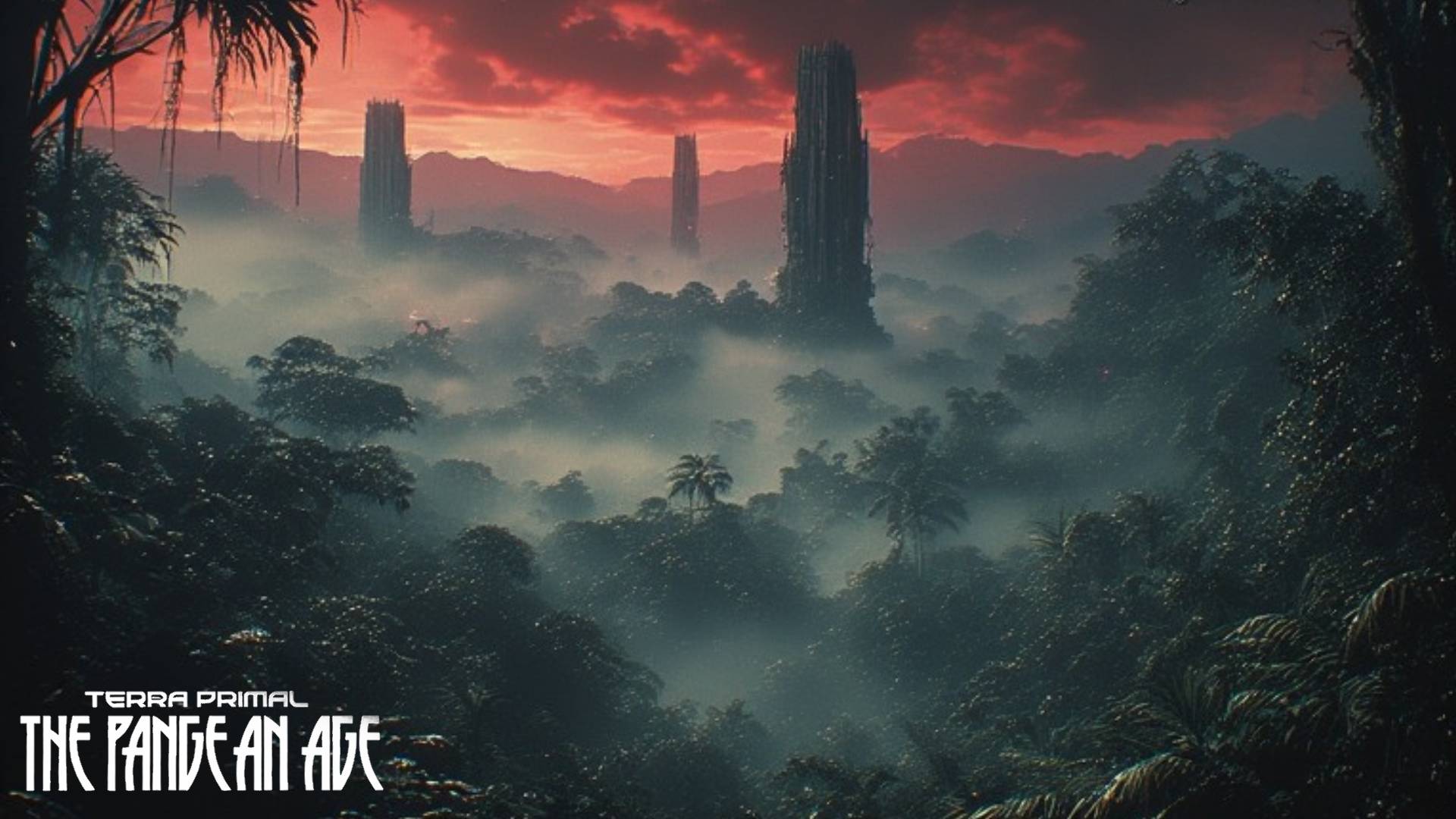
Jyntar had risen not as a city but as a spiraling web of black archology towers fused by skybridges and subterranean transit veins. It functioned less as capital than processor—an interlocked lattice of ministries, weapons directorates, compliance tribunals, and orbital uplinks tracing lineage to offworld benefactors whispered to have emerged from Saturnian collectives. Authority had not centralized there; it had circulated. Decrees were not announced but compiled. Expansion registered as adjustment. Leadership, when glimpsed at all, appeared as silhouette and transmission artifact—never singular, never fully embodied.
South of Jyntar lay Pyrolanthia—the wasteland border and the true crucible of Gondwana. The ocean crossing had been trivial; Pyrolanthia had been punishment. Once an industrial corridor of reactors and transit lines, it had collapsed into a field of oxidized megastructures and ruptured hulls scavenged by whatever endured the attrition cycles of prior eras. Towers leaned like broken fangs across irradiated plains. Buried systems discharged intermittent surges, lighting the horizon in irregular pulses. What lived there did not rebuild—it consumed. Those who wandered unshielded did not disappear into myth; they were catalogued as loss.
To the north, beyond elevation breaks and containment grids, Kir had festered into a protomutational hell-jungle. Bioengineered growth had breached protocol generations earlier and run feral. River systems choked under hypertrophic canopy. Predatory clades reproduced without equilibrium. The grid had held—for a time—separating ordered territory from uncontrolled bloom, but projections had marked Kir as eventual contagion. Without decisive intervention, spread had been inevitable. Kir was not rebellion; it was entropy made vegetal.
Balro had operated in deliberate contrast: open, regulated, weaponized. It served as the primary testing ground for Tellus’s armament programs—atmospheric suppression arrays, long-range deterrents, and platform-scale annihilation systems. Explosions had been scheduled. Catastrophes rehearsed. Terra Proxima had targeted Balro as a priority for infiltration, and the sector had been guarded accordingly—sensor fields buried beneath agricultural facades, strike divisions embedded within logistics infrastructure. Every prototype had departed under escort. Every failure had been reduced to data and ash.
Mundolasia had remained an anomaly. Dense jungle and deliberate neutrality shielded its populations—herbivores, Gaianist sectarians, and exiles from both megacorporate blocs. They had facilitated rather than fought, trading passage, intelligence, and sanctuary without permanent allegiance. Survival had been doctrine. Neither Terra nor Tellus had claimed them fully; both had relied upon them. Their forests had harbored unspoken accords and temporary alignments, dissolving as quickly as they formed.
Vandyr had persisted as the wound beneath the southern order. Former host to the Greater Vandyrian Empire, its reactor infrastructure had lingered in long-rim decay, output diminishing while risk indices remained elevated. Entire districts had been abandoned to structural collapse. Residual surges and containment breaches rendered reclamation costly. Tellus had maintained skeletal oversight, extracting stabilized yield while sealing off the irreparable. VandyR had not been asset nor relic; it had been liability too potent to discard.
Across Gondwana, governance had expressed itself not through spectacle but through endurance. When a sector destabilized, it had been isolated. When a region failed, it had been sealed. Pyrolanthia had rotted yet held the line. Kir had mutated yet remained partitioned. Balro had detonated yet advanced. Jyntar had compiled, recalibrated, and continued. If serpent-folk operatives had existed within these territories, their presence had manifested as gaps in audit trails and anomalies in predictive models. They had been calculated as variables rather than myths. No command architecture had been complete without its ghosts.
Each prior cycle had left residue—rusted corridors in Pyrolanthia, unstable cores in Vandyr, feral canopy in Kir. Tellus had not erased residue; it had built through it, over it, and when necessary, around it. Destiny there had not been conquest nor spectacle. It had been persistence under diminishing returns. Systems failed; archives endured. Sectors collapsed; quarantines followed. When the age had turned, the objective had not been triumph. It had been continuity. Power had not burned bright. It had settled deep, waited out collapse, counted losses, and prepared for recalibration in the silence that followed.