



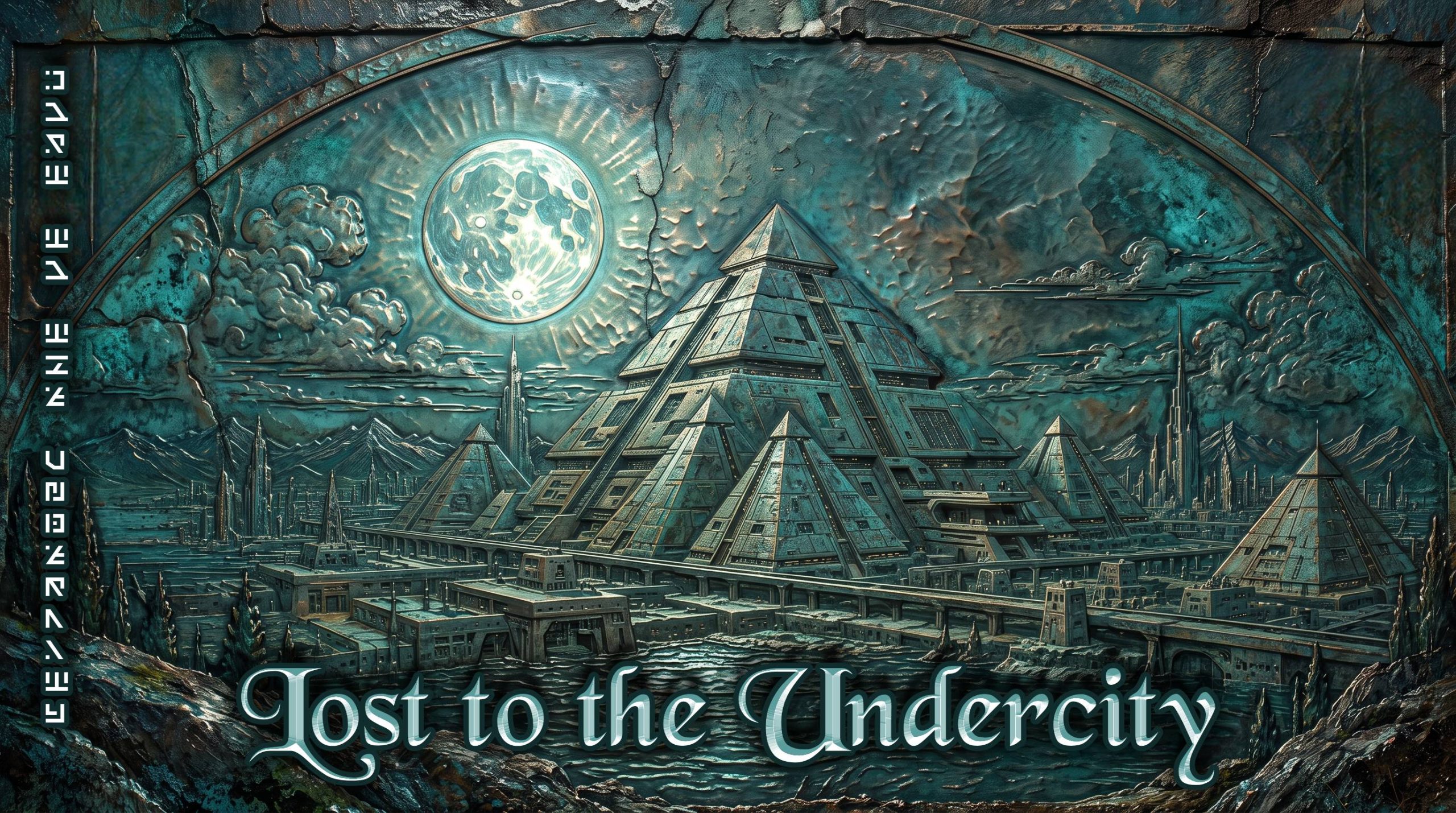
Lost to the Undercity
Nari and Yazha were quite certain that the afternoon had been altogether too brief, although neither could have said with any confidence how many hours had passed beneath the Surface.
Time, that most exacting of tyrants, had been little regarded in the warm and secluded waters of the subterranean pool, where the two young lovers had hidden themselves from the inquisitive eyes of the world above. There, among the ancient stones and beneath a ceiling lost in the perpetual twilight of the Undercity, they had passed the better portion of the day in embraces, affectionate whisperings, and those innumerable little follies which attend the private happiness of the young.
Now, however, the daylight beyond the narrow apertures of the ancient masonry had begun to diminish, and the unhappy necessity of returning to civilization could no longer be postponed. Their clothing lay in various states of disorder upon the stones, while the girls themselves, both nineteen years of age and entirely unwilling to surrender the afternoon, giggled and blushed as they attempted to make themselves respectable once more.
Yazha, a slender blonde fox of considerable intellectual accomplishment and decidedly less practical courage, was having particular difficulty arranging her garments while her black-haired wolf companion persisted in distracting her. Nari possessed the quick smile and mischievous disposition of one who regarded the greater portion of life’s obligations as unfortunate interruptions to more pleasurable pursuits. An aspiring bard, she carried a small lute upon her shoulder and entertained romantic notions concerning the great musicians of antiquity, whose compositions she maintained possessed a dignity and refinement almost entirely absent from the vulgar entertainments of her own generation. Yazha, for her part, reserved a comparable devotion for the mysteries of philosophical mathematics, an affection so profound that Nari occasionally professed herself jealous of equations. This accusation never failed to amuse the fox, who would solemnly assure her lover that mathematical truths, unlike musicians, were at least dependable. Yet there was little of either music or mathematics in their immediate conversation, which consisted chiefly of teasing suggestions that they abandon their clothing altogether and return to the delicious warmth of the pool.
Indeed, their choice of refuge had been inspired by considerations more immediate than either scholarship or artistic sentiment. The Undercity, despite the innumerable warnings attached to its name, offered one exceedingly attractive advantage: privacy. No meddlesome acquaintance was likely to wander among its deserted passages, no elderly neighbor would report their whereabouts, and, most importantly, there was little prospect of encountering Dija. This last consideration was of particular importance to both girls, for Dija was an obnoxious young male whose chief pleasures in life appeared to consist of stealing unattended clothing, pouring icy beverages upon unsuspecting victims, and reporting the indiscretions of his elders to their mothers. To escape his attentions for an afternoon was itself a small triumph, and the prospect of doing so in the company of one’s beloved had rendered the old warnings concerning the Undercity rather less persuasive than they might otherwise have been.
It was, of course, no ordinary ruin into which they had ventured. Beneath the ancient City of Steel extended a labyrinth of chambers, vaults, stairways, and galleries belonging to epochs whose very names had passed from common remembrance. Its foundations spread beneath the entire city and continued outward under the surrounding forests, though not so far as the distant Towerpine Borders.
Within those buried precincts lay the remnants of a civilization whose grandeur had become the substance of legend: libraries filled with mouldering scrolls, ceremonial halls deprived of their courts, chambers wherein the dust of dead centuries lay undisturbed, and armories containing swords of a workmanship no living smith could readily reproduce. Deeper still were the sepulchral halls of the ancient Ro’Edyne, where those who had served the city in life continued, by a covenant older than the present age, to serve it in death. Such matters were generally considered sufficient reason for sensible folk to remain aboveground, particularly after sunset. Nari and Yazha, having found the pool most agreeable, had elected to concern themselves with these warnings at some more convenient hour. That hour, regrettably, had arrived.
“We really must go,”
Yazha murmured, although her arms remained entwined about Nari’s waist and her expression suggested that she considered the proposition thoroughly objectionable.
“Mother will have everyone searching for me if I am not home before supper, and I have no wish to explain why my books have remained unopened all afternoon.”
“Then we shall tell her that you were engaged in the most demanding of philosophical investigations,”
Nari replied, fastening her belt with an air of innocence that convinced neither of them.
“A rigorous examination of warmth, affection, and the properties of water.” “You are a dreadful scholar.”
“And you are a dreadful distraction.”
Yazha laughed, and for another moment their departure was delayed by an embrace which threatened to become considerably longer. At last Nari retrieved her lute, settled its strap upon her shoulder, and bestowed a final kiss upon the fox’s cheek. Yazha took her hand, and together they abandoned the warm waters and their cherished solitude, making their way through the dim passage toward the stairway by which they believed they had entered. Neither looked back, though both would later remember the pool with an affection rather greater than that inspired by the remainder of their adventure.
Their route appeared simple enough. First to the left, then upward along a flight of worn stone steps, and thereafter to the right through a corridor terminating at a great wooden door. Nari remembered the door distinctly, for it was constructed of massive timbers darkened almost to blackness by age, and bore upon its surface iron fittings of a design no longer employed by the craftsmen of the upper city. She approached it with confidence, laid her hand upon the ancient latch, and pulled. The door remained unmoved. She pulled again, this time with considerably greater determination, and was rewarded only by the groaning complaint of the ironwork. Yazha watched her with an expression of gathering apprehension. “It is locked,” she said.
“So it would appear,” Nari answered, giving the door another vigorous tug.
“But it was not locked before.”
“I am quite aware of that.”
The wolf placed one foot against the stone threshold and strained with both hands upon the latch, producing a noise suggestive of a large and thoroughly uncooperative piece of furniture. The door did not yield so much as a finger’s breadth. Yazha joined her, and together they pushed, pulled, rattled the iron handle, and examined the surrounding masonry for some forgotten fastening. Their efforts were accompanied by several uncomplimentary remarks concerning the intelligence of ancient carpenters, the unnecessary thickness of old doors, and the peculiar enthusiasm with which the people of bygone ages had constructed everything to endure until the end of creation. At length, breathless and disheveled, they stood before the unyielding portal and regarded it in unhappy silence.
“I suppose,”
Yazha said, slipping her arms around Nari from behind,“that we shall simply have to remain here forever.”
“That would be inconvenient.”
“Would it? We have a pool, we have privacy, and we have each other. I can think of worse arrangements.”
“We have no supper.”
“A minor consideration.”
“And no breakfast.”
Yazha reflected upon this objection with a seriousness altogether disproportionate to the circumstances.
“Perhaps,” she conceded, “we should endeavor to escape before breakfast.”
Nari smiled despite herself, but there was less confidence in the expression than she would have wished. The failing daylight had become noticeably weaker, and the long shadows gathered along the corridor with a patience she found increasingly disagreeable. Somewhere beyond the visible masonry lay an immensity of buried streets and sepulchral vaults, and within those vaults rested the Ro’Edyne dead. They were the ancient defenders of the city, warriors who had fallen in battle yet had not been released from their final obligations. In the days of their living service they had signed their souls to the nation in silver ink, kneeling before clerics, druids, and sorcerers to enter a covenant with the city itself. Should any enemy rise to threaten its peace, they would arise in turn, bearing cold Vandyrian steel against those who profaned the ancient precincts. How many centuries had passed since those oaths were sworn, neither girl could have said. It was enough to know that the covenant endured, and that the dead were said to be exceedingly particular concerning its observance.
“Are we quite certain,” Yazha ventured at last,
“that this is the right door?”
Nari turned to regard her companion with an expression of such immediate disappointment that the fox almost regretted having spoken.
It was the look one reserves for a question so plainly foolish that its mere utterance constitutes an offense against reason. Yet even as Nari prepared to reply, a most unwelcome possibility presented itself to her mind. There had been another stairway, had there not? Or perhaps another corridor, rather like this one, though situated farther along the gallery. The more carefully she examined the door before them, the less certain she became that it was the particular door through which they had entered.
“That,” she admitted after an uncomfortable silence, “is a very reasonable question.”
Yazha’s ears drooped.
“Oh, Nari.”
“Come along. There was another passage below, and I distinctly remember seeing it.”
“You distinctly remembered this one.”
“Yazha.”
“Yes, darling?”
“Not another word.”
They descended the stairway together, their earlier levity gradually yielding to a watchfulness neither cared to acknowledge. The second corridor proved considerably longer than the first and descended by imperceptible degrees into a gloom that seemed almost substantial. Here the air possessed the dry, mineral stillness of places long withdrawn from the traffic of the living, and the walls were interrupted by recesses containing objects whose shapes were scarcely distinguishable in the failing light. Nari thought she could discern the outlines of ancient candle stands, ceremonial furnishings, and upright racks of weapons, though she deliberately refrained from examining them too closely. Far overhead, through narrow shafts cut into the masonry, the last illumination of evening struggled against the advancing night. The moon had begun to rise, and its pallid radiance touched certain portions of the corridor while leaving others submerged in a darkness seemingly indifferent to the existence of the sun.
At the farther end stood another great wooden door, so similar to the first that Nari felt a momentary return of confidence. “There,” she announced. “You see?” Yazha hurried forward and seized the handle. The door would not open. She tried again. Nari joined her, and the two resumed their struggle with increasing desperation, until at last even the wolf’s confidence had been worn to a very thin and brittle remnant. They stood panting before the sealed portal, listening to their own breathing and to the faint, unfamiliar noises of the Undercity. Somewhere in the distance a little trickle of water murmured through ancient stone. From another direction came a dry creaking sound which might have been timber settling beneath the burden of centuries, though neither girl was sufficiently reassured by that explanation to mention it.
“I do not like this place anymore,”
Yazha whispered.
Nari took her hand.
“We shall find another way.”
“There are no other ways.”
“There are always other ways.”
“Then why have we not found one?”
Nari had no satisfactory answer.
The fox drew nearer, reaching blindly through the gloom for her lover’s arm. Her fingers encountered something cold and unfamiliar, and before she could withdraw them the object shifted from its resting place with a harsh metallic clatter. Instinctively she stooped to retrieve it, anxious to restore whatever she had disturbed before further misfortune attended her carelessness. “Yazha, no!” Nari’s cry came an instant too late. In the thin moonlight the fox found herself holding a sword. Its blade was long, narrow, and of a pale metallic substance whose surface possessed none of the common dullness of age. Though dust lay thick upon its hilt and guard, the weapon itself retained an almost unnatural perfection, and its edge caught the wan illumination with a cold and merciless brilliance. It was Vandyrian steel, the ancient substance of which so many terrible and marvelous accounts were told, and its preservation among the relics of the Undercity marked it unmistakably as an object belonging to the Ro’Edyne.
For several dreadful moments Yazha could do nothing but stare.
“Nari,” she whispered.
“Put it back.”
“I did not mean—”
“Put it back, Yazha!”
The fox turned hurriedly toward the recess from which the weapon had fallen and attempted to restore it to its original position.
Her trembling hands missed the rack, and the sword struck another blade with a clear, ringing note that carried along the corridor like the tolling of some diminutive funeral bell. The second weapon slipped loose, clattered against the masonry, and fell to the floor. Yazha gasped, snatched it up, and found herself standing with a sword in either hand, both of which she regarded as though they were venomous serpents.
“Oh, no. Oh, no, no, no.”
“Give me one!”
Nari seized the nearest weapon and attempted to replace it, only to strike an ancient candle stand with her elbow. The thing toppled with majestic deliberation, struck the stone floor, and produced a clamor entirely disproportionate to its size. Both girls recoiled. For a moment they stood motionless, staring at the fallen stand as if expecting the whole Undercity to awaken in response.
Nothing happened. With movements of exaggerated caution they returned the weapons to their resting places, raised the candle stand, and arranged everything as nearly as possible in accordance with their imperfect recollection of how it had appeared before. Yazha’s hands shook so badly that Nari finally took the last sword from her and settled it carefully into the rack. There followed a period of silence during which the girls examined their handiwork with the anxious concentration of criminals attempting to conceal evidence of some appalling offense. “There,” Nari breathed at last.
“Precisely as it was.”
“Are you sure?” “Absolutely.”
They looked at one another, and for an instant the absurdity of their predicament threatened to provoke a nervous laugh.
Then they turned around.
Yazha screamed.
From the farther reaches of the corridor two figures advanced with the slow and solemn tread of beings to whom the passage of ordinary time had ceased to possess significance. They were enormous wolves, towering above the girls, clad in armor whose ancient plates were burdened with the dust of uncounted years. The flesh had long since departed from their faces and hands, leaving the gaunt architecture of their skulls exposed beneath the shadow of their helmets. Within those hollow crania burned pale lights of an unearthly whiteness, encompassed by a faint greenish vapor that shifted and trembled as they moved. Their garments hung in rotted tatters from beneath the steel, and at their sides rested swords whose blades had known battle in ages when the very kingdoms of the present world were yet unimagined.
They were the Ro’Edyne dead.
Their footsteps sounded upon the stone in measured intervals, accompanied by the faint creak of ancient armor and the dry movement of bones that had not known living sinew for centuries. Neither guardian displayed haste, nor did either appear troubled by the terror of the intruders. They advanced with the dreadful composure of soldiers accustomed to obedience, their empty gazes fixed upon the two figures standing amid the disturbed relics of the corridor. Yazha retreated behind Nari so quickly that she nearly upset the candle stand again. “Please,” she whispered, clutching the wolf’s arm. “Please tell me those are statues.” Nari swallowed. “Statues do not generally walk.” “Then tell me something else!” The ancient guardians continued forward.
Both girls knew the old song, as nearly everyone born within the shadow of the City of Steel knew it. They had heard its verses in childhood, whispered beside winter fires and sung by elderly relatives who remembered warnings passed down through generations. Its words belonged to a time when the northern isles still bore the scars of ancient calamities, and when the dead of Ro’Edyne were spoken of with an awe bordering upon religious dread.
Rowan red and iron bright,
Bar the door and bless the night;
Heap the peat and bank the flame,
Never call the lost by name.
Should you hear them cross the snow,
Let them pass and let them go—
For the antique isles remember
What the living must not know.
Neither dared give voice to the familiar refrain. It was a song of warning, not of welcome, and in their present condition its recital seemed perilously close to announcing themselves before powers from which sensible folk had always sought concealment. Yazha pressed her face against Nari’s shoulder, while Nari, whose own courage was diminishing with every ponderous footfall, searched desperately for some means by which they might escape. The door remained sealed behind them. The corridor offered little room for flight, and even if they could outrun the dreadful sentinels, there was no certainty that the passages beyond would lead anywhere but deeper into the subterranean city. Then, amid the confusion of her thoughts, Nari remembered something.
It was not the warning song, nor any childish charm against wandering spirits, but a melody belonging to a far older tradition. She had heard it in the study of ancient imperial compositions, where it survived among the remnants of ceremonial music attributed to the vanished courts of Ro’Edyne. Its opening measures were severe and stately, possessed of that peculiar dignity which Nari so admired in the music of antiquity, and she recalled that the composition had once been associated with those who had sworn themselves to rise in the city’s defense. Her hand flew to the lute upon her shoulder.
“Nari?” Yazha whispered.
“Be quiet.”
“What are you doing?”
“Trying something.”
“Is it a spell?”
“No.”
“Are you certain?”
“Yazha, please!”
Nari brought the instrument before her, adjusted its tuning with fingers made clumsy by terror, and bent her ear toward the strings. Never in her nineteen years had she tuned an instrument with such desperate haste, nor had the finer distinctions of pitch seemed quite so immediately consequential. The guardians drew nearer, their pale lights wavering through the gathering darkness. Yazha held her breath, scarcely daring to move, while the wolf tightened one string, loosened another, and silently cursed the stubborn little instrument for every moment it demanded of her.
At last she raised her hand.
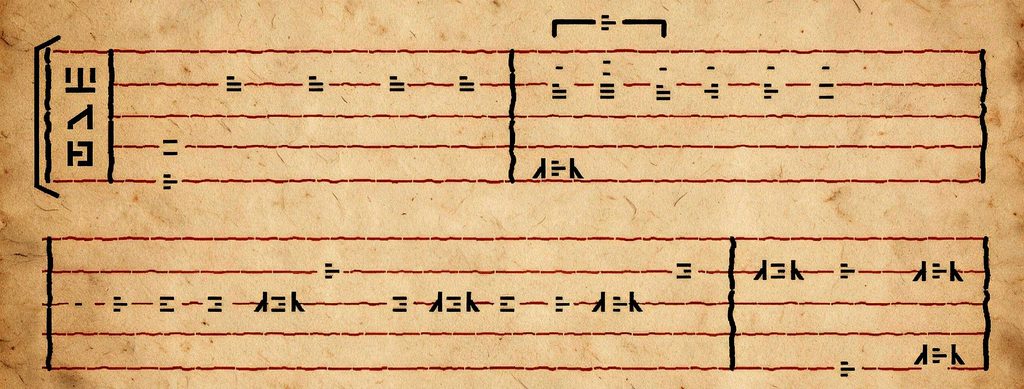
The first notes sounded thinly in the cavernous corridor, their delicate resonance almost swallowed by the immense stillness of the buried city. Nari steadied herself and continued, plucking the solemn measures with the precision of one whose entire existence had narrowed to the proper succession of a handful of notes. The melody unfolded with an austere grace alien to the songs of her own age, a fragment of ceremonial splendor preserved through the long decline of kingdoms and the oblivion of their courts. It was music composed for an authority no living sovereign now possessed, and for warriors whose obedience had endured beyond the death of those who commanded them. The shambling ceased.
Both guardians halted so abruptly that Yazha gave a little gasp and clapped a hand over her mouth. Before the astonished girls, the two skeletal wolves drew themselves erect, shoulders squared and heads raised, assuming with perfect solemnity the posture of soldiers standing before a superior authority. The pallid fires within their eye sockets diminished, and in their depths appeared another radiance, quieter and more remote, as though some long-buried recollection had stirred beneath the enchantments sustaining their ancient vigil. Nari continued to play. Behind the girls came the low, prolonged creaking of a massive wooden door.
Yazha yelped, turned, and nearly stumbled over her own feet. The great portal which had resisted their combined efforts now stood open, its heavy timbers drawn back by a third figure whose presence neither had perceived. This guardian was taller even than the other two, and his ancient armor bore upon its breastplate the worn insignia of an office whose meaning had long since departed from the knowledge of the living. His skull was bare beneath the shadow of his helm, yet about its ivory contours there gathered a wavering likeness of the face he had possessed in life. The spectral image hung upon his bones like a thin veil of moonlit vapor, revealing the stern muzzle and deeply set eyes of an aged wolf whose countenance had known little indulgence. He was not smiling. Indeed, there was nothing particularly kindly in those ancient features, and the girls had no inclination to test the limits of his patience. Yet the guardian stood aside, one gauntleted hand resting upon the opened door, and beyond him stretched a passage whose familiar incline and distant glimmer of evening light promised escape from the sepulchral labyrinth.
For several heartbeats neither girl moved. Then Nari lowered her lute. “Thank you,” she whispered. The sentinel inclined his head by the smallest perceptible degree. Yazha seized her lover’s hand. They hurried past the ancient wolf with all the dignity they could muster, which under the circumstances was very little indeed. Once beyond the doorway they broke into a run, their footsteps clattering wildly along the stones as they fled through the passage and toward the dim light of the world above. They did not stop when they reached the outer stairway, nor when the first breath of cool evening air touched their faces. Only when the buildings of the City of Steel rose about them once more did their terror begin to dissolve into the helpless laughter of those who have escaped some dreadful calamity and can scarcely comprehend their continued good fortune.
Hand in hand they ran through the streets, shrieking and giggling, alternately blaming one another for the adventure and swearing with extraordinary conviction that they would never again set foot within the Undercity. Yazha insisted that Nari had led them to the wrong door, while Nari maintained that the fox’s handling of the swords had been the principal source of their difficulties. Both accusations were advanced with considerable enthusiasm and little regard for consistency. Their quarrel ended beneath the lamps of the upper city, where Yazha embraced her lover with sufficient fervor to silence further argument, kissed her once, and hurried away toward the gates of her family’s residence.
Yazha reached home in time to slip unnoticed among the numerous members of her household, who were occupied with their own affairs and had paid little attention to her absence. Her books remained upon the table where she had left them, and she settled herself among them with an expression of such studious concentration that no one thought to inquire concerning the day’s activities. Nari was less fortunate. She arrived after supper had begun, offered an explanation concerning musical studies that satisfied no one, and was promptly sentenced to wash the dishes of the entire household. Thus did the two young lovers receive the full measure of worldly punishment for an afternoon spent trespassing among the ancient dead.
Far beneath the streets, where the lights of the living could not penetrate and the stones retained the silence of forgotten ages, the guardians returned to their appointed places. They went without haste, their armored feet descending stair after stair through the galleries of the Undercity. The pale fires of their eyes resumed their accustomed brilliance, and the spectral semblance that had briefly clothed the face of the elder sentinel faded once more into the naked austerity of bone. Past the ancient weapon racks they walked, past the candle stands blackened by centuries of neglect, and through the silent corridors where the swords of their fallen brethren remained undisturbed. There was no ceremony attending their return, no spoken command or solemn declaration, for theirs was a duty older than the memories of the living and requiring no witness to its observance.
At length they passed the warm subterranean pool. One of the guardians continued onward, his armor creaking softly in the stillness. The elder sentinel, however, paused beside the water, where a faint vapor rose toward the vault of ancient masonry. His hollow gaze rested upon the stone sconces bordering the pool, and there he perceived two pairs of linens, carelessly hung to dry by visitors who had departed in rather more haste than they had intended. For a little while the dead wolf stood regarding them.
He had known another world once, in those distant centuries before silver ink and solemn oaths had bound his soul to the everlasting service of the city. He had known the laughter of the young, the little deceptions of growing children, the exasperations of a household, and the countless affectionate follies that attend the passage from youth into maturity.
These were memories almost extinguished beneath the immense burden of his years, yet not so utterly lost that the sight before him could awaken nothing of their former warmth. Long ago, when his flesh had still clothed his bones and his heart had beaten beneath his armor, he too had been a father. A dry, scarcely audible sound issued from the place where his lungs had once resided. It was not the groan of a restless spirit, nor the dreadful whisper of some sepulchral enchantment. It was a chuckle, faint and rough, such as an elderly father might utter upon discovering that two foolish youngsters had been engaged in precisely the sort of mischief that youngsters have practiced since the first days of civilization.
Then the old sentinel turned away from the pool and followed his companion into the darkness, his sword resting at his side and his ancient obligation unbroken. The echoes of their passage diminished among the buried halls, until once more the Undercity lay silent beneath the sleeping streets of the City of Steel. And above, in the comfortable ignorance of their households, Nari and Yazha slept soundly, neither knowing that the dead had found their afternoon adventure quite so amusing.
