


Agrarian Continuity
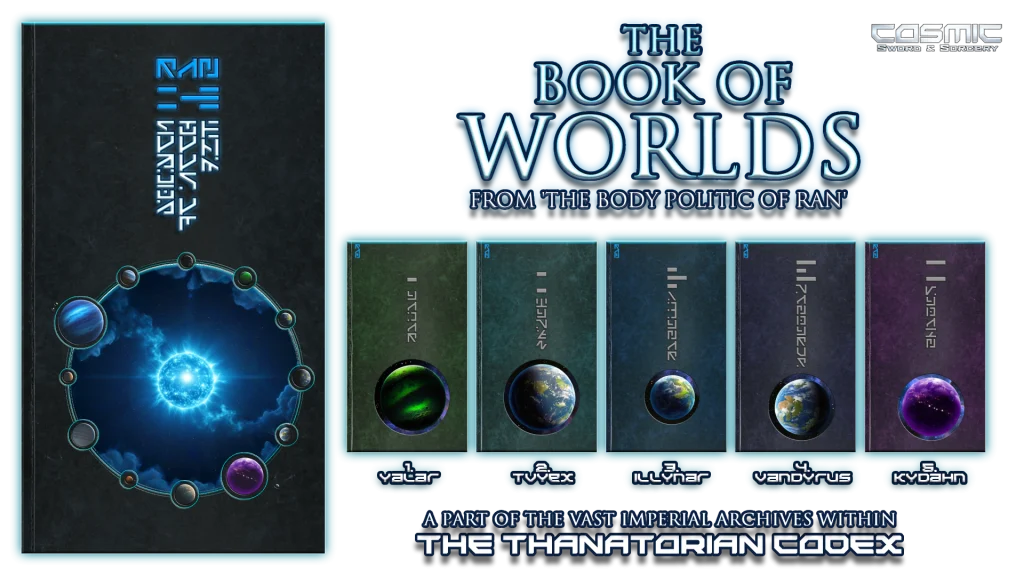
Illynar occupies an unusual position within the Ran system. Though commonly classified as an agricultural world, this designation often creates a misleading impression of uniform farmland and predictable production. The reality is considerably more complex. Much of the planet consists of unstable terrain where broad floodplains, shifting waterways, rugged mountain regions, and extensive grasslands compete for dominance across the landscape.
The great floodplains remain the foundation of Illynar’s agricultural output. Rich soils deposited through centuries of seasonal inundation produce substantial harvests and support much of the food export upon which neighboring Vandaxium worlds rely. These regions are among the most valuable territories on the planet, not because they are easy to cultivate, but because their fertility consistently outweighs the difficulties imposed by the environment itself.
Beyond these fertile belts, the terrain becomes far less predictable. Mountain regions frequently interrupt settlement patterns, creating isolated communities separated by difficult travel routes and irregular terrain. Many of these upland areas remain only lightly developed, serving instead as grazing territory, timber sources, mineral extraction zones, or natural barriers between larger agricultural districts. The result is a world whose productive regions are fragmented rather than continuous, forcing settlement and cultivation to adapt to the landscape rather than reshape it.
The great grasslands further complicate the planetary pattern. Vast stretches of open country break apart the floodplain networks and create natural divisions between population centers. These regions support extensive herding operations and contribute significantly to local food production, yet they also reinforce Illynar’s tendency toward dispersed settlement. Rather than drawing populations into large urban concentrations, the land encourages communities to spread outward along productive corridors wherever soil, water, and terrain permit.
This geography has had profound effects upon Illynar’s social and political development. Population centers emerged where conditions allowed rather than according to any singular planetary design. Agricultural communities, river settlements, grazing territories, and mountain holdings developed according to local circumstances, producing a patchwork of regional identities that remain visible even in the modern era. The planet’s structure favors practical cooperation over centralized control, as no single region possesses complete dominance over the others. For this reason Illynar’s agricultural classification should not be interpreted as evidence of simplicity or developmental delay.
The world serves as one of the principal food-producing regions of the Vandaxium sphere precisely because its inhabitants learned to exploit a landscape that is productive without ever becoming entirely predictable. Flood, drought, erosion, and shifting waterways remain constant realities, and generations of experience have produced cultures adapted to managing these conditions rather than attempting to eliminate them. The result is a world whose importance rests not upon industrial concentration or urban expansion, but upon its ability to transform a geographically inconsistent environment into a reliable source of food, livestock, and agricultural exports for the surrounding systems.